
How to Choose Greek Olive Oil in the UAE: A Label Checklist
Supermarket shelves across the UAE are stacked with Greek-sounding olive oil, but few bottles tell you where the fruit grew, when it was pressed or how it travelled. Here is what to check before you buy.

In this article7 sections
Key takeaways
- A PDO (Protected Designation of Origin) mark legally ties an oil to one defined region and one set of production rules. A generic "Product of Greece" label guarantees neither.
- Genuine extra virgin olive oil must not exceed 0.8% free acidity. A confident producer prints the figure rather than hiding behind the word "premium".
- The EU allows one authorised health claim for olive oil polyphenols, and only for oil with at least 5 mg of hydroxytyrosol and its derivatives per 20 g, roughly 250 mg/kg (Commission Regulation (EU) No 432/2012). Most supermarket bottles never print a polyphenol figure at all, so there is no way to tell whether the claim could apply to them.
- A harvest date tells you more than a best-before date. Oil pressed soon after picking keeps flavour and polyphenols that fruit left waiting for the mill begins to lose.
- Single-estate, single-variety oils trace back to one grove and one harvest. Blended oils can mix fruit from several regions, countries or years.
How to Choose Greek Olive Oil in the UAE: The Short Answer
The Greek olive oil brands in the UAE worth your money are the ones that can prove three things on the label: where the olives grew, when they were picked, and what the oil measures in the laboratory. That means a protected origin mark such as PDO, a named organic certifier, a printed harvest date, a single named variety, and published figures for acidity and polyphenols. A Greek flag, a white-washed village on the label or the word "premium" proves none of these.
We are Oleum Crete, and we import single-estate Cretan olive oil into the UAE. The questions below matter far more than any one brand, including ours, and they apply to any bottle you pick up.
Greece is one of the world's major producers. In 2022, Spain alone made 24% of the world's olive oil, while Italy, Greece and Turkey together accounted for 59% of the global market. With that much oil moving between countries, the label is the only thing standing between you and a bottle whose origin is a marketing story.
Read the Label Before You Read the Price
Price tells you what a brand wants for its oil. The label tells you what it is prepared to stand behind. Read the back of the bottle first.
PDO and PGI: What the Letters Actually Protect
A Protected Designation of Origin (PDO) is an EU mark that ties a food to a named geographical area. The olives must be grown there, and the oil must be produced there, under a written specification that sets out how it is made. A region such as Messara, the wide valley in southern Crete, can carry its own PDO status, so a bottle marked with it comes from that valley and follows its rules, not a general "Crete" or "Greece" claim. Oleum Crete's own range is certified PDO Messara, which is why we can name the valley on the bottle rather than simply the country.
A Protected Geographical Indication (PGI) is a looser link. It connects a product to an area, but not every stage of production has to happen there. PGI is still meaningful. It is simply a different promise from PDO.
"Product of Greece", "Greek style" or "Mediterranean blend" are not certifications. They may be accurate, but no external body has checked them against a specification. On a shelf crowded with Greek-sounding names, look for the PDO or PGI symbol itself, not just the word Greek.
Organic Marks Worth Trusting (and Ones That Mean Little)
The EU Organic logo, the green leaf made of stars, appears only on products certified under EU organic rules. Next to it you should find a code identifying the control body that inspected the farm and the mill. Recognised inspection bodies such as TÜV Austria publish their audit work, so the code is something you can follow up.
Words like "natural", "pure" or "farm fresh" carry no organic certification behind them. A brand that is genuinely certified will show the logo and the code, not just the adjective. If you want to understand what organic certification actually changes in the bottle, it is worth reading how organic farming affects the grove, the fruit and the finished oil.
Why a Printed Harvest Date Matters More Than a Best-Before Date
A best-before date is usually set from the bottling day. Oil can sit in a tank for many months before it is bottled, so a distant best-before date tells you nothing about how fresh the fruit was.
A harvest date tells you when the olives left the tree. Olive oil is a fruit juice. From the moment of pressing it begins, slowly, to lose its aroma and its polyphenols, and heat and light speed that up. A bottle that states the harvest season, or better still the harvest day, is a bottle you can judge for yourself. Our guide on how to read a harvest date on an olive oil label walks through the wording producers use and what each version really tells you.
Before comparing prices, it helps to understand what separates cold pressed olive oil from regular refined oil, since that distinction drives much of the price gap.
Check the Numbers: Acidity and Polyphenols
Taste is personal. Laboratory figures are not. Two numbers in particular separate a carefully made oil from an ordinary one, and both are routinely left off supermarket labels.
Acidity: The Legal Minimum vs What the Best Oils Achieve
Olive oil acidity measures free fatty acids, expressed as oleic acid. To be sold as extra virgin under International Olive Council standards, an oil must have no more than 0.8% free acidity. The same standards cap the peroxide value, a measure of oxidation, at 20 for virgin oils.
The 0.8% figure is a ceiling, not a target. Acidity rises when olives are bruised, overripe or left waiting before they reach the mill. Fruit that is picked by hand, handled gently and pressed quickly comes in far lower. A low acidity reading is evidence of care at harvest, which is why producers who achieve it tend to publish it and producers who do not tend to stay quiet.
Polyphenols: Why the Figure Matters
Polyphenols are natural compounds in olive fruit. They give fresh oil its bitterness on the tongue and the peppery catch at the back of the throat. They are also the basis of the one health claim the EU authorises for olive oil: "olive oil polyphenols contribute to the protection of blood lipids from oxidative stress". Under Commission Regulation (EU) No 432/2012, that claim may be used only for oil with at least 5 mg of hydroxytyrosol and its derivatives per 20 g, roughly 250 mg/kg, and only with the note that the effect comes from 20 g of the oil a day.
That means a figure in polyphenols mg/kg is not decoration, it is the only thing that makes any health wording meaningful. Without a recent laboratory figure, treat health claims on an olive oil label as unsupported. Our Organic Early Harvest oil, for example, tests above 800mg/kg polyphenols, which is the kind of figure this checklist asks you to look for. Polyphenol content varies with variety, ripeness, milling and the age of the oil, so ask any brand when its test was done, and talk to a pharmacist or doctor rather than a label if you have a health condition or take medication. A bottle of oil is not a treatment.
Single-Estate vs Blended: Why It Changes What's in the Bottle
Many oils sold under a Greek-sounding name are perfectly legal blends. The question is whether you know what you are buying.
What 'Single-Estate' Actually Guarantees
A single estate olive oil comes from groves owned or managed by one producer, pressed and bottled under that producer's control. Every bottle can be traced back to a known place and a known harvest. A single-variety oil goes further, naming the olive itself, such as Koroneiki, the small-fruited variety widely grown across Crete and known for green, herbaceous notes and a firm peppery finish.
Oil pressed within a day of picking keeps a brightness, green tomato, garden herb, a clean peppery finish, that many oils have lost long before they reach the bottle. That freshness is the real difference a single-estate, quickly-pressed oil can offer over one that has travelled through several hands before bottling.
Not all Greek oil tastes the same, and neither does all Cretan oil. If you want to go further, read how Cretan olive oil differs from mainland Greek oil, from varieties to climate.
Blending Across Regions or Harvests: What You Lose
Blending is how large brands keep a consistent taste and price across millions of bottles. Oil from several regions, sometimes several countries and sometimes more than one harvest, is combined in a tank to hit a flavour profile.
What you lose is traceability. If last year's oil is in the blend, the bottle is already older than its bottling date suggests. If fruit from several countries is mixed, "Greek" describes the brand's address more than the olives. And a blend's character is built in the tank, not in one grove. A label that says "a blend of EU and non-EU oils", or names no region at all, is telling you this plainly.
How Far Did It Travel, and How Was It Kept Cool?
Crete to the UAE is a long journey, and the final stretch, from warehouse to your door, can be the hardest on the oil. Olive oil shipping in the UAE deserves the same scrutiny as the label.
Why Heat Is the Enemy of Fresh Olive Oil
Heat speeds up oxidation. Oxidation dulls aroma, breaks down polyphenols and, given enough time, turns an oil rancid. Light does the same, which is why serious producers bottle in dark glass or tins. An oil that left the mill in excellent condition can be damaged in a hot container, an unshaded loading bay or a delivery van parked in summer sun.
Questions to Ask Before You Order Online
Before you buy from any brand, online or in store, it is fair to ask:
- Where is the oil stored once it arrives in the UAE, and is that storage temperature-controlled?
- How is it delivered to my door, and how long is it in transit?
- Is it packed in dark glass or tin, or in clear bottles?
- What is the harvest date of the batch I will receive?
- Can you share the latest laboratory figures for acidity and polyphenols?
A brand that handles its oil properly will answer all five without hesitation.
A Quick Checklist: What to Look For on Any Greek Olive Oil Bottle
Keep this olive oil checklist for the UAE in mind at the shelf or the checkout page. It brings every point above into one view.
| What to check | A strong answer | A warning sign |
|---|---|---|
| Origin mark | PDO symbol with a named region | "Product of Greece" or "Greek style" with no certification |
| Organic status | EU Organic logo plus a control body code | "Natural" or "pure" with no logo |
| Harvest information | Harvest season or harvest day printed | Best-before date only |
| Acidity | Laboratory figure printed, well below the 0.8% legal limit | No figure given |
| Polyphenols | Recent figure in mg/kg, with any health claim tied to it | Vague health wording with no figure |
| Variety | One named variety, such as Koroneiki | No variety named |
| Source | Single estate, named producer or family | "Blend of EU and non-EU oils" |
| Packaging | Dark glass or tin | Clear glass or plastic |
| Delivery in the UAE | Clear information on storage and shipping | No information given |
| Independent recognition | Named competitions, such as NYIOOC, London IOOC, TerraOlivo or Great Taste | Unnamed "award-winning" claims |
An award never replaces a label you can read, but a named competition is something you can check.
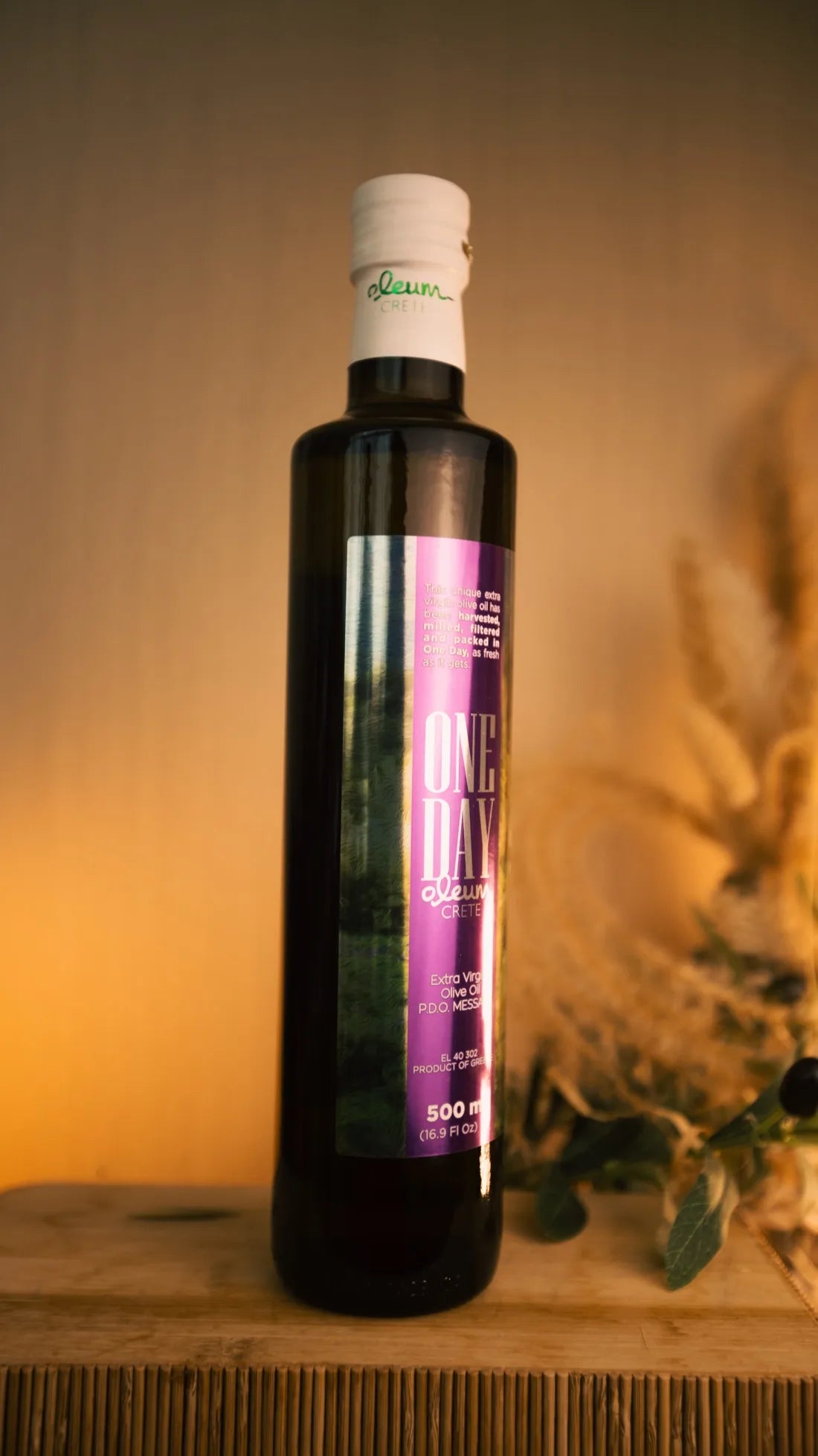
To see what this looks like in practice, Oleum Crete's own range runs from the One Day Extra Virgin Olive Oil (500ml), pressed and bottled within a day of picking, through the Organic Early Harvest Olive Oil (500ml) and the everyday Organic Extra Virgin Olive Oil (750ml, PDO Messara), up to the Collection Premium Organic Olive Oil (500ml) for gifting and a 5L Tin for the kitchen or catering use. All of it ships free across the UAE with no minimum spend, so you can compare a traceable, single-estate oil against anything else on your shelf without extra cost.
Related: One Day Extra Virgin Olive Oil, pressed within a day of harvest
Frequently asked questions
Is all olive oil labelled 'Greek' actually made in Greece?
Not always. Brand names, flags and imagery can suggest Greek origin without guaranteeing that every olive was grown there. A PDO or PGI mark, or a clear statement naming the region and the producer, is far stronger evidence than the word "Greek" on the front of a bottle.
How can I tell if an olive oil has been mixed with cheaper oils?
You cannot reliably tell at home. Simple kitchen tests are not dependable, because genuine oils behave differently depending on variety and wax content. Your best protection is buying certified, traceable oil from a producer that publishes laboratory figures and names its estate and variety.
Does a higher price always mean better quality Greek olive oil?
No. Price reflects branding, packaging and import costs as well as quality. Judge the label and the numbers first: origin certification, harvest date, acidity, polyphenols and variety. A higher price is justified only when the bottle can back it up with those details.
What's the difference between Cretan olive oil and mainland Greek olive oil?
Crete and the mainland grow different mixes of olive varieties in different climates and soils, so their oils taste different. Much of Crete's oil comes from Koroneiki, which gives a green, peppery character. Within Crete, a named PDO narrows the origin down further to one valley and its production rules.
How should I store Greek olive oil once it arrives in the UAE heat?
Keep it in a cool, dark cupboard, away from the hob, the oven and sunny windows, and close the cap firmly after each use. Avoid leaving bottles in a car or near air-conditioning exhaust. If oil turns cloudy in the fridge, that is harmless and clears at room temperature, but a cool cupboard is usually the simpler choice.
If you want a Greek olive oil you can trace back to one estate and one harvest, shop the Oleum Crete collection and judge it against the checklist above.
More from the Journal
All entriesHow Olive Oil Purity Is Lab Tested in the UAE
Supermarket shelves in the UAE are full of oil labelled 'extra virgin', but the label alone proves nothing. We look at how purity is actually verified, from chemical lab tests to sensory panels, and where PDO certification fits in.

Olive Oil for Skin and Hair: What Works, What to Skip
Olive oil earns its place on the Messara table because of oleic acid and polyphenols, not folklore. On skin and hair the picture is mixed: some uses hold up, others don't, and some skin types should leave the bottle in the kitchen. Oleum Crete separates the two before pointing to the oil worth using

Koroneiki vs Other Olives: Why It Wins on Crete
Koroneiki isn't the only olive variety that makes extra virgin oil, but on Crete's Messara Plain it outperforms Picual, Coratina, Leccino and Arbequina on acidity, polyphenol content and resilience to a hot, dry climate. Here's what the comparison actually shows.
