
Koroneiki Olive Oil Grades: Extra Virgin vs Virgin Explained
Not every bottle labelled Koroneiki sits in the same grade. Acidity limits, sensory testing and harvest timing separate extra virgin from virgin and lower grades, and the difference shows up in the glass long before it shows up on a label.

In this article5 sections
Key takeaways
- Extra virgin Koroneiki must have free acidity of no more than 0.8% and show no defects before an official tasting panel. Virgin oil may reach 2% acidity and carry a slight defect.
- Lampante Koroneiki falls below even the virgin grade on taste or chemistry. It cannot be sold for direct consumption until it has been refined.
- PDO Messara certification goes beyond the basic EU extra virgin grade. The olives must come from the Messara Plain, and the harvest must be traceable.
- Acidity, harvest date and certification marks on a label tell you more about real grade than price or packaging.
Koroneiki Olive Oil Grades: What Are the Official Categories?
Koroneiki olive oil grades follow the same legal ladder as every other olive oil. The International Olive Council (IOC) sets the trade standard, and the European Union applies its own rules to every bottle pressed on Crete. "Extra virgin" is a defined category with measured limits, and an oil has to pass them both in a laboratory and in a tasting room. At Oleum Crete we treat those limits as the floor, not the target.
The Four Legal Grades Under EU and IOC Rules
All virgin olive oils are extracted from the fruit by mechanical means alone, with no solvents and no chemical treatment. Within that family, the IOC sorts oil by free acidity and by sensory quality.
| Grade | Free acidity limit (as oleic acid) | Tasting panel result | Can it be sold as it is? |
|---|---|---|---|
| Extra virgin | Not more than 0.8 g per 100 g | No defects, fruitiness present | Yes |
| Virgin | Not more than 2 g per 100 g | Slight defect allowed, fruitiness present | Yes |
| Ordinary virgin | Above 2 g, up to 3.3 g per 100 g | Defects beyond the virgin limit | Not under current EU rules; this grade exists only in the IOC's trade standard |
| Lampante | More than 3.3 g per 100 g | Clear defects | No. Refining or technical use only |
The acidity limits come from the International Olive Council's definitions. Acidity is only part of the test. Laboratories also measure peroxide value, UV absorbance (the K232 and K270 readings) and ethyl esters. Together these show whether an oil has oxidised, aged or been made from tired fruit.
Under the current EU standard, there is no "ordinary virgin" category for retail sale. Once an oil's free acidity passes 2%, EU rules classify it as lampante, destined for refining, not for the consumer shelf. The ordinary virgin grade, with its wider 3.3% ceiling, exists only in the IOC's trade standard and is not recognised in EU marketing rules, so you will not find it sold as such within the EU.
Why Koroneiki Is Graded Like Any Other Olive
The variety has no grade of its own. Koroneiki is a small, intensely flavoured olive that is naturally rich in polyphenols, but none of that exempts it from the rules. A Koroneiki oil pressed from bruised fruit that sat in sacks for days can fail as badly as any other.
Grade depends on how the olives are handled: how healthy the fruit is, how quickly it reaches the mill, how cool the extraction stays and how the oil is stored afterwards. Variety sets the flavour. Handling sets the grade.
Extra Virgin vs Virgin Koroneiki: What Actually Separates Them
These two grades confuse buyers the most, because both are legal, both are edible and both can come from the same grove. Two measurements separate them: one in the lab and one on the palate.
Acidity Thresholds That Define Each Grade
Free acidity measures the fatty acids that break away from the oil's triglycerides when fruit is damaged, overripe or left waiting before milling. It has nothing to do with sourness, and you cannot taste it. It is a record of how well the olives were treated.
The legal ceiling for extra virgin is 0.8%. Careful producers aim much lower. A reputable, fresh extra virgin oil often sits around 0.2 to 0.4%. An oil that only just scrapes under 0.8% at bottling has little margin left once heat, light and time begin to work on it. Virgin grade allows up to 2%.
Sensory Panel Testing: Defects vs Fruitiness
A trained panel tastes each oil blind. Tasters score positive attributes, such as fruitiness, bitterness and pungency, and look for defects such as fusty, musty, winey or rancid notes.
- Extra virgin: the panel finds no defect and some fruitiness.
- Virgin: the panel finds fruitiness but also a slight defect, within the limit the standard allows.
The panel can override the lab. An oil with perfect chemistry still drops out of extra virgin if the tasters detect a defect. That is why good extra virgin Koroneiki has an unmistakable character: green tomato, cut grass, artichoke and a peppery catch at the back of the throat. If you want to know what that should taste like, here is what Koroneiki actually tastes like, pepper, grass and all.
Why Virgin Koroneiki Rarely Reaches UAE Shelves
An importer pays the same freight, duty and handling on every litre. Shipping a virgin-grade Koroneiki to a premium market makes little commercial sense when extra virgin oil commands the higher price. In practice, the bottles you meet are almost all labelled extra virgin.
The real question is whether they still are by the time you buy them. Grade is tested at the source. Heat and light during shipping and storage can push an oil that only just met the limits into virgin territory, while the label still says extra virgin. The UAE currently has no mandatory rule requiring harvest dates or detailed composition on olive oil labels, and grading enforcement is lighter than in the EU. Here, the producer and importer you buy from matter as much as the grade printed on the bottle.
How PDO Messara Certification Raises the Bar Above Generic Extra Virgin
The EU extra virgin grade tells you what the oil is. A Protected Designation of Origin tells you where it came from and how it was made. Our oil carries both.
What PDO Messara Requires Beyond EU Extra Virgin Rules
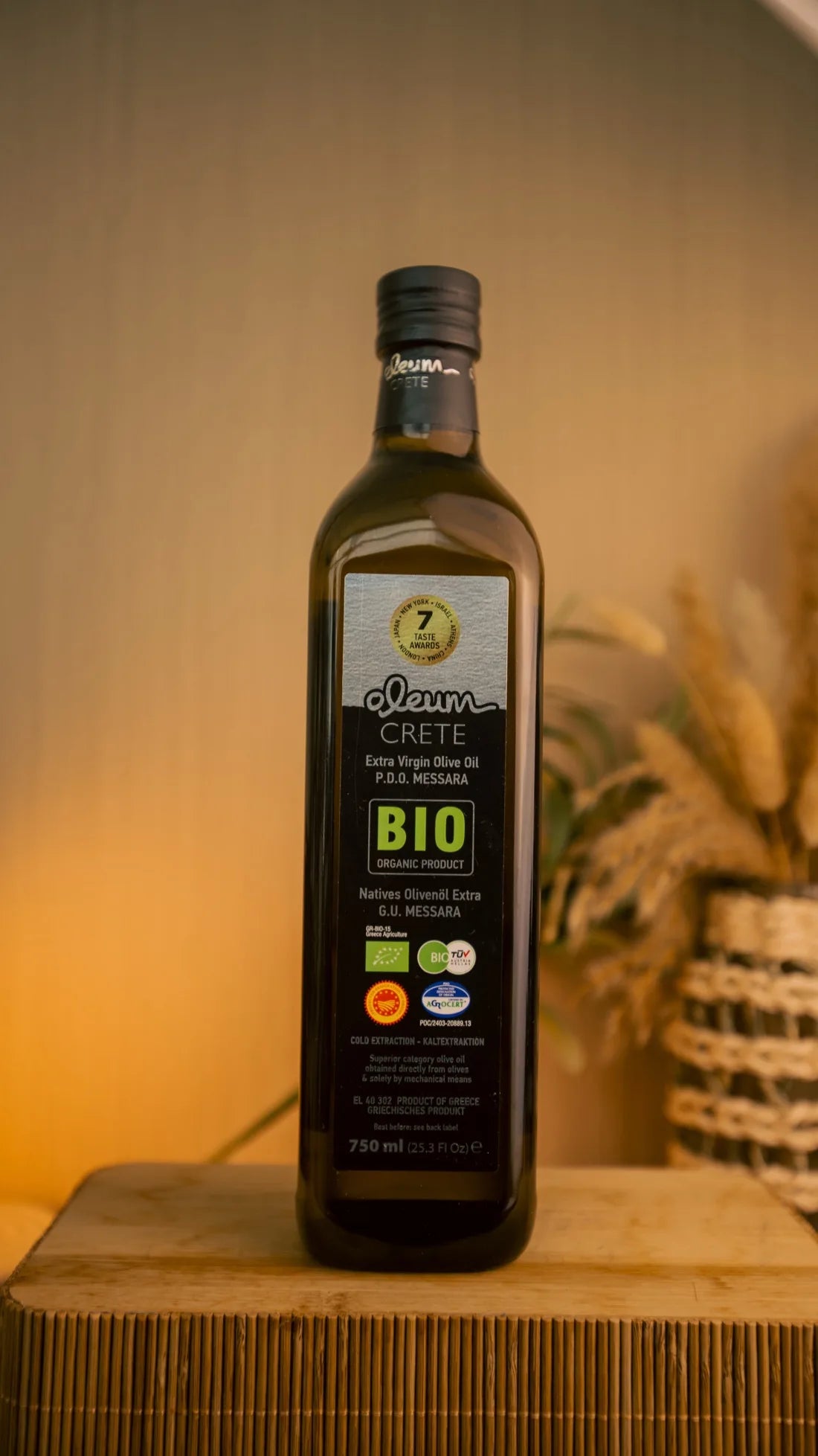
PDO Messara links the oil to one place: the Messara Plain in south-central Crete. The olives must be grown in the defined zone, and the oil must be produced under a registered specification. Every lot can be traced back to its harvest. A generic extra virgin oil can be a blend of fruit from several countries. A PDO Messara oil cannot.
Be clear about what the PDO mark does and does not cover. It guarantees origin and method, not chemical composition, so polyphenol levels have to be confirmed by lab data rather than assumed from the mark alone. Our oils are EU Organic certified and independently certified by TÜV Austria. The One Day range carries over 800mg/kg polyphenols, meeting the EU health claim threshold under Regulation (EU) No. 432/2012. We make no wider medical claim than that.
Single-Day Harvest and Why Timing Affects Polyphenol Levels
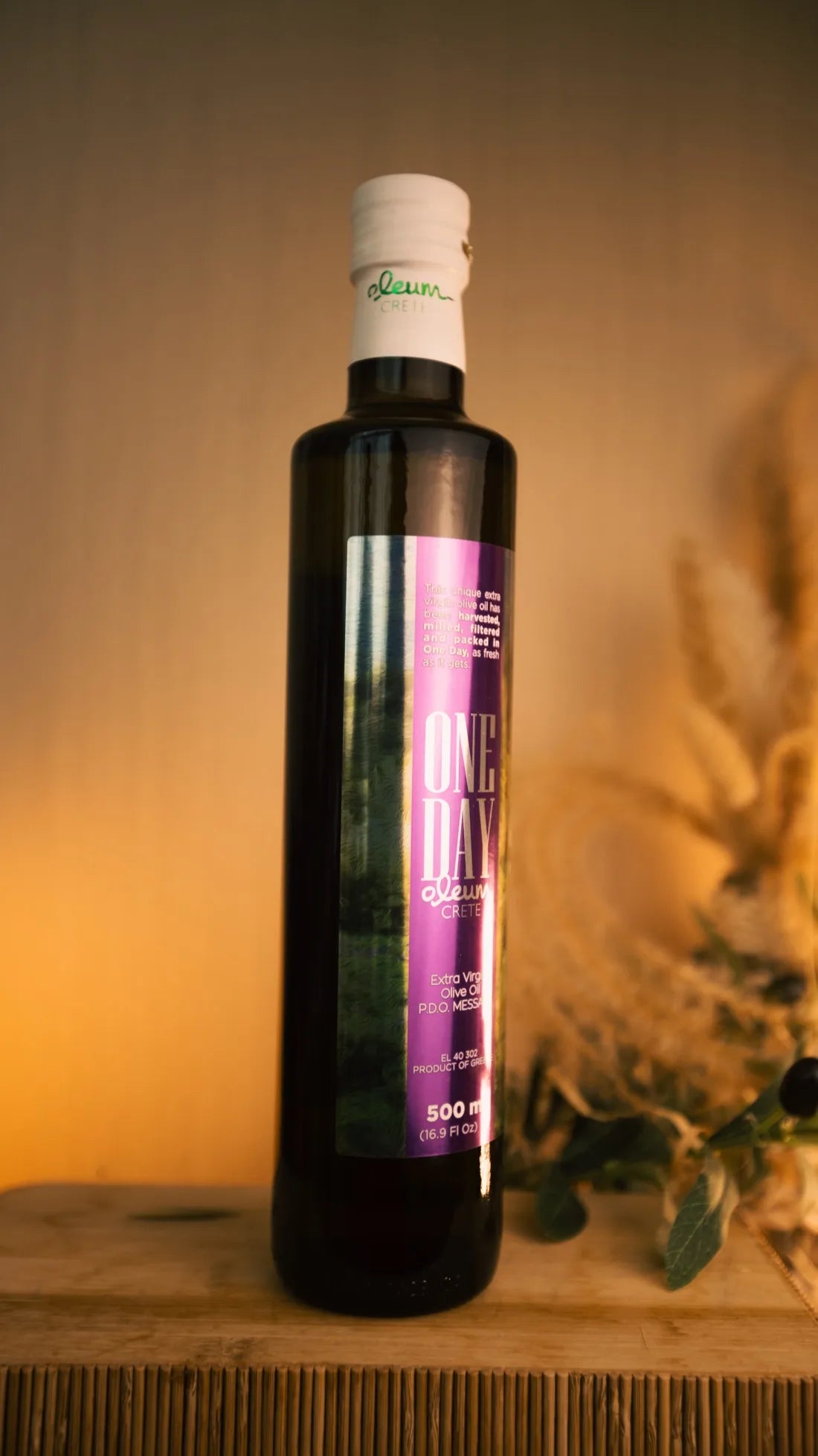
The Kidonakis family has farmed this estate on the Messara Plain for four generations, and every olive is picked by hand. Our One Day range moves from harvest to bottle within a single day, preserving freshness that most oils lose long before they reach the bottle.
Timing matters because an olive starts to deteriorate as soon as it leaves the branch. Enzymes go to work, the fruit begins to oxidise, and polyphenols decline while the olives wait. Each hour between picking and pressing costs the oil some of its freshness and bitterness. An oil that starts life far inside the extra virgin limits has room to stay there through shipping and storage.
How Our Range Fits These Grades
All five of our oils, including the One Day Extra Virgin Olive Oil, the Organic Extra Virgin Olive Oil (750ml) and the Collection Premium Organic Olive Oil, are PDO Messara, single-estate, 100% Koroneiki extra virgin oils, tested within the EU limits described above. The difference between them is not grade, all three are extra virgin, but harvest timing and presentation. The One Day oil is pressed within a day of harvest for maximum freshness. The 750ml Organic Extra Virgin is our everyday PDO bottle for the kitchen table. The Collection Premium is the same estate quality in a gift-ready black bottle. You can compare all five across our full range.
How to Check an Olive Oil's Grade Before You Buy
You cannot run a sensory panel in a supermarket aisle. You can read a label properly, though, and most of what you need is printed on the bottle or conspicuously missing from it.
Reading the Label: Acidity, Harvest Date and Certification Marks
Work through the label in this order:
- Grade name. Look for the words "extra virgin". "Pure", "light" and plain "olive oil" usually describe refined oil blended with a little virgin oil.
- Acidity. Producers confident in their oil often print the figure. Compare it with the 0.8% ceiling. Fresh, well-made oil sits well below it.
- Harvest date. A best-before date alone tells you little. A harvest date tells you how old the oil really is.
- Origin. UAE food labels must show the product name, ingredients, net quantity and country of origin under the UAE.S GSO 9 labelling standard. Look for one country and, ideally, one region and one estate.
- Certification marks. The EU PDO symbol, the EU Organic leaf, and the names of the certifying bodies.
- Variety. "100% Koroneiki" is specific. "Mediterranean olives" is not.
- Packaging. Dark glass or a tin protects the oil from light. Clear glass does not.
For more detail, read our full label checklist for buying Greek olive oil in the UAE.
Red Flags That Suggest a Lower Grade Than Claimed
- A "blend of EU and non-EU oils" or several countries of origin on one label.
- No harvest date, and no producer or estate named anywhere.
- "Packed in" or "bottled in" a country, with no statement of where the olives were grown.
- Clear bottles displayed under bright shop lighting.
- A price far below other extra virgin oils of the same size.
- A flat, greasy or waxy taste with no bitterness or pepper. Fresh extra virgin Koroneiki should never taste dull.
Related: One Day Extra Virgin Olive Oil · Everyday Organic Extra Virgin Olive Oil, 750ml
Frequently asked questions
What does 'extra virgin' actually mean on an olive oil label?
Extra virgin is the highest legal grade of olive oil. The oil must be extracted mechanically, with free acidity of no more than 0.8 g per 100 g. It must also pass a tasting panel with no defects and some fruitiness. It is a tested category, not a marketing term.
Can virgin olive oil still be good quality?
Yes. Virgin olive oil is legal, edible and fit for consumption as it is, with acidity of up to 2%. It may carry a slight flavour defect, so it lacks the clean intensity of extra virgin oil. If you are paying a premium, though, you should expect extra virgin.
Is lampante olive oil safe to cook with?
Lampante oil is not fit for consumption as it is. It is intended for refining or technical use. Once refined, it can be used in blended products sold as "olive oil". It is never sold for kitchen use in its unrefined state.
How do I know if my olive oil has been adulterated or mislabelled?
Only laboratory testing can confirm it. Strong signals help, though: a named estate, a single variety, a harvest date, PDO and organic marks, and a fresh, peppery taste. Home tricks such as chilling the bottle in the fridge are unreliable. Buy from producers and importers who can trace every bottle to its grove.
Does a higher price always mean a higher grade of olive oil?
No. Price reflects packaging, branding and shipping as well as quality. Grade is a lab and tasting panel result, so read the acidity, harvest date, origin and certification marks rather than relying on the price. A price far below the market, however, is a reason for caution.
Ready to taste the difference a true extra virgin grade makes? Shop the Oleum Crete collection and bring home PDO Messara Koroneiki, pressed within a day of harvest.
More from the Journal
All entriesHow Olive Oil Purity Is Lab Tested in the UAE
Supermarket shelves in the UAE are full of oil labelled 'extra virgin', but the label alone proves nothing. We look at how purity is actually verified, from chemical lab tests to sensory panels, and where PDO certification fits in.

Olive Oil for Skin and Hair: What Works, What to Skip
Olive oil earns its place on the Messara table because of oleic acid and polyphenols, not folklore. On skin and hair the picture is mixed: some uses hold up, others don't, and some skin types should leave the bottle in the kitchen. Oleum Crete separates the two before pointing to the oil worth using

Koroneiki vs Other Olives: Why It Wins on Crete
Koroneiki isn't the only olive variety that makes extra virgin oil, but on Crete's Messara Plain it outperforms Picual, Coratina, Leccino and Arbequina on acidity, polyphenol content and resilience to a hot, dry climate. Here's what the comparison actually shows.
