
How to Tell If Extra Virgin Olive Oil Is Fake: 7 Real Tests
The fridge test tells you nothing about whether your olive oil is genuine. Here are seven checks, drawn from how adulteration actually happens on the production side, that a UAE shopper can run before buying or at home.

In this article9 sections
Key takeaways
- The fridge test is unreliable. Whether an oil clouds or firms up in the cold depends on its fatty acid profile, its wax content and the temperature. Purity has nothing to do with it, so genuine and fake oils can behave in exactly the same way.
- Genuine extra virgin olive oil must have a free acidity of no more than 0.8%. For origin, a PDO or PGI seal backed by a lot number is the strongest proof a label can give you.
- High-polyphenol oils taste bitter and peppery and often make you cough. That catch at the back of the throat comes from oleocanthal, a natural polyphenol that refined or diluted oils lack.
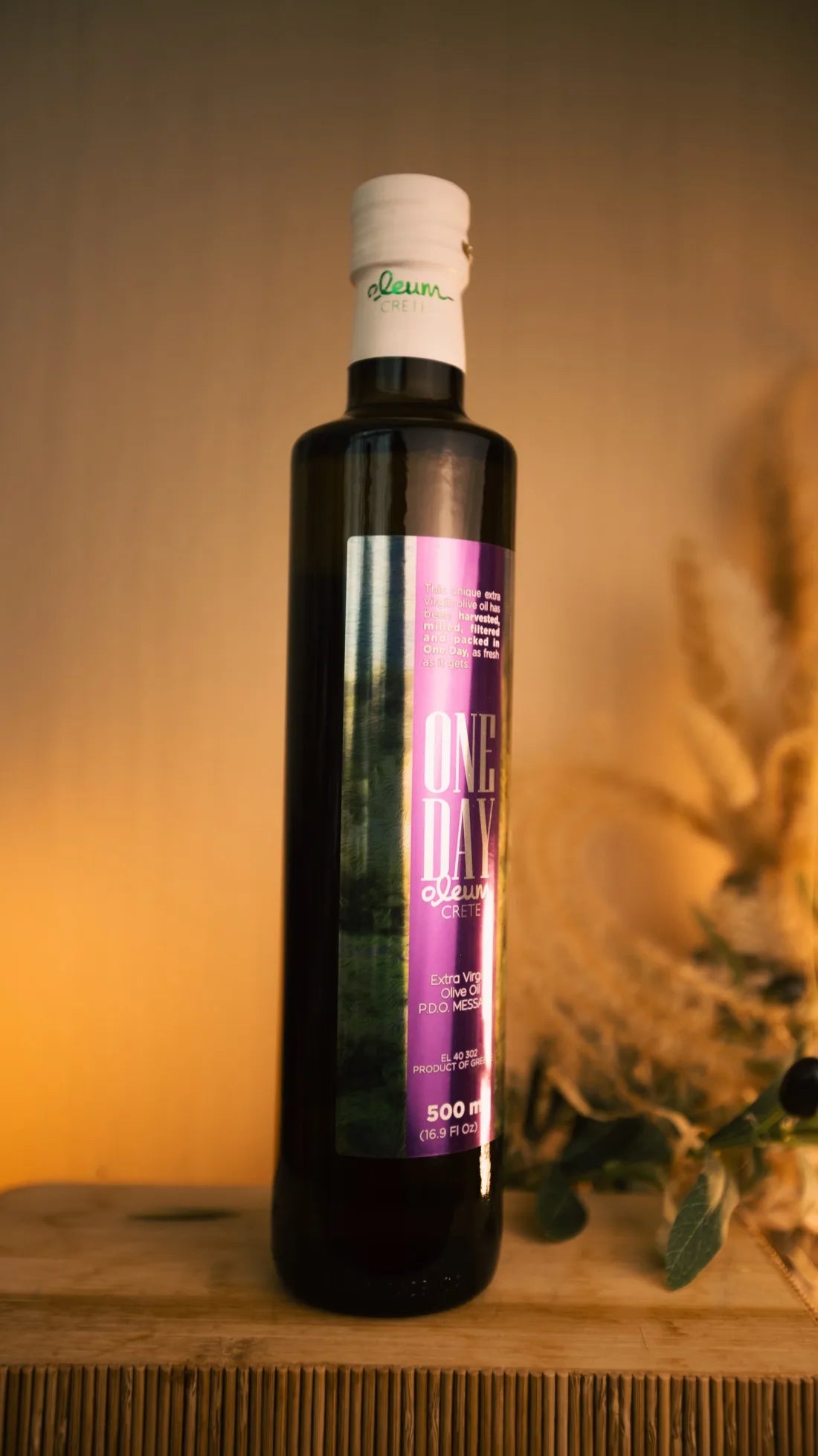
- Harvest and bottling dates matter more than best-before dates. Oil pressed and bottled within a day of picking, like our One Day range, keeps far more of its original character than oil left in tanks for months.
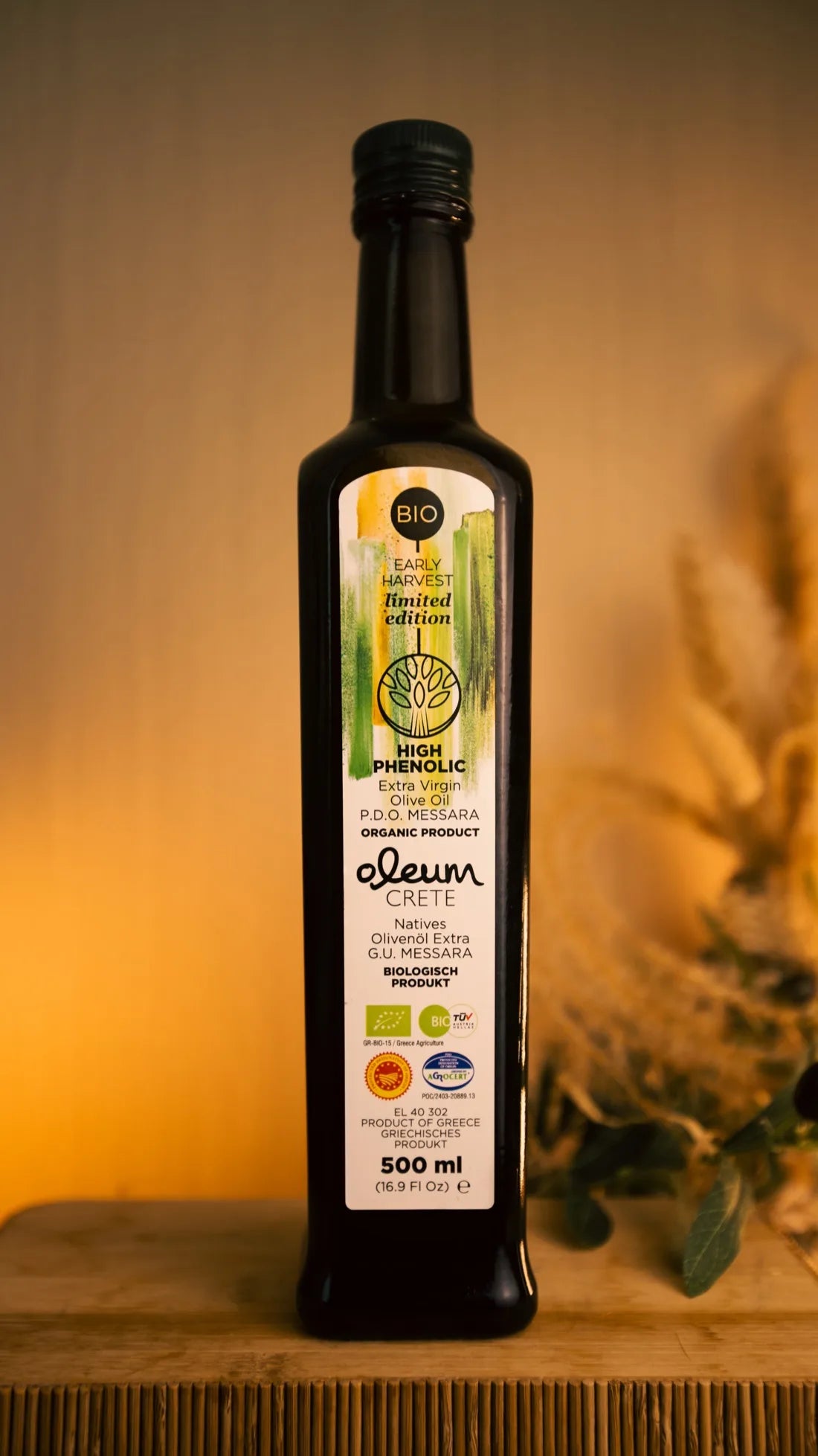
- The fastest in-store test is the label. Look for a named olive variety, a harvest date and certification marks such as PDO Messara or TÜV Austria organic. Be wary of a line that reads "blend of oils from EU and non-EU countries".
How to tell if extra virgin olive oil is fake: the short version
The way to tell if extra virgin olive oil is fake is to run several checks together. No single trick settles it. Read the label for a variety and a harvest date. Look for PDO or PGI and organic marks with a control code. Confirm the acidity is 0.8% or lower. Taste for bitterness and pepper. Find out how long the oil sat between grove and bottle. Then judge the price, the packaging and the seller.
Only a laboratory can prove purity outright. These seven tests will still filter out most oils that don't deserve the name. We hold every pressing we bring from Crete to the UAE to the same standard.
Why the fridge test doesn't work
The advice is everywhere: chill your oil, and if it solidifies it's real. Researchers at the UC Davis Olive Center put that to the test. They refrigerated seven samples: two extra virgin olive oils, a standard olive oil, canola, safflower and two blends. None showed any sign of congealing after 60 hours at about 4.7°C, and even after 180 hours none had fully solidified. Their conclusion was blunt. The fridge test is unreliable for judging either the purity or the quality of olive oil.
What the fridge test actually measures
Olive oil is mostly oleic acid, a monounsaturated fat that stays liquid at fridge temperature. When an oil clouds in the cold, you are seeing its saturated fats and natural waxes crystallise first. How much that happens depends on the olive variety, the climate, when the fruit was picked and how the oil was filtered. So the test tells you about fat composition. It tells you nothing about whether the oil was refined, diluted or left to go stale.
Why even fake oils can solidify
A cheap blend with more saturated fat may cloud faster than a genuine early-harvest oil. A high-oleic seed oil can behave much like olive oil in the cold. Two authentic extra virgin oils from different valleys can react differently too. Does olive oil solidify in the fridge? Sometimes, partly, and it proves nothing either way. Set the fridge aside and use the tests below instead.
Test 1: Read the label like a chemist
This is the easiest way to check if olive oil is fake before you spend a dirham. It takes about thirty seconds in the supermarket aisle.
Look for the variety, not just "extra virgin"
Serious producers name their olives: Koroneiki, Picual, Arbequina, Coratina. A named single variety from a named estate can be traced back to the grove. Ours is 100% Koroneiki, the small, intensely flavoured olive of Crete, grown on one estate and never blended. If the only claim on a bottle is "extra virgin" in large type, you have been told very little.
Check for "blend of oils from EU and non-EU countries"
EU labelling rules require origin to be stated. When oils from several countries are mixed, the label has to say so, usually in small print on the back. A blend is not automatically fake. It does mean nobody can tell you which grove, which harvest or how long each component waited before bottling.
Find the harvest date, not just the best-before date
A best-before date is usually set long after bottling and says nothing about the age of the oil inside. A harvest date does. In autumn 2026, a fresh bottle should show the 2025/26 harvest. If there is no harvest date at all, assume the oil is older than you would like.
Test 2: Verify the certification marks
Knowing how to tell if olive oil is original often comes down to telling official seals from marketing language. Some marks are audited by an independent body. Others are words anyone can print.
PDO and PGI: what they actually guarantee
A Protected Designation of Origin (PDO) means the olives were grown, milled and bottled inside a legally defined area, to a registered specification. A Protected Geographical Indication (PGI) is looser: only one stage of production has to happen in the named region. Our oil carries PDO Messara, which ties every bottle to the Messara Plain in south-central Crete. You can read more about the Kidonakis family estate on the Messara Plain, farmed by the same family for generations and harvested entirely by hand.
Organic certification: TÜV Austria and EU Organic
The EU Organic leaf logo must appear with the code of the control body that inspected the producer. TÜV Austria is one of those inspection bodies. A leaf logo without a control code is a warning sign.
Why "cold-pressed" alone means nothing
Under EU marketing rules, "cold extraction" is reserved for oil obtained below 27°C. Almost every genuine extra virgin oil is made that way, so the phrase can't separate a great oil from an ordinary one. It certainly can't prove an oil is extra virgin.
| Mark or claim | Independently audited? | What it guarantees | What it does not tell you |
|---|---|---|---|
| PDO (e.g. PDO Messara) | Yes | Grown, pressed and bottled in one defined area, to a registered specification | Freshness of that particular bottle |
| PGI | Yes | At least one production stage in the named region | That the olives came from there |
| EU Organic leaf with control code | Yes | Organic farming, inspected by a named body such as TÜV Austria | Origin or flavour |
| International awards (NYIOOC, London IOOC, Great Taste) | Judged panels | That a specific lot impressed expert tasters | Anything about other lots |
| "Cold-pressed" or "first press" | No meaningful distinction | Low-temperature extraction, standard for good oil | Grade, origin or purity |
| "Pure", "Premium", "Mediterranean" | No | Nothing specific | Everything that matters |
Test 3: Check the acidity percentage
This is the hardest number in olive oil. Look for it on the label or ask the seller.
The 0.8% legal limit for extra virgin
The International Olive Council defines extra virgin olive oil as oil with a free acidity, expressed as oleic acid, of no more than 0.8 grams per 100 grams. Virgin olive oil may reach 2 grams. Lampante oil is not fit for consumption as it is. EU rules set the same 0.8% ceiling for extra virgin, and this applies to PDO oils such as Messara.
Acidity is measured in a laboratory as a percentage of oleic acid. You can't taste it. A low-acidity oil can still be strikingly bitter and peppery, because those sensations come from polyphenols, not free fatty acids.
Why single-estate oils often sit well below it
Free acidity climbs when olives are bruised, diseased or left in sacks before milling. Hand-picked fruit, taken straight to the mill, keeps it low. That is why careful single-estate producers usually come in well under the legal line. Ask any seller for the certificate of analysis for the lot you are buying. A producer who stands behind their oil will have one.
Test 4: Taste it properly
This is how to tell if olive oil is fake or real with your own senses. Judges and producers use the same method.
- Pour a tablespoon into a small glass.
- Cup it in your hand for a minute to warm it.
- Smell it deeply.
- Sip, then draw air through your teeth so the oil coats your mouth.
- Swallow and wait for the finish.
The peppery cough: what oleocanthal tells you
A sting at the back of the throat, sometimes a cough, is the signature of oleocanthal, one of the polyphenols in fresh olive oil. Refined and diluted oils can't fake it. Our early-harvest oil is tested for polyphenol content by an independent lab, and the level is high enough to qualify for the EU's approved health claim on olive oil polyphenols and the protection of blood lipids from oxidative stress. If you want to feel that pepper at full strength, start with our high-polyphenol Early Harvest oil.
Green tomato, artichoke, buttery: what genuine tasting notes look like
Good oil has three positive attributes: fruitiness, bitterness and pungency. Early-harvest oils lean green, with tomato leaf, cut grass, artichoke and garden herbs. Oils from riper fruit turn softer and more buttery, with almond and apple. Either way, you should taste olives, not just fat.
Rancid, greasy or flat: signs of oxidised or refined oil
Rancid oil smells of crayons, putty or stale nuts. Fusty oil tastes of fermented olives. Winey or vinegary notes point to fruit that sat too long before pressing. Refined oil passed off as extra virgin is flat and greasy, with no bitterness and no pepper at all.
Test 5: Trace the harvest-to-bottle timeline
This is the test most people never think to run, and it tells you the most about freshness.
Why months in a tank change the chemistry
From the moment an olive is picked, it starts to oxidise and ferment. Once pressed, the oil keeps meeting oxygen, light and heat. Oil stored in bulk tanks for months before bottling loses polyphenols and aroma along the way, while acidity and oxidation creep upward. It can still pass as extra virgin on paper and taste tired in the glass.
What "single-day harvest" means for polyphenol levels
Our single-day-harvest One Day oil is picked at dawn on the Messara Plain, pressed within hours and bottled the same day. Less time for oxidation means more polyphenols carried into the bottle, with brightness to match: green tomato, garden herb and a clean, peppery finish. For fresh extra virgin olive oil in the UAE, the journey after bottling matters too. We ship in temperature-controlled conditions within 24 hours, so the oil isn't cooked in a delivery van on its way to you.
Test 6 and 7: Price, packaging and where you buy it
These last checks happen at the moment of purchase.
Why genuine single-estate oil rarely sells at supermarket discount prices
Hand-harvesting, low early-harvest yields, independent certification, lab testing and careful freight all cost money. Treat a litre of "extra virgin" priced below what it could plausibly cost to make as a warning sign. Price alone won't prove quality, but a price that seems too good usually is.
Dark glass or tin, never clear plastic
Light degrades olive oil quickly. Genuine producers use dark glass or tin, which shields the oil from light and heat. Our 5L tin and the black bottle of our Collection oil are chosen for exactly that reason. Clear glass or plastic on a supermarket shelf under bright lights is a poor home for any oil.
Buying direct from an importer versus an unknown middleman
Every extra handler adds time, heat and uncertainty. An importer who buys from a single estate can give you the lot number, the harvest date and the lab analysis. An anonymous marketplace seller or repackager usually can't. Browse our range of single-estate extra virgin olive oils, each traceable to one family estate, with free delivery across the UAE and no minimum spend.
Frequently asked questions
Is extra virgin olive oil sold in UAE supermarkets often fake?
We haven't found reliable public data on olive oil fraud in the UAE, so we won't guess at a figure. A 2013 UC Davis article reported experts saying as much as 70 percent of olive oil sold in America was adulterated or of a lower grade, but that estimate is old and US-specific. The more common problem on any shelf is oil that is genuine but old, heat-damaged or untraceable.
What does high polyphenol content actually taste like?
It tastes bitter on the tongue and peppery in the throat, often strong enough to make you cough. Fresh, green aromas such as tomato leaf, artichoke and cut grass usually come with it. Bitterness and pepper are signs of quality in olive oil, not faults.
Can adulterated olive oil be dangerous to health?
Most adulteration uses cheaper edible oils, so the usual harm is paying for something you didn't get and missing the polyphenols you wanted. Undisclosed oils can matter for anyone with allergies. Lower grades such as lampante oil are not fit for consumption as they are, which is why grade labelling exists.
How long does genuine extra virgin olive oil stay fresh once opened?
Aim to finish an opened bottle within a couple of months, while its aroma and pepper are at their best. Close the cap tightly and keep it in a cool, dark cupboard, away from the hob and out of direct sun. In UAE summers, never leave it in a hot car or on a sunny windowsill.
What is the difference between PDO and organic certification on an olive oil label?
PDO certifies origin: the oil was grown, pressed and bottled in a defined area to a registered specification. Organic certification covers farming methods and is inspected by a control body such as TÜV Austria. An oil can carry one without the other. Ours carries both.
If you'd rather skip the guesswork, shop a range that's already single-estate, PDO-certified and harvested within a day of pressing, delivered free across the UAE.
Read next: Buy Cretan Olive Oil in Dubai: Free Delivery, No Minimum
More from the Journal
All entriesBuy Cretan Olive Oil in Dubai: Free Delivery, No Minimum
Ordering genuine PDO Messara olive oil in Dubai should not mean guessing at supermarket labels. Here is how to buy direct from the Kidonakis family estate on Crete's Messara Plain, what each pressing suits, and exactly what happens between checkout and your doorstep.

Best Extra Virgin Olive Oil in UAE: 2026 Buyer's Guide
Most 'extra virgin' labels in UAE supermarkets tell you nothing about when the olives were picked, how they travelled through 45°C heat, or whether the polyphenol claims on the bottle are real. Here is how to score an oil properly, and which single-estate Messara pressing to reach for.

Why a single day matters
The aromas that make a great olive oil are the first thing it loses. Here is why we race the clock from branch to bottle.
