
Single Estate Olive Oil Online in the UAE: A Buyer's Guide to Verifying Authenticity
Buying single estate olive oil online in the UAE means checking four things before you click buy: the harvest date, the PDO seal, the single-estate labelling, and a lab polyphenol report. Here is how to run each check in under five minutes.

In this article7 sections
Key takeaways
- A genuine single-estate bottle names one farm or estate, not a regional blend from many growers.
- The harvest date tells you how fresh the oil really is. A bottling date or a loose "best before" does not.
- A PDO seal such as PDO Messara ties the oil to one defined valley and the varieties its specification allows. Our PDO Messara oil is 100% Koroneiki.
- A real lab report gives polyphenols in mg/kg and free acidity as a percentage. Oil described only in marketing language has not been proven.
- Oleum Crete's One Day range is pressed within a day of harvest and carries over 800mg/kg polyphenols, independently tested, well above what most supermarket oils carry.
What counts as single-estate olive oil, and why it matters when you're buying online
Single-estate olive oil comes from olives grown, harvested and pressed for one named farm, with nothing added from anyone else's trees. When you buy single-estate olive oil online, that definition is your first test. The product page should name the estate, the place and the variety, and every detail should point back to the same grove. At Oleum Crete, that grove belongs to the Kidonakis family on the Messara Plain in southern Crete. The family has worked the estate since 1983, it is now in its fourth generation, and the harvest is done entirely by hand.
The test matters because olive oil is easy to blend and hard to trace. Once oil from several growers meets in one tank, the character of any single grove is averaged away, and so is the ability to say exactly where and when the fruit was picked. We explain the reasoning in more depth in why no blending matters for a single-estate bottle.
Single-estate versus "product of Greece"
"Product of Greece" tells you a country. It does not name a farm, a valley, a variety or a harvest. Oil sold under that line may be entirely honest, but it can combine fruit from many growers, several regions and more than one variety. "Packed in Greece" or "bottled in Crete" tells you where the bottle was filled. It does not tell you where the olives grew.
A single-estate label narrows all of this to one source. If you want authentic Greek olive oil in the UAE, the practical difference is simple. A single-estate oil can be traced to one place, so its claims can be checked. A broad country-of-origin oil can only be trusted.
Why UAE shelves and webshops blur the two
Every bottle of Greek oil sold in the UAE has travelled. Between grove and kitchen it may pass through a mill, a bottler, an exporter, a distributor and a retailer, and detail tends to fall away at each step. Online listings add another layer. Grove photographs and words like "estate" and "family" appear on pages for blended oil because nobody checks adjectives. The label, the harvest date and the lab figures are what remain once the photography is set aside.
Check one: the harvest date on the bottle or product page
Olive oil is the juice of a fruit. It is at its most vivid the day it is pressed, and from then on it slowly loses aroma and polyphenols. Heat, light and air speed that loss. The harvest date is the only date that measures where an oil sits on that curve. A bottling date can fall long after pressing if the oil was held in tanks. A best-before date is set by the bottler and says nothing about when the olives left the tree.
Before you buy single-estate olive oil from any website, look for the harvest season or harvest date on the label photograph or in the product description. If neither appears, ask. A seller who knows its source can answer in one line.
Where sellers hide or omit the harvest date
- Only a best-before date is shown, on the label and on the page.
- The back label, where dates usually sit, is never photographed.
- The same product photo runs across several seasons, so the pictured date may not match the stock.
- The copy says "new season" or "fresh harvest" with no year attached.
- The harvest date is printed on the bottle but missing from the page, so you only find out after delivery.
What a single-day harvest claim should state
"Harvested and pressed in one day" is a specific claim, and it should come with specific detail: the harvest date, the estate, the variety and where the oil was pressed. A one-day claim attached to an oil with no named source cannot be checked.
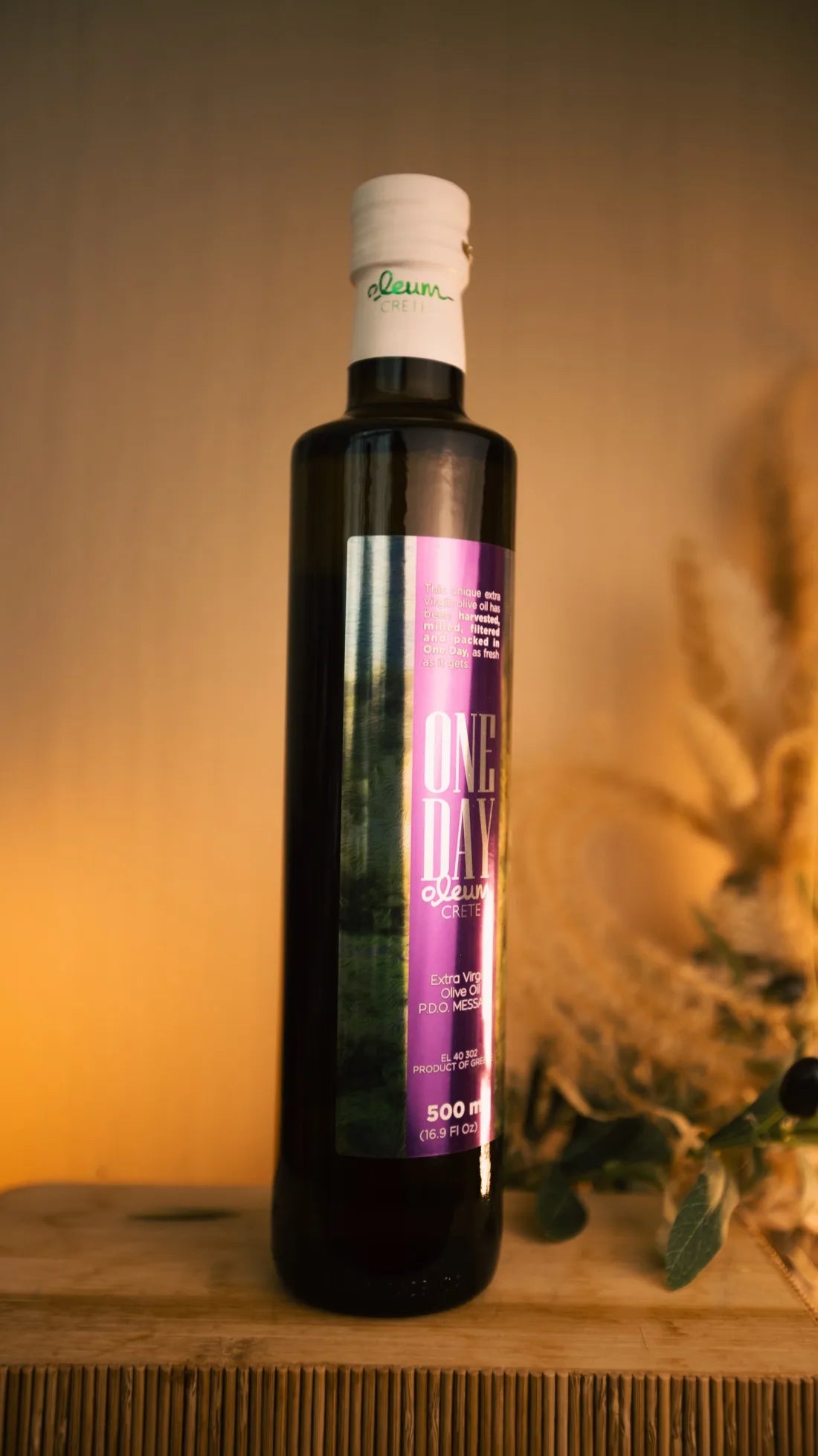
This is the claim behind our One Day Extra Virgin Olive Oil, pressed within a day of harvest. Picked at dawn on the Messara Plain and pressed within hours, it keeps a brightness that most oils lose long before they reach the bottle: green tomato, garden herb and a clean, peppery finish. Speed from grove to press is the whole point. It is why we put the harvest first.
Check two: does the PDO seal match the claim on the label
A Protected Designation of Origin is a name registered with the European Union and tied to a published product specification. That specification sets out where the olives may be grown and pressed and which varieties qualify. The PDO logo is red and yellow, and the registered name appears beside it. When you buy PDO olive oil online in the UAE, two questions matter. Is the seal genuine, and does it match the rest of the label?
We cover the detail in what the PDO Messara seal actually certifies. The short version follows.
What a valid PDO Messara seal restricts
PDO Messara limits the oil to the Messara area of Heraklion, Crete, and to the varieties named in its registered specification. Our PDO Messara oils are 100% Koroneiki, the small-fruited Cretan variety that gives the valley's oil its green, peppery character. The registered name and its specification sit in the EU's public register of geographical indications, eAmbrosia, so anyone can look it up.
PDO and single-estate are different promises. PDO defines a valley, and many growers within it can produce PDO Messara oil. Single-estate defines one farm within that valley. A bottle that carries both a PDO seal and a named estate gives you the strongest traceability available.
Spotting a PDO name used loosely in marketing copy
- The page says "from the Messara region" or "Messara-style", but the label carries no PDO logo.
- The PDO logo appears on the website banner, not on the product label itself.
- One product in a range is PDO, and the copy implies the rest are too.
- A place name forms part of the brand name, which suggests origin without certifying it.
- The variety listed on the label does not match the PDO it claims.
Check three: asking for a lab polyphenol and acidity report
Words like "rich", "high-phenolic" and "robust" descriptions describe an oil. Numbers prove it. A seller of single-estate olive oil online that tests its oil should be able to share the results for the harvest it is selling.
What a real report includes
- The name of the laboratory and the date of analysis
- The batch or harvest the results refer to
- Free acidity, expressed as a percentage
- Peroxide value, a measure of oxidation
- Total polyphenols, expressed in mg/kg
- The analytical method used
The method matters more than most buyers realise. The EU health claim for olive oil polyphenols counts hydroxytyrosol and its derivatives. Researchers have noted that no official method fully separates all forms of hydroxytyrosol and tyrosol, so polyphenol figures from different labs may not be directly comparable. Others have validated a UHPLC method for measuring total hydroxytyrosol and tyrosol for this purpose. A credible report names its method, so you know what the number actually represents.
Numbers worth asking a seller to confirm
- The total polyphenol figure in mg/kg, the harvest it comes from, and the method behind it.
- Free acidity as a percentage. Lower acidity generally reflects sound fruit and careful handling between tree and press.
- Whether the oil meets the EU-authorised health claim for olive oil polyphenols, and on which test that conclusion rests.
- How long after harvest the sample was tested, since polyphenol levels fall over time.
Our One Day range carries over 800mg/kg polyphenols, independently tested. A lab report tells you what is in the bottle. It does not tell you what the oil will do for you. If you are choosing an oil for a health reason, a doctor or registered dietitian is the right person to advise on your situation.
Red flags that signal blended oil sold as single-estate
Most blended oil sold as something grander gives itself away in a few places. Use the table to disqualify a listing quickly. If you want to test the oil itself once it arrives, our guide to seven real tests for spotting fake extra virgin olive oil goes further.
| Red flag | What it can mean | What a genuine single-estate bottle shows |
|---|---|---|
| No farm or estate named | Oil pooled from several growers | One named estate and its location |
| "Blend of EU oils" or "Mediterranean oils" in small print | Oil from more than one country | One country, one valley |
| No harvest date anywhere | Older stock or mixed seasons | A stated harvest date or season |
| Several varieties listed, or none at all | A varietal blend | One named variety, such as 100% Koroneiki |
| PDO wording without the official EU logo | A place name used decoratively | The PDO logo and the full registered name |
| Health language with no figures | An unverified claim | Polyphenols in mg/kg, with the method named |
| Awards mentioned with no competition or year | Recognition that cannot be checked | Named competitions, such as NYIOOC or Great Taste |
| Clear glass or a plastic bottle | Exposure to light and oxidation | Dark glass or a sealed tin |
One red flag is a reason to ask a question. Two or three together usually mean you are not looking at single-estate oil, whatever the label says. Authentic Greek olive oil in the UAE should survive all eight rows. Before you buy single-estate olive oil, check it against each one.
A five-minute checklist before you order single-estate olive oil online
The three checks above work best together. Each one closes a gap the others leave open.
Run through this before you add to cart
- Find the estate. The page names one farm and one location, not a country or a region alone.
- Find the variety. A single named variety, stated as 100%.
- Find the harvest date. A season or date on the label or in the description. If it is missing, message the seller before you order.
- Check the seal. If the oil claims PDO status, the EU logo and full registered name appear on the label, and the variety matches.
- Ask for the numbers. Polyphenols in mg/kg, acidity as a percentage, the lab's name and the method used.
- Check the awards. Competitions are named, such as NYIOOC, TerraOlivo, London IOOC or Great Taste, so you can look them up.
- Check the journey. Dark glass or a tin, and delivery that keeps the oil out of the heat on its way to you.
For PDO olive oil online in the UAE, step seven deserves as much care as the label. We ship free across the UAE with no minimum spend, using temperature-controlled delivery within 24 hours, because an oil pressed within a day of harvest should not lose that freshness in the back of a hot van.
Frequently asked questions
Can supermarket extra virgin olive oil in the UAE really be fake or diluted?
Olive oil fraud is a known problem in the international trade. It ranges from blending in cheaper oils to selling a lower grade as extra virgin. Not every supermarket bottle is suspect, but a label alone cannot prove the grade. A named estate, a harvest date and a lab report give you something you can check.
How long does it take for olive oil to lose its freshness after harvest?
Freshness begins to fade from the moment of pressing. Aroma and polyphenols decline gradually, and faster with heat, light and air. There is no single cut-off date, which is why the harvest date matters: it lets you choose the most recent oil and judge it against how it has been stored.
Is organic certification the same thing as single-estate?
No. Organic certification covers how the olives were grown and processed. Single-estate covers where they came from. An organic oil can be blended from many certified farms, and a single-estate oil may or may not be organic. Several of our Messara oils are both, which is why our labels state each claim separately.
Does a higher price always mean a more authentic olive oil?
Price alone proves nothing, since a premium bottle can still hold blended oil. Hand harvesting, single-day pressing and lab testing do cost more, so very low prices for oil sold as single-estate deserve scrutiny. Judge the evidence on the label and the report, then decide whether the price reflects it.
What temperature and shipping conditions protect olive oil quality in the UAE?
Olive oil keeps best cool, dark and sealed, away from direct sun and heat. In the UAE, the risk points are a hot delivery vehicle and a parcel left outdoors. Choose sellers who ship quickly under temperature control. Once the oil arrives, store it in a cool cupboard, never near the hob.
Once you know what to check, the fastest way to see it in practice is to shop the Collection of Oleum Crete's single-estate, PDO Messara oils and compare the harvest date and lab figures on every bottle for yourself.
More from the Journal
All entriesEarly Harvest Olive Oil Uses: 9 Ways to Use It Daily
Early harvest olive oil belongs on the table every day, not just on special occasions. Here are nine practical ways to use it, and the proof points that separate a genuine high-polyphenol Cretan oil from a marketing claim.

Olive Oil Harvest Date: How to Read Labels and Buy Fresh
Most bottles on UAE shelves hide the one date that actually matters. Here is the checklist we use ourselves to separate a genuinely fresh, single-estate oil from an old blend dressed up in a nice label.

Greek Olive Oil vs Italian and Spanish: What Sets Crete Apart
Most Italian and Spanish extra virgin olive oil is blended from several varieties, regions and harvest dates. Single-estate Cretan Koroneiki, pressed within a day of picking on the Messara Plain, takes a different path, and the polyphenol numbers show it.
