
Early Harvest Olive Oil Uses: 9 Ways to Use It Daily
Early harvest olive oil belongs on the table every day, not just on special occasions. Here are nine practical ways to use it, and the proof points that separate a genuine high-polyphenol Cretan oil from a marketing claim.

In this article6 sections
Key takeaways
- Research on harvest timing shows early-picked olives yield oil with measurably higher polyphenol and antioxidant levels than late-harvest oil from the same cultivars.
- A genuine early harvest oil fits into daily life in at least nine ways: a morning spoonful, breakfast drizzles, finishing soups off the heat, dressing salads, dipping bread, low-heat sautéing, marinating, baking, and a drop for skin and hair.
- To check authenticity, read the harvest date, the PDO Messara seal and the single-estate sourcing on the label. The word "premium" proves nothing on its own.
- Buying direct from a Greek estate gives you traceability back to one grove on the Messara Plain, rather than an unnamed blend.
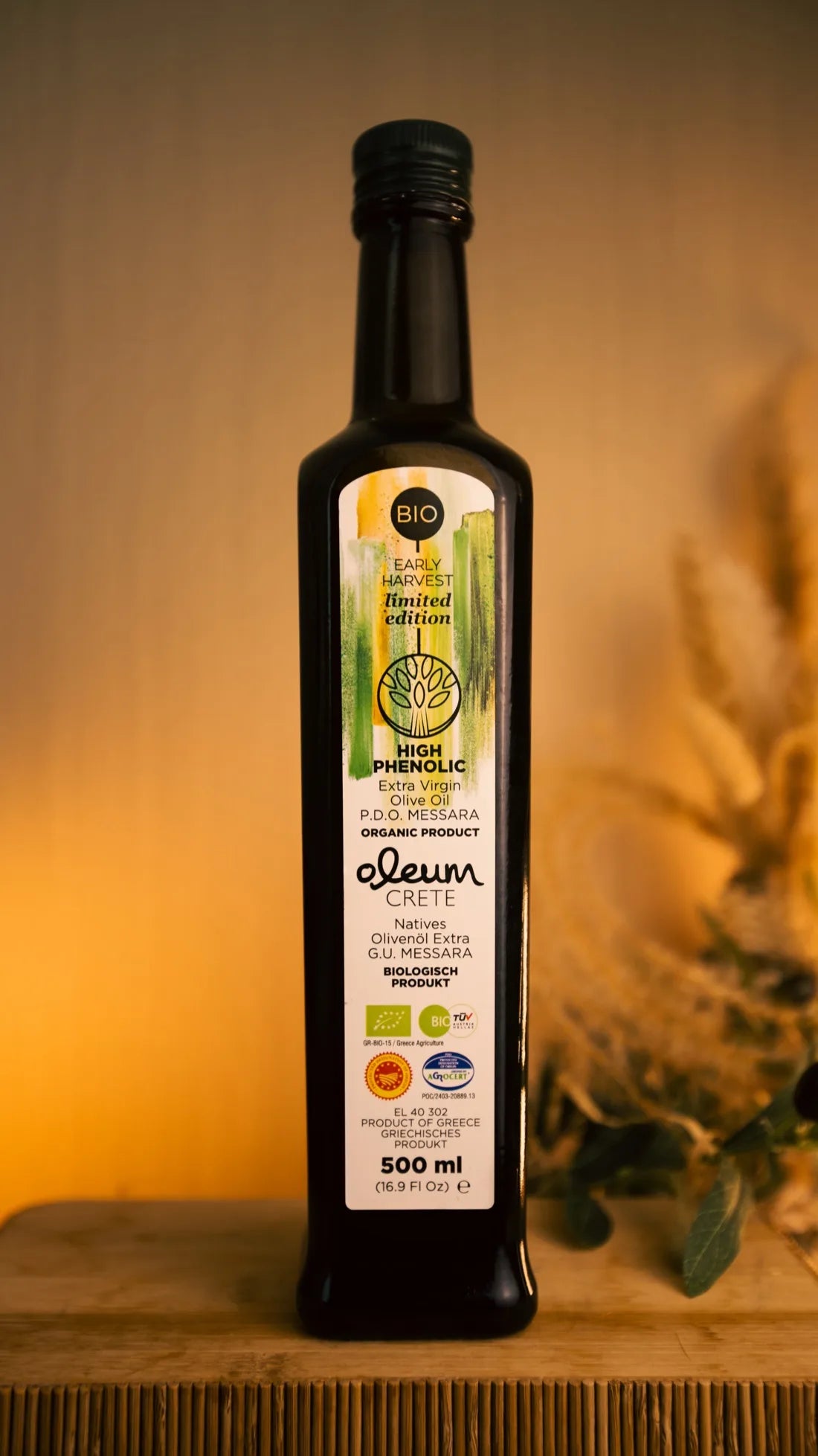
- Oleum Crete ships its Organic Early Harvest oil across the UAE in temperature-controlled conditions, with free delivery and no minimum spend.
The best early harvest olive oil uses are the everyday ones. Take a spoonful in the morning. Pour it over eggs, yoghurt and toast. Stir it into soup once the pan is off the heat. Toss it through raw vegetables, dip bread in it, and use it for gentle pan cooking, marinades and baking. At Oleum Crete we press 100% Koroneiki olives from the Kidonakis family estate on Crete's Messara Plain, and our early harvest oil is meant to be opened, poured and finished, not kept for best. A bottle saved for a special occasion loses the brightness that makes it worth buying in the first place.
Why Early Harvest Olive Oil Belongs in Daily Use
Early harvest oil is pressed from green, underripe olives picked at the start of the season. Green fruit gives less oil than ripe fruit, but that oil holds more of the compounds that make extra virgin olive oil taste bitter and peppery. Those compounds are polyphenols, and a cupboard does nothing to preserve them. The oil does you the most good when you use it while it is fresh, which is exactly why early harvest olive oil uses tend to be frequent, small ones rather than occasional, ceremonial ones.
What the Research Says About Polyphenols and Harvest Timing
A study of Northern Italian extra virgin oils found that early harvest oils reached total phenol levels of up to 263 to 326 mg/kg in organic mono-cultivar samples, against lower levels in late harvest oils from the same trees. The same research found early harvest oils carried higher antioxidant capacity (up to 1285.97 ORAC units) and higher α-tocopherol content (up to 280.67 mg/kg) than their late-harvest counterparts. Harvest timing is not a marketing detail. It changes what is measurably in the bottle.
How Early Harvest Differs From a Standard Extra Virgin Bottle
Both are extra virgin, so both are mechanically extracted and free of defects. The difference shows in the glass and on the tongue. A standard extra virgin oil from riper fruit tends to be golden, soft and buttery. An early harvest oil is greener and grassier, with bitterness on the middle of the tongue and a peppery catch at the back of the throat. In the Koroneiki of the Messara you will taste green tomato, cut grass and garden herbs. That pepper is the polyphenols announcing themselves, and it tells you the oil is fresh.
9 Early Harvest Olive Oil Uses for Every Day
1. A Spoonful Straight
The simplest use needs no cooking. Many people in Crete take a spoonful of new oil neat, often before breakfast. You will taste the bitterness first, then the pepper, which may make you cough. That cough is a good sign in early harvest oil. If neat oil is too much, stir the spoonful into a glass of water with lemon, or take it on a piece of bread.
2. Drizzled Over Yoghurt, Eggs and Breakfast Toast
A thin line of oil over thick strained yoghurt with za'atar or sumac makes a quick, savoury breakfast. Finish fried or scrambled eggs with oil after they come off the heat. Toast sourdough, rub it with a cut garlic clove and grated tomato, then pour over the oil and add a pinch of flaky salt. This is the Cretan dakos idea, built on a weekday slice of bread.
3. Finishing Soups and Stews Off the Heat
Lentil soup, harira, white bean stew and roasted tomato soup all improve with a spoonful of raw oil stirred in at the table. The heat of the bowl releases the aroma, and the pepper cuts through rich, earthy dishes the way a squeeze of lemon would. Add the oil just before serving, once the pan is off the hob.
4. Dressing Raw Vegetables and Leafy Salads
Early harvest oil does its best work raw. Use three parts oil to one part red wine vinegar or lemon juice and season with salt. That is enough for a horiatiki, a fattoush or a plate of sliced cucumber and tomato. The oil is bold enough to stand up to bitter leaves like rocket and radicchio, so you need less dressing and still taste it.
5. Dipping Bread at the Table
Pour a shallow pool onto a small plate, add a pinch of sea salt and serve with warm bread. Leave out the balsamic. Good early harvest oil has enough flavour without it, and this is also an easy way to taste the difference between pressings side by side.
6. Low-Heat Sautéing and Pan Cooking
You can cook with early harvest oil. Laboratory testing of virgin olive oil found that at 100°C, simulating boiling conditions, the phenolic compounds appeared to be stable, and even after extended heating only one group of compounds fell by around a fifth. Gentle cooking keeps most of what you paid for: softening onions, sweating garlic, wilting spinach, or cooking greens in a covered pan. For high-heat searing and deep frying, a larger everyday tin is the more sensible kitchen choice.
7. Marinating Fish, Meat and Cheese
Oil carries the flavour of herbs, citrus and garlic into food. Coat sea bream or hammour in oil with lemon zest and oregano before grilling. Rub chicken thighs with oil, smoked paprika and garlic. You can also cover cubes of feta or labneh balls with oil, chilli flakes and thyme in a clean jar, refrigerate it and use it within a few days. The leftover marinade makes a ready-made dressing.
8. Baking: Swapping Butter for Early Harvest Oil
Olive oil cake is an old Mediterranean recipe, and oil gives a moist, tender crumb that keeps for days. Swap it for melted butter in cakes, muffins, focaccia and savoury breads. Use slightly less oil than the butter called for, because butter contains water. Pair it with orange, lemon, almond or rosemary, which suit its green notes.
9. Beyond the Kitchen: A Drop for Skin and Hair
Some people warm a few drops between their palms and smooth them over dry ends of hair or rough skin on elbows and heels. We sell olive oil as food and make no claims for it as a cosmetic. If you have sensitive skin or a skin condition, ask a dermatologist first.
How to Tell a Genuine High-Polyphenol Oil From a Marketing Claim
Anyone can print "extra virgin" and "premium" on a bottle. Trustworthy sellers show you evidence instead.
Check the Harvest Date, Not Just the Best-Before Date
A best-before date is usually set from the bottling date, which can be long after the olives were pressed. The harvest date tells you how old the oil really is. Look for a stated harvest season. If a bottle does not show one, the seller has chosen not to tell you.
Look for the PDO Messara Seal and Single-Estate Sourcing
Protected Designation of Origin is a legal standard, not a slogan. Under EU rules it applies to a product whose entire production cycle, from raw material to final product (processing, preparation and packaging), is carried out in a specific territory. The olive crop must also exclusively emanate from PDO regions. A PDO Messara oil must be grown, pressed and packed within the designated area of Crete: being merely "sourced" there is not enough. A named single estate adds another layer of proof, because you know which family and which groves produced the oil.
Why "Early Harvest" on a Label Means Nothing Without a Lab Figure
"Early harvest" is a description, not a regulated grade. Ask for a measured polyphenol figure in mg/kg from a recent laboratory analysis of that specific harvest. If a label gives you no number at all, treat the claim as unproven. If you are weighing up the cost, our guide on whether early harvest is worth paying more for sets out the trade-offs.
Buying Direct From a Greek Estate vs a Supermarket Shelf
Traceability: One Grove vs an Unnamed Blend
Many supermarket oils are blends from several farms, regions or even countries, bottled under one brand. Oil bought direct from a Greek estate can be traced to one place. Ours comes from the Kidonakis family estate on the Messara Plain, pressed from a single variety grown in a single valley. For a step-by-step method, read a buyer's guide to verifying single-estate authenticity.
What Happens to Oil Between Harvest and Shelf
Oil starts to change as soon as it is pressed. It may sit in a tank, be shipped in bulk, be bottled elsewhere, wait in a warehouse, and then stand under shop lighting. The storage research cited above found that hydroxytyrosol derivatives fell by around 30% over storage and heating, while lignans remained unchanged. Every week spent in that chain costs some of the oil's character.
Cold Chain and Shipping Time
Heat speeds up oxidation, and summer temperatures in the UAE are hard on oil left in a van or a hot loading bay. We ship in temperature-controlled conditions within 24 hours of your order, and delivery is free across the UAE with no minimum spend.
| Direct from the estate (Oleum Crete) | Typical supermarket blend | |
|---|---|---|
| Origin | One estate, Messara Plain, Crete | Often several farms or countries |
| Variety | 100% Koroneiki | Frequently mixed |
| Origin claim | PDO Messara | Varies; often unverifiable |
| Harvest date | Stated | Often only a best-before date |
| Polyphenol figure | Lab-tested per harvest | Rarely published |
| Time in the supply chain | Harvest to bottle within a day; dispatched within 24 hours | Unknown |
| Storage before you buy | Temperature-controlled | Shop lighting and ambient heat |
Storing Early Harvest Oil to Protect Its Polyphenols
Good storage protects the polyphenols you paid for, and they are what make every one of the early harvest olive oil uses above worth doing.
Light, Heat and Air: The Three Things That Break Down Polyphenols
- Light: keep the bottle in a cupboard, not on a sunny windowsill. Dark glass helps, but it does not replace a dark place.
- Heat: store the oil away from the hob, the oven and any wall that faces the afternoon sun. A cool cupboard is best. The fridge is not needed, and the oil may turn cloudy in the cold.
- Air: replace the cap tightly after every pour. If you buy a larger tin, decant a small amount into a dark bottle for daily use so the tin is opened less often.
Delivery affects this too. Our guide on what to expect from organic olive oil delivery in the UAE explains how we handle the journey and what to do when the box arrives.
How Long an Opened Bottle Stays at Its Best
Once a bottle is opened, oxygen starts to work on the oil, so aim to finish it while it still has its pepper. If you use oil daily in the ways above, a 500ml bottle goes quickly, which is ideal. When the bitterness fades and the aroma goes flat, the oil is past its best. It is still safe to eat, but it no longer has the qualities you bought it for.
Related: Organic Early Harvest Olive Oil
Frequently asked questions
How much early harvest olive oil should I use each day?
There is no single amount that suits everyone. As a reference point, Mediterranean diet research describes 25 to 30g a day of extra virgin olive oil as the principal source of fats in that dietary pattern. If you have a medical condition or follow a specific diet, ask your doctor or a registered dietitian what fits your needs.
Does early harvest olive oil taste different from a standard extra virgin oil?
Yes. Early harvest oil is greener, more bitter and more peppery, with notes of cut grass, green tomato and herbs. A standard oil from riper fruit is usually softer and more buttery. The stronger taste tracks with the higher polyphenol content.
Can early harvest olive oil be used for cooking, or only raw?
You can cook with it. Research found its phenolic compounds were stable at 100°C, which makes it well suited to gentle sautéing, braising and baking. For high-heat frying, a larger everyday tin is the more practical choice, so you can keep your early harvest bottle for raw and low-heat dishes.
How long does early harvest olive oil stay fresh once the bottle is opened?
It begins to change as soon as air reaches it, so the sooner you finish it, the better it tastes. Keep the bottle tightly capped, in a cool, dark cupboard. When the pepper and fresh aroma have faded, the oil is past its peak.
Is early harvest olive oil the same thing as cold-pressed olive oil?
No. "Cold-pressed" or "cold-extracted" describes how the oil was extracted. "Early harvest" describes when the olives were picked. An oil can be cold-extracted from ripe fruit, so look for both details on the label, alongside a measured polyphenol figure where one is available.
Ready to put early harvest olive oil to work every day? Shop the Oleum Crete collection and bring the Messara Plain to your own kitchen.
More from the Journal
All entriesOlive Oil Harvest Date: How to Read Labels and Buy Fresh
Most bottles on UAE shelves hide the one date that actually matters. Here is the checklist we use ourselves to separate a genuinely fresh, single-estate oil from an old blend dressed up in a nice label.

Greek Olive Oil vs Italian and Spanish: What Sets Crete Apart
Most Italian and Spanish extra virgin olive oil is blended from several varieties, regions and harvest dates. Single-estate Cretan Koroneiki, pressed within a day of picking on the Messara Plain, takes a different path, and the polyphenol numbers show it.

Early Harvest Olive Oil Benefits: Is It Worth Paying More?
Early harvest costs more for a reason that shows up in a lab report, not a slogan. Here is the cost-versus-benefit case for Oleum Crete's Organic Early Harvest bottle, set against the Classic, in numbers a shopper can actually check.
