
Early Harvest Olive Oil Benefits: Is It Worth Paying More?
Early harvest costs more for a reason that shows up in a lab report, not a slogan. Here is the cost-versus-benefit case for Oleum Crete's Organic Early Harvest bottle, set against the Classic, in numbers a shopper can actually check.

In this article7 sections
Key takeaways
- Early harvest olives are picked green, before full ripeness. They give less oil per kilo, and that oil tastes greener, more bitter and more peppery.
- Early harvest is often sold as automatically higher in polyphenols. Research shows the difference depends on variety, orchard and milling, so the lab figure on a specific bottle tells you more than the words on the label.
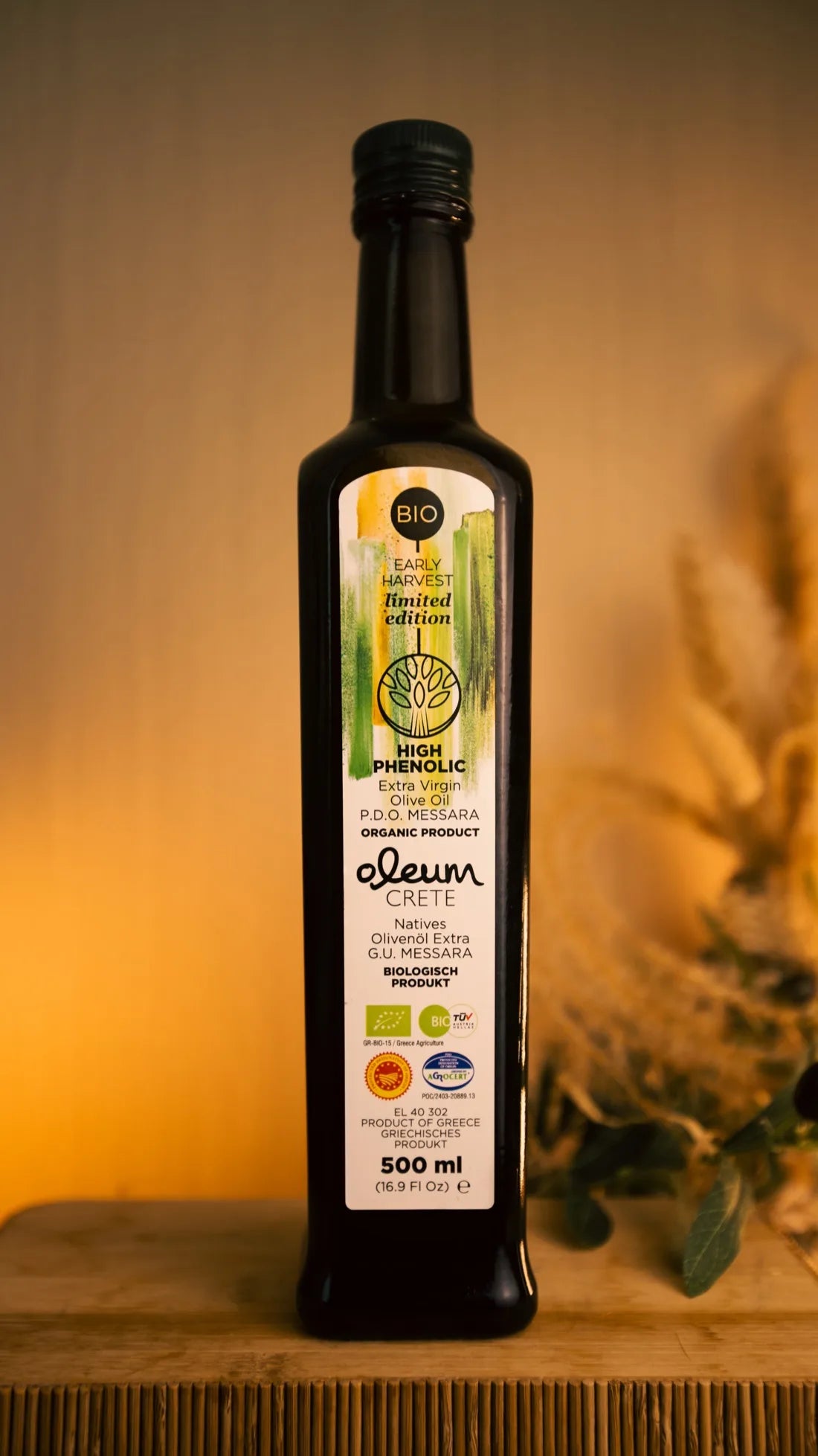
- Oleum Crete's Organic Early Harvest Olive Oil is a single-estate Koroneiki early harvest from the Messara Plain, picked by the Kidonakis family and pressed within the same day.
- Lower oil yield and earlier, hand-picked harvests are the main reasons early harvest costs more than a classic pressing.
- The price gap narrows when you measure cost per portion instead of per bottle, because early harvest oil is mostly used raw, in small drizzles, rather than poured into a frying pan.
- Early harvest is worth the extra if you use oil raw every day or to finish dishes. For high-volume cooking, the Classic is the smarter buy.
What Does 'Early Harvest' Actually Mean?
"Early harvest" describes one thing: when the olives come off the tree. It says nothing about the mill, the storage or the bottle. At Oleum Crete, most of the early harvest olive oil benefits people ask us about, from the sharper flavour to the different chemistry, start with that single decision about timing. The phrase is not a quality grade on its own, so it pays to know what sits behind it.
Green Olives vs Fully Ripe Olives at Harvest
An olive changes colour as it ripens. It starts green, turns a mottled violet as it begins to colour, then deepens to purple-black. Green fruit has not finished building its oil, so each olive gives less. It does carry the sharp, vegetal compounds that make a young oil taste of cut grass and leaf. Fully ripe fruit gives more oil, and the oil is softer, rounder and milder.
An early harvest oil is pressed from fruit at the green or just-turning stage. A classic or normal-harvest oil comes from fruit picked later, when yields are higher and the flavour has mellowed.
Why We Pick Early on the Messara Plain
Our olives grow on a single estate on Crete's Messara Plain, farmed by the Kidonakis family. Every tree is Koroneiki, the small-fruited Cretan variety, and every olive is picked by hand. Nothing is blended in from another grove, another variety or another valley.
For our Organic Early Harvest Olive Oil, we pick the Koroneiki fruit while it is still green and press it within the same day. Picked at dawn on the Messara Plain and pressed within hours, the oil keeps a brightness, green tomato, garden herb, a clean peppery finish, that most oils lose long before they reach the bottle. Each bottle carries PDO Messara protected designation of origin status, which ties the oil to this specific plain.
The Benefit Side: Early Harvest Olive Oil Benefits You Can Measure
Polyphenol Content and What the Research Actually Shows
Polyphenols are the reason most people look for a high polyphenol olive oil. The science on harvest timing is less tidy than the marketing suggests. In an industrial-scale study, researchers picked olives early and at normal ripeness from the same orchard and processed them under identical conditions. The normal-harvest oil actually scored higher for biophenols and sterols combined, 2,379 mg/kg against 1,981 mg/kg, and the authors found only small differences in phenolic compounds overall.
The lesson is simple. Picking early does not guarantee a high-polyphenol oil. Variety, orchard, milling speed and storage all count. That is why we test every batch and keep our lab analysis on file rather than printing a number we cannot stand behind. If you are thinking about olive oil as part of managing a health condition, speak to your doctor or a registered dietitian rather than relying on a bottle label.
The same study did find one clear compositional edge for early harvest: more alpha-tocopherol, or vitamin E, at 101.25 mg/kg against 86.35 mg/kg in the normal-harvest oil.
Flavour: Grassy Intensity vs Buttery Balance
Flavour is where early harvest differs most clearly. In the study, trained tasters scored the early-harvest oil higher for fruity-green flavour, bitterness and pungency. Ordinary consumers preferred it too, rating its colour, appearance and smell above the normal-harvest oil.
In the glass, early harvest Koroneiki tends towards cut grass, green leaf and herb, with a bitter edge on the tongue and a pepper catch at the back of the throat. A classic pressing is gentler: rounder, more buttery, with less bite. Neither is better. They do different jobs in the kitchen.
Acidity and Freshness Markers
Free acidity is measured as a percentage of oleic acid. A low figure signals sound fruit, handled gently and milled fast. Damage, delay and heat between tree and mill all push it up. Our One Day process moves every pressing from harvest to bottle within a day, so the fruit has little time to degrade.
Freshness also depends on the journey after pressing. Olive oil dislikes heat and light, and the UAE climate is hard on any bottle left in a hot warehouse or van. We deliver free across the UAE with no minimum spend, with temperature-controlled shipping.
The Cost Side: Why Early Harvest Costs More
Lower Oil Yield Per Kilo of Olives
The main reason is arithmetic. Green olives have not finished filling with oil, so each kilo of fruit gives less. In the same orchard study, the early-harvest olives produced significantly less oil than the normal-harvest fruit from the same trees. The grower pays to farm, pick and mill the same weight of olives and gets fewer litres back. Every bottle of early harvest carries that cost.
Earlier, More Labour-Intensive Picking
Green fruit holds to the branch more firmly than ripe fruit, and Koroneiki olives are small. Picking them by hand, tree by tree, takes time and skilled hands. A same-day pressing also means the mill has to run on the harvest's schedule rather than on its own. None of this is a markup. It is what it costs to make oil this way.
Price Per Bottle vs Price Per Use: The Real Comparison
Why Price Per Bottle Is the Wrong Metric
A 500ml bottle of early harvest and a 750ml bottle of classic sit side by side on a shelf, and the eye compares the two prices. That comparison assumes you will use both oils the same way and at the same rate. Most people don't. Early harvest is a finishing oil, used raw in small amounts. A classic organic extra virgin is an everyday oil that goes into pans, dressings and marinades in larger pours.
How Serving Size Changes the Maths
The table below works out portions per container at two portion sizes: an equal 15 ml tablespoon, and a typical portion for each oil's usual job. To find your own cost per portion, divide the current shelf price by the number of portions.
| Organic Early Harvest | Organic Extra Virgin (Classic) | Extra Virgin 5L Tin | |
|---|---|---|---|
| Size | 500ml | 750ml | 5 litres |
| Character | Green, bitter, peppery, single-estate Koroneiki | Balanced, everyday PDO organic | Kitchen and catering size |
| Typical job | Raw drizzle, finishing, spoonful on bread | Dressings, roasting, sautéing | High-volume cooking |
| Portions at 15 ml each | About 33 | About 50 | About 333 |
| Typical portion | 1 teaspoon (5 ml) drizzle | 2 tablespoons (30 ml) in a pan | 2 tablespoons (30 ml) in a pan |
| Portions at typical use | About 100 | About 25 | About 166 |
| Cost per portion | Shelf price ÷ 100 | Shelf price ÷ 25 | Shelf price ÷ 166 |
At equal portions, the early harvest bottle costs more per spoonful, and that is the honest starting point. At realistic use, a teaspoon drizzle against a two-tablespoon pour, the 500ml early harvest bottle lasts four times as many portions as the 750ml classic. The gap per use shrinks sharply. For more on the flavour and use differences, see our full comparison of Early Harvest versus Classic.
Who Should Pay More for Early Harvest?
Finishing Dishes and Everyday Raw Use
Early harvest earns its price when you use it raw, where its character survives. That suits you if you take a spoonful of oil on its own each morning, finish grilled fish or vegetables with a thread of green oil, or dip good bread into a saucer. In each case you get the full bitterness and pepper of a Koroneiki early harvest, with nothing lost to the heat of a pan.
It is also the bottle to choose for a curious cook who wants to taste what single-estate, single-day oil can be. For a gift, our Collection Premium Organic Olive Oil in its black bottle is made for presenting.
When the Classic Is the Smarter Buy
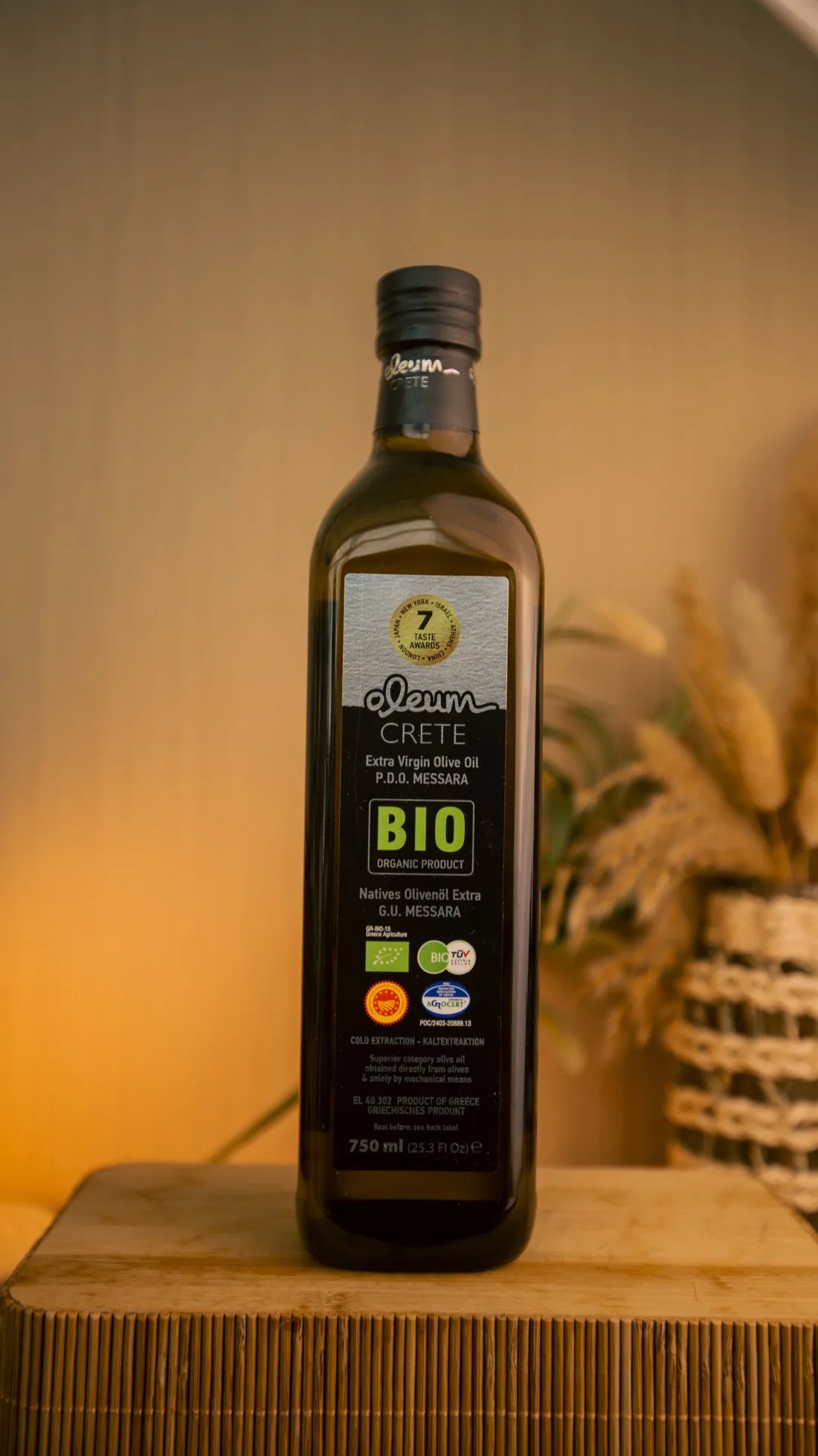
If most of your oil goes into cooking, the Classic serves you better. Roasting, sautéing and slow-cooked sauces use oil in volume, and heat softens the green intensity you would be paying extra for. Our Organic Extra Virgin Olive Oil 750ml is the same single-estate, PDO Messara, 100% Koroneiki oil, made for daily use. Large households and professional kitchens can step up to the 5L tin.
Many of our customers keep both: the Classic beside the hob, the Early Harvest on the table.
Is Early Harvest Olive Oil Worth It?
Yes, if you use it for what it does best. You pay more because green olives give less oil and take more work to pick, not because of a label. In return you get a bitter, peppery, green-fruited oil from a single estate, tested rather than marketed on guesswork. Used raw in small portions, it costs far less per use than its shelf price suggests. If your oil mostly goes into a hot pan, the extra spend buys you little, and the Classic is the better buy. Match the bottle to the job and the question answers itself.
Frequently asked questions
Does early harvest olive oil taste bitter?
Yes, a little, and that is by design. Bitterness and a peppery catch in the throat are typical of oil from green fruit, and tasters in a controlled comparison scored early harvest higher for both. In a well-made oil they sit in balance with fresh, grassy fruit rather than overpowering it.
How should I store early harvest olive oil to keep its character intact?
Keep the bottle sealed, upright, and somewhere cool and dark. Heat, light and air all break down the compounds that give the oil its character. In the UAE, that means away from the hob, sunny windowsills and the car, and with the cap closed between uses.
Can I cook with early harvest olive oil or should I only use it raw?
You can cook with it safely, but you will get the most from it raw. Heat mutes the green flavour and some of the delicate compounds you paid for. Most people keep early harvest for finishing and use a classic extra virgin for cooking.
How do I know a bottle's polyphenol figure is accurate and not a marketing claim?
Ask for the laboratory analysis behind the number, ideally tied to the harvest year or batch. Polyphenols decline as oil ages, so a figure measured long ago may not describe the bottle in front of you. A producer with nothing to hide will tell you how and when the figure was measured.
Is early harvest the same as first cold pressed?
No. Early harvest describes when the olives were picked. "First cold pressed" describes extraction: one pass through the mill with the temperature kept low. Most modern extra virgin oils are produced in a single extraction, so look for the harvest timing, harvest date and a polyphenol analysis instead.
Taste the difference for yourself: shop the Oleum Crete collection and choose the bottle that matches how you actually use oil.
Read next: Early Harvest Olive Oil Uses: 9 Ways to Use It Daily
More from the Journal
All entriesEarly Harvest Olive Oil Uses: 9 Ways to Use It Daily
Early harvest olive oil belongs on the table every day, not just on special occasions. Here are nine practical ways to use it, and the proof points that separate a genuine high-polyphenol Cretan oil from a marketing claim.

Olive Oil Harvest Date: How to Read Labels and Buy Fresh
Most bottles on UAE shelves hide the one date that actually matters. Here is the checklist we use ourselves to separate a genuinely fresh, single-estate oil from an old blend dressed up in a nice label.

Greek Olive Oil vs Italian and Spanish: What Sets Crete Apart
Most Italian and Spanish extra virgin olive oil is blended from several varieties, regions and harvest dates. Single-estate Cretan Koroneiki, pressed within a day of picking on the Messara Plain, takes a different path, and the polyphenol numbers show it.
