
Olive Oil Harvest Date: How to Read Labels and Buy Fresh
Most bottles on UAE shelves hide the one date that actually matters. Here is the checklist we use ourselves to separate a genuinely fresh, single-estate oil from an old blend dressed up in a nice label.

In this article7 sections
Key takeaways
- An olive oil harvest date tells you when the olives were picked and pressed. A best-before date tells you how long the producer expects the oil to hold, and it can sit far enough ahead to hide how old the oil already is.
- Oil starts losing its peppery, grassy character within months of pressing. A bottle without a harvest date on a UAE shelf is a guess, not a guarantee.
- Genuine PDO oil carries a certification mark tied to a named region, such as PDO Messara on Crete. The word "Greek" or "Product of Greece" on its own is not the same thing.
- Dark glass (deep green or amber) shields oil from light-driven oxidation. Clear glass, or a bottle displayed under bright retail lighting, is a warning sign.
- At Oleum Crete, we state the harvest date on every bottle we sell.
Why the Harvest Date Matters More Than Any Other Date on the Bottle
The olive oil harvest date is the most useful line on any label. It tells you when the fruit came off the tree and went through the mill, and that one fact predicts flavour, aroma and polyphenol content better than price, branding or a gold medal sticker. At Oleum Crete, we print the harvest date on every bottle. We want you to see exactly how young the oil is, not just how long the producer hopes it will last.
What a harvest date tells you that a best-before date does not
A best-before date is a forecast. The producer chooses it, and it says nothing about when the olives were grown or pressed. Two bottles with the same best-before date could hold oil from very different seasons.
A harvest date is a record, and under EU law it is tightly controlled. Only extra virgin and virgin olive oil may show a harvesting year at all. The year may appear only if 100% of the oil in the bottle comes from that single harvest (Regulation (EU) 2022/2104). So a stated harvest date also tells you the oil has not been blended across seasons to stretch an older stock.
The rules set the format too. The year must appear either as the marketing year, written like "2025/2026", or as the month and year of harvest, in that order. The "month" is legally the month the oil was extracted from the olives, so in practice it is a pressing date (EUR-Lex). The EU states plainly that harvest-year labelling exists to tell consumers how old the oil is. It allows the two-year form because the olive harvest usually begins in autumn and runs into the following spring (EUR-Lex).
How fast flavour and polyphenols actually fade
From the moment of pressing, oil is exposed to oxygen, light and heat, and it starts to change. The first things to soften are the bitterness on the tongue and the peppery catch at the back of the throat. Both come largely from polyphenols. Next, the green notes of cut grass, artichoke and green tomato drift towards something flatter and nuttier. Leave the oil long enough and it turns waxy and stale, the smell of old crayons that marks rancidity.
This is why the harvest date matters so much when you're judging freshness. EU Regulation 432/2012 sets a polyphenol threshold an olive oil must meet to carry the EU's approved health claim, and that threshold is easiest to meet soon after pressing, when polyphenol levels are at their highest. As the oil ages, the level falls, and with it the bright, peppery character that marks a genuinely fresh extra virgin oil.
The Olive Oil Label Checklist: Six Things to Check Before You Buy
Use these six checks at the shelf or on a product page. If you are ordering from home, our guide to verifying authenticity when buying single-estate oil online covers the extra steps for screens and photos.
1. Find the harvest date, not just a best-before date
Look for a harvest year, a marketing year such as "2025/2026", or a month and year. A label that shows only a best-before date leaves out the freshness information you most need.
2. Check the harvest year is recent, not several seasons old
A harvest date only helps if it is current. Buy oil from the most recent harvest available. A bottle from two or three seasons back may still be safe to cook with, but it will have lost much of what you are paying a premium for.
3. Look for a PDO or PGI certification mark and number
A protected origin mark ties the oil to a named, registered region and its rules. Look for the official EU symbol together with the full registered name, such as PDO Messara, rather than a loose reference to a country.
4. Check the bottle is dark glass, not clear
Deep green or amber glass protects oil from light. Clear glass looks attractive under shop lighting, and that same lighting is what damages the oil inside.
5. Confirm the olive variety and estate are named
A single variety and a named estate tell you someone is willing to stand behind one grove and one style. "Blend of olive oils" with no variety or source tells you very little. Our oils are 100% Koroneiki, hand-harvested on the Kidonakis family estate, with no blending.
6. Check for a 'produced and bottled by' address, not just 'imported by'
An importer's address tells you who shipped the bottle, not who made the oil. Under EU law, the place of origin on extra virgin or virgin oil covers the area where the oil was extracted as well as where the olives grew. If the olives were grown in a different country from the mill, the label must say so (Regulation (EU) 2022/2104). A full producer and bottler address lets you trace the oil back to its mill.
How to Read a PDO Certification Mark
PDO is one of the most misunderstood marks on an olive oil label. Many shoppers take it as a general quality badge. It is something more specific than that.
What PDO actually certifies
A Protected Designation of Origin links a product to one defined geographical area and a registered specification. For olive oil, that specification sets out where the olives may be grown and where the oil may be pressed and handled. A certifying body checks producers against it. In practice the mark is a promise about origin and method: this oil comes from this valley, made this way, and an independent body has checked.
PDO does not replace a harvest date. A PDO oil from an old season is still an old oil. The two marks answer different questions, and the strongest labels carry both. For the detail on our own region, we explain what the PDO Messara seal actually guarantees.
PDO Messara versus generic 'Product of Greece' labelling
"Product of Greece" tells you a country. PDO Messara tells you a plain in south-central Crete, with its own registered rules. That is a much narrower and more checkable promise. Phrases like "Greek style", "Mediterranean blend" or a flag on the front carry no certification at all.
When you see a PDO claim, look for three things together: the official EU PDO symbol, the full registered name of the region, and a producer you can identify. Our oils carry PDO Messara alongside EU Organic and TÜV Austria certification, and every bottle comes from a single estate in a single valley.
Why Bottle Colour Is Part of the Freshness Story
A recent harvest date gives you a fresh start, and the bottle decides how well that freshness holds. Bottle colour in olive oil is not about looks. It is about how much light reaches the oil.
How light degrades olive oil
Light, especially under bright shop lighting or near a window, drives oxidation in olive oil. It speeds the breakdown of the compounds that give oil its aroma and its peppery bite, and it pushes the flavour towards stale. Dark green or amber glass filters out much of that light; an opaque tin blocks it entirely.
Light is only one part of it. Heat and air matter just as much, and in the UAE heat is the bigger risk once a bottle is home. Our guide to the storage mistakes that undo a fresh harvest date covers cupboard placement, cooker heat and how long to keep a bottle once opened.
What to do if your oil only comes in clear glass
If a favourite oil only comes in clear glass, buy the smallest size you will use quickly. Avoid bottles from the front of a brightly lit shelf. Keep it in its box or in a dark cupboard, away from the hob and the oven, or decant it into a clean, dark, airtight container. These steps slow the damage. They do not undo light exposure the oil has already had in transit or on display.
Harvest Date vs Best-Before: A Side-by-Side Comparison
Here is the best before vs harvest date question at a glance.
| Harvest date | Best-before date | |
|---|---|---|
| What it records | When the olives were harvested and the oil extracted | How long the producer expects the oil to keep its quality |
| Who decides it | Fixed by the harvest itself | Chosen by the producer |
| EU format | Marketing year (e.g. "2025/2026") or month and year of harvest | A future date |
| Rule on blending | Allowed only if 100% of the oil is from that one harvest | No information on blending |
| What it tells you about age | Directly how old the oil is | Nothing on its own |
| Best use when shopping | Comparing freshness between bottles | Knowing roughly when to finish the bottle |
The EU details in the table come from Regulation (EU) 2022/2104. Read the two dates together. The olive oil harvest date tells you where the oil's life began, and the best-before date tells you where the producer expects it to end.
What a Genuinely Fresh Label Looks Like
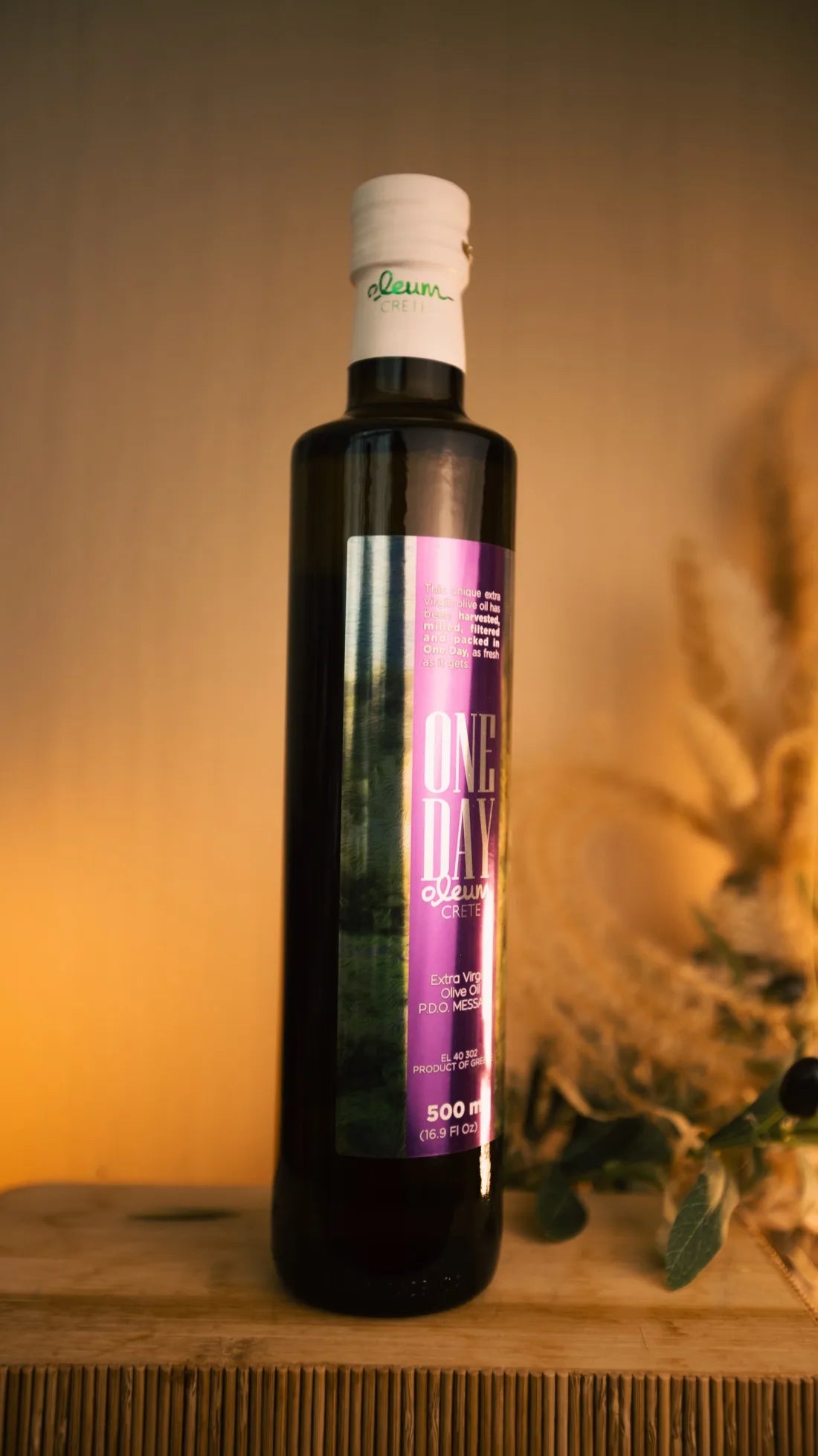
A checklist only becomes useful when you can see it on a real bottle. Our One Day Extra Virgin Olive Oil is built around a single idea: olives picked on the Messara Plain and pressed within a day. We state the harvest date on every bottle because that is the proof of the promise. The label also names the variety (100% Koroneiki), the estate (the Kidonakis family), and the PDO Messara designation, and it sits in dark glass.
Poured fresh, the oil tastes of green tomato and garden herb, with a clean peppery finish that tells you the brightness is still there. That is what a label built around an honest harvest date should let you taste, not just read.
Many mass-market bottles on UAE shelves show a best-before date and no harvest date. They say "packed in" or "imported by" rather than naming a producer and mill. They describe the oil as a blend of oils from several countries, with no variety named. Some sit in clear glass under bright lights. Some print "low acidity" on the front. Under EU rules, a label may state maximum acidity only alongside the maximum peroxide, wax and UV absorption values, in the same print size and the same part of the label. The acidity figure must also be the value expected at the best-before date, not on harvest day (EUR-Lex). A lone "low acidity" boast falls short of that standard.
None of this proves a bottle is bad. It means the label is not giving you enough information to judge.
Frequently asked questions
Is it legal to sell olive oil without a harvest date in the UAE?
Bottles without a harvest date are widely sold on UAE shelves. In EU law, the harvest year is a tightly controlled statement that producers may make under strict conditions, not a line every bottle carries. Treat a missing harvest date as a freshness question rather than a legal one: without it, you cannot tell how old the oil is.
How long does extra virgin olive oil stay fresh after the harvest date?
It depends on how the oil was made and stored. Oil kept sealed, cool and dark holds its character far longer than oil left in clear glass or a warm kitchen. Once a bottle is open, air speeds the decline, so buy a size you will finish while the pepper and green notes are still vivid.
Does a dark bottle guarantee the oil inside is fresh?
No. Dark glass protects oil from light, but it cannot make an old harvest young or reverse heat damage in transit. Use bottle colour together with a recent harvest date and a named producer.
Can olive oil still be good to use after its best-before date?
Often, yes, for cooking, provided it smells clean and not waxy or stale. It will have lost much of its aroma, bitterness and peppery finish, which is most of what makes a premium extra virgin oil worth drizzling raw. Taste a little on its own first.
Why do some bottles show a harvest date range instead of a single date?
The olive harvest usually starts in autumn and runs into the following spring, so EU rules allow a two-year marketing year such as "2025/2026". The alternative is the month and year of extraction. Both are legitimate, and both mean all the oil comes from that one harvest.
Once you know what a genuine harvest date and PDO mark look like, put the checklist to use. Shop the Oleum Crete collection and see a harvest date stated on every bottle, pressed on the Messara Plain and delivered across the UAE.
More from the Journal
All entriesEarly Harvest Olive Oil Uses: 9 Ways to Use It Daily
Early harvest olive oil belongs on the table every day, not just on special occasions. Here are nine practical ways to use it, and the proof points that separate a genuine high-polyphenol Cretan oil from a marketing claim.

Greek Olive Oil vs Italian and Spanish: What Sets Crete Apart
Most Italian and Spanish extra virgin olive oil is blended from several varieties, regions and harvest dates. Single-estate Cretan Koroneiki, pressed within a day of picking on the Messara Plain, takes a different path, and the polyphenol numbers show it.

Early Harvest Olive Oil Benefits: Is It Worth Paying More?
Early harvest costs more for a reason that shows up in a lab report, not a slogan. Here is the cost-versus-benefit case for Oleum Crete's Organic Early Harvest bottle, set against the Classic, in numbers a shopper can actually check.
