
Cretan Olive Oil vs Mainland Greek: What Really Differs
Cretan olive oil and mainland Greek olive oil share a flag but rarely share a bottle. Oleum Crete breaks down the soil, the variety, the certification and the harvest timing that actually separate the two, so you can read a label with confidence rather than guessing from the word 'Greece'.

In this article8 sections
Key takeaways
- In the Cretan olive oil vs Greek mainland comparison, the clearest difference is focus. Cretan oil tends to come from a single plain and a single variety, Koroneiki. Mainland Greek oil often blends Koroneiki with Athinolia, Manaki or Lianolia from several regions.
- PDO Messara certification legally ties an oil to the Messara Plain in south-central Crete and, under its own specification, to Koroneiki. A mainland PGI blend cannot offer that same guarantee.
- Harvest-to-press timing matters as much as region. The shorter the gap between picking and pressing, the more aroma and polyphenols survive in the finished oil.
- Cretan Koroneiki oils lean towards peppery, green-tomato intensity. Many mainland Greek blends taste milder and more buttery, a result of warmer lowland groves and later harvest dates.
- Check the label for PDO or PGI status, variety, harvest date and acidity percentage. "Product of Greece" on its own tells you very little.
Cretan Olive Oil vs Mainland Greek Oil: The Short Answer
The real difference between Cretan olive oil and mainland Greek oil comes down to three things: where the olives grow, which variety they are, and how quickly they reach the press. At Oleum Crete, we work from the Messara Plain in south-central Crete, pressing single-variety Koroneiki under PDO Messara certification, which binds the oil to that valley and that cultivar. Much mainland Greek oil is good, but it is often a blend of varieties and regions, bottled under a broader label.
Neither origin is automatically better. A late-harvest mainland blend and an early-harvest Cretan single-estate oil are simply different products. The questions worth asking are about traceability, freshness and flavour, and the sections below take each one in turn.
Terroir: Why the Messara Plain Grows a Different Olive
Long before an olive reaches the mill, its character is already set by soil, sun and water. Greece is a country of many microclimates, and its olive regions differ sharply.
Crete's limestone soil and Mediterranean microclimate
The Messara is the largest plain on Crete. It lies between the Psiloritis massif to the north and the Asterousia mountains to the south, opening west towards the Libyan Sea. The soils are limestone-rich and free-draining, so the trees send roots deep and the fruit develops under steady stress rather than abundance.
Long, dry summers and strong southern light concentrate flavour in the olive. Sea air moderates the extremes. The result is fruit with a dense, green intensity, and a grove that rewards hand-harvesting at the right moment rather than mechanical shaking at the end of the season.
Mainland Greece's varied terrains, from the Peloponnese to Macedonia
Mainland Greece covers far more ground and far more variation. The Peloponnese, with Messinia and Laconia, holds some of the country's most important groves. Further north, Epirus, Central Greece and Macedonia bring cooler winters, different rainfall and different soils.
That variety is a strength for Greek agriculture, but it makes "Greek olive oil" a broad category. A bottle labelled only as Greek may combine fruit from hillside groves, lowland plains and several climates. That is why the region on the label matters more than the country.
Variety: Single-Estate Koroneiki vs Mainland Blends
Variety shapes flavour, polyphenol potential and how an oil ages in the bottle. Here the Cretan and mainland approaches part ways most clearly.
Why Crete favours Koroneiki almost exclusively
Koroneiki is a small olive with a high ratio of skin to flesh, which gives it a naturally high level of polyphenols and a bright, peppery profile. The tree tolerates heat and drought well, which suits the Messara's dry summers. It is the variety we press at Oleum Crete, with no blending across groves, regions or seasons.
How mainland producers blend Athinolia, Manaki and Lianolia
Mainland Greece grows a wider range of native varieties. Athinolia is associated with Laconia, Manaki with the Peloponnese, and Lianolia with the north-west. Koroneiki is widely planted on the mainland too, especially in the Peloponnese.
Blending these varieties lets producers balance flavour and keep a consistent house style from year to year. The trade-off is traceability. When an oil combines several varieties from several regions, you cannot taste one place or one cultivar in the glass. A single-variety olive oil gives you that clarity. A blend gives you an average.
PDO and PGI: What Certification Actually Guarantees
The EU created the PDO and PGI framework in 1992 to protect traditional regional foods, updating it under Regulation No 510/2006 and consolidating the rules under Regulation No 1151/2012, which still governs the system today. For olive oil, two labels matter most: PDO (Protected Designation of Origin) and PGI (Protected Geographical Indication).
What PDO Messara ties to the Messara Plain
A PDO is a full-chain guarantee. The olives must be grown in the designated area, the oil must be extracted there, and it must be bottled there. Every step from grove to bottle happens inside the protected zone.
Each PDO specification can also set permitted varieties, maximum acidity, minimum polyphenol content in some cases, harvest timing and expected sensory profile. In Greece, the Ministry of Rural Development and Food oversees PDO and PGI certification.
PDO-GR-0973 Messara was registered on 12 October 2013. For oil from this plain, it ties each bottle to the Messara Plain and, in practice, to Koroneiki. A broader label cannot make that promise.
Where PGI Crete and PGI Greek oils differ
Crete has also gained an island-wide designation, PGI Kriti, listed in the EU's Geographical Indications Register in September 2025. Supporters argue the registration gives Cretan oil international commercial promotion and legal protection against unfair competition, with the European Commission itself able to act on disputes. Its architect expects PGI Kriti to increase the amount of oil bottled and branded on the island, so Cretans capture more of the added value than when oil is sold in bulk and bottled elsewhere.
A PGI covers a wider area than a PDO and follows its own specification. Mainland PGI oils follow theirs. An oil with no designation at all, sold simply as "Product of Greece", carries no regional specification of any kind.
| PDO Messara | PGI Kriti | Mainland PGI | "Product of Greece" only | |
|---|---|---|---|---|
| Area covered | The Messara Plain, south-central Crete | Island of Crete | A defined mainland region | Anywhere in Greece |
| Grown, pressed and bottled in the zone | Yes, every step | Set by its specification | Set by its specification | No requirement |
| Variety rule | Koroneiki | Set by its specification | Set by its specification, may allow blends | None |
| Registered | 12 October 2013 | September 2025 | Varies | Not applicable |
| Official oversight | Ministry of Rural Development and Food | Ministry of Rural Development and Food | Ministry of Rural Development and Food | General grading rules only |
The takeaway is simple. The narrower the designation, the more the label tells you.
Harvest Timing and Polyphenols: Crete's Early Harvest Edge
Certification tells you where an oil comes from. It does not tell you how fresh the fruit was when it was pressed. That depends on harvest date and mill speed.
Why harvest-to-press time matters more than the map
Once an olive leaves the branch, it starts to oxidise. Bruised fruit left waiting in sacks loses aroma and polyphenols, and the oil's acidity creeps up. The shorter the gap between tree and press, the more of the fruit's character survives. At Oleum Crete, we pick by hand and press quickly for exactly this reason.
How polyphenol levels differ between early and late harvest oils
Early harvest olive oil comes from greener fruit. That fruit yields less oil, but it is richer in polyphenols, the compounds behind bitterness, pungency and stability in the bottle. Late-harvest fruit is riper and gives more oil, with softer flavour and typically lower polyphenol levels.
Many mainland blends are pressed from riper fruit later in the season, which suits a milder house style. Koroneiki picked early on the Messara sits at the other end of the scale, which is why early-harvest oil is prized by anyone chasing the full green intensity of the fruit.
Taste in the Glass: Cretan vs Mainland Flavour Profiles
The easiest way to understand the difference is to pour two oils side by side. Warm a little of each in a small glass, cupped in your hand, then smell, sip and draw in some air.
Peppery, green-tomato intensity from Crete
Early-harvest Cretan Koroneiki opens with green tomato leaf, fresh-cut grass and artichoke. Garden herbs follow, sometimes with green almond. There is a measured bitterness on the tongue and a peppery catch at the back of the throat that can make you cough. That catch is a sign of polyphenols, not a flaw.
This profile holds up to grilled vegetables, pulses, bitter leaves and a finishing drizzle over soup.
Milder, buttery notes common in mainland blends
Many mainland Greek blends taste rounder and softer. Expect ripe fruit, butter, almond and a gentle finish with little bite. Riper fruit, later picking and gentler varieties all contribute to this style.
These oils suit delicate fish, baking and dishes where you want olive oil in the background. A peppery Koroneiki is the choice when you want the oil itself to be tasted.
Buying Guide: What to Check Before You Choose
In a UAE supermarket or online, Greek bottles can look alike. The label is where the real differences show, and it takes less than a minute to read.
Four things to read on the label
- Designation. Look for PDO or PGI and the name of the area. PDO Messara is among the most specific designations available. "Product of Greece" alone tells you only the country.
- Variety. A single named variety, such as 100% Koroneiki, means no blending. If no variety is named, assume a blend.
- Harvest date. This matters more than a best-before date, which can sit well after the oil has peaked.
- Acidity percentage. Lower free acidity points to healthy fruit pressed quickly. Producers who are proud of their numbers print them.
Look for independent recognition too. EU Organic certification, TÜV Austria verification and results from competitions such as NYIOOC are assessed outside the producer, which makes them a useful check against the label's own claims.
When single-estate Cretan oil is worth the extra cost
Single-estate olive oil tends to cost more than a supermarket blend. Hand-harvesting, quick pressing and lower early-harvest yields all add cost, and so does certification. Whether that is worth paying depends on how you use the oil: raw, where its flavour is the point, or as a background cooking oil, where a milder blend may suit you just as well.
Heat is a separate concern in the UAE. An oil that sits in a hot warehouse or delivery van loses freshness quickly, whatever its origin. Whichever oil you choose, ask how it has been stored and shipped, not just where it was grown.
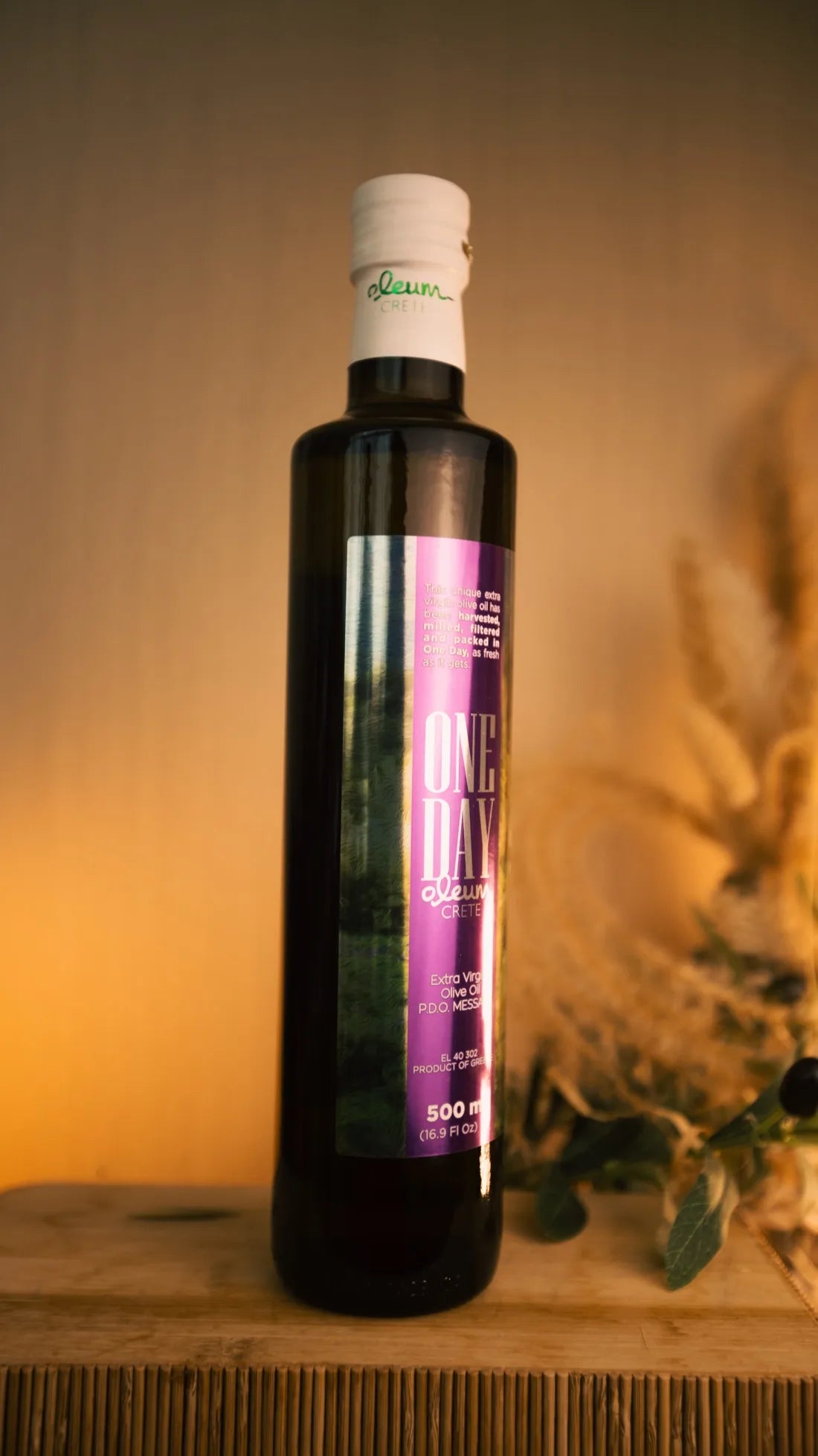
Related: How Greek oil compares with Italian and Spanish producers · Kidonakis family's four generations on the Messara Plain · One Day Extra Virgin Olive Oil
Frequently asked questions
Is Cretan olive oil better than mainland Greek olive oil?
Not by default. A PDO, single-variety, early-harvest Cretan oil offers more traceability and usually more intensity than an unlabelled blend. A well-made mainland oil with a clear designation and harvest date can also be excellent. Judge the bottle, not the map.
What is PDO Messara and how does it differ from other Greek PDOs?
PDO Messara is the protected designation for olive oil from the Messara Plain in south-central Crete, registered on 12 October 2013. Like every PDO, it requires the olives to be grown, pressed and bottled inside its zone. Each Greek PDO has its own specification covering area and permitted varieties, and the Messara specification centres on Koroneiki.
Does all Greek olive oil come from Koroneiki olives?
No. Koroneiki is the most widely planted oil variety in Greece and dominates in Crete, but the mainland also grows Athinolia, Manaki, Lianolia and others. Many mainland oils blend several of these. If the label does not name a single variety, the oil is likely a blend.
Why is Cretan olive oil often more expensive than mainland Greek oil?
Prices vary by producer rather than by island, but single-estate Cretan oil tends to cost more for practical reasons. Hand-harvesting, early picking with lower yields, quick pressing and PDO certification all add cost. You are paying for traceability and freshness, which a bulk blend does not offer.
Can you tell Cretan oil from mainland Greek oil by taste alone?
Often, but not always. Early-harvest Cretan Koroneiki usually shows green tomato, artichoke and a strong peppery finish, while many mainland blends taste milder and more buttery. Harvest date and storage can blur those lines, so read the label as well as tasting.
Taste the difference for yourself: explore Oleum Crete's single-estate, PDO Messara range and see how the Messara Plain compares to the oils you already know.
Read next: Cold Pressed Olive Oil vs Regular: What the Label Really Means
More from the Journal
All entriesKoroneiki Olive Oil and Heart Health: What Studies Show
Koroneiki olive oil carries some of the highest polyphenol counts of any olive variety, and that matters for heart health. We look at what the research actually shows, what the EU health claim permits us to say, and how much oil delivers it.

Olive Oil Acidity Level: How to Check Before You Buy
Acidity is the one number most shoppers skip past on an olive oil label, yet it decides whether a bottle can legally call itself extra virgin. Here is how to find it, read it and check it against the PDO Messara standard before you buy.

How Much Olive Oil Should a Family of Four Buy Monthly?
Most households either run out of olive oil mid-month or let a bottle oxidise on the shelf. Here is a concrete monthly estimate for a family of four, broken down by cooking, salads and daily shots, mapped straight onto Oleum Crete's 500ml, 750ml and 5L sizes.
