
How Much Olive Oil Should a Family of Four Buy Monthly?
Most households either run out of olive oil mid-month or let a bottle oxidise on the shelf. Here is a concrete monthly estimate for a family of four, broken down by cooking, salads and daily shots, mapped straight onto Oleum Crete's 500ml, 750ml and 5L sizes.

In this article7 sections
Key takeaways
- At Oleum Crete, our rule of thumb for how much olive oil to buy is simple: a family of four cooking most meals at home works through 1.5 to 2.5 litres a month once cooking, salads and daily shots are counted together.
- A 750ml bottle used mainly for cooking and salads lasts an average household about two to three weeks, so two bottles a month is a realistic baseline.
- Households that take a daily olive oil shot or dress every salad in oil use noticeably more, often closer to 2.5 litres a month.
- The 5L tin suits households using 1.5 litres or more a month. It means fewer reorders and less packaging per litre than repeat 500ml or 750ml bottles.
- Opened extra virgin olive oil tastes best within roughly four to eight weeks, and in UAE kitchens the shorter end of that window applies. Buying amounts you will finish in time matters more than buying in bulk.
How Much Olive Oil to Buy for a Family of Four Each Month
A family of four that cooks most meals at home needs between 1.5 and 2.5 litres of extra virgin olive oil a month. That is the honest answer to how much olive oil to buy. Where you land in that range depends on three habits: how much you cook with it, how often you dress food raw, and whether anyone takes a daily shot.
The lower end, around 1.5 litres, fits a household that cooks with olive oil every day and dresses a salad most evenings. The upper end fits a household that does all of that and also has one or two adults taking oil neat each morning. Families who fry, roast and finish with olive oil at every meal can go higher.
Two common rules of thumb support this range. A widely cited guideline, based on European food safety advice, puts a healthy daily intake at about 30ml (two tablespoons) per person across cooking and dressing. That works out to roughly 900ml per person per month. Not everyone in a family of four eats at that level, especially younger children, so real family olive oil consumption usually sits well below the four-person maximum of 3.6 litres. The second rule: two adults who cook regularly tend to get through a 500ml bottle in about two weeks. Double the household and you are close to 2 litres a month.
Breaking Down Where the Oil Goes
The headline figure only helps if it matches your kitchen. The easiest way to check is to split your olive oil consumption into three parts and estimate each one. A tablespoon is about 15ml, which makes the maths quick.
Cooking: Sautéing, Roasting and Finishing
Cooking is the largest share for most families. A typical dinner might take a tablespoon to soften onions and garlic, another to roast a tray of vegetables, and a final thread over the plate before it reaches the table. Two to three tablespoons a day comes to about 30 to 45ml, or roughly 0.9 to 1.35 litres a month.
Good extra virgin olive oil handles everyday sautéing and roasting well. Many households keep one bottle by the hob for cooking and a brighter oil for finishing. Our One Day oil, picked at dawn on the Messara Plain and pressed within hours, is the one we reach for at the end of a dish: green tomato, artichoke, a clean peppery catch at the back of the throat.
Salads and Raw Dressing
Raw use adds up quietly. A dressed salad for four takes around two tablespoons of oil. Make one four or five times a week and you use about half a litre a month. That figure rises quickly if your table also includes hummus, labneh or fattoush finished with a generous pour, or bread for dipping.
Raw use is where freshness shows most. Heat softens an oil's character, but a raw drizzle tastes exactly as the bottle does. That is why it pays to finish each bottle while it is still vivid.
Daily Olive Oil Shots
Shots are the factor that moves a household from the middle of the range to the top. If two adults each take a tablespoon every morning, that alone is 30ml a day, or about 900ml a month. Before you settle on a routine, read our guide on how much olive oil to take as a daily shot.
For shots, polyphenol content is what matters, which is why we press our Organic Early Harvest oil earlier and for a shorter window: more bitterness, more peppery bite, more of the compounds that carry the EU-approved olive oil polyphenol claim.
Add the three parts together:
- Cooking only, salads occasionally: about 1 to 1.5 litres a month
- Cooking plus regular salads: about 1.4 to 1.85 litres a month
- Cooking, salads and two daily shots: about 2.3 to 2.75 litres a month
Matching Bottle Sizes to Monthly Use
Once you know your monthly figure, choosing between olive oil bottle sizes in the UAE becomes simple. One useful sizing rule holds that at 30ml a day, a 500ml bottle lasts two to three weeks and a 1L bottle about five. The point is to match the container to how fast you actually pour.
| Monthly use | Typical household | Best fit from our range | How it plays out |
|---|---|---|---|
| Under 1 litre | Couples, light cooks, occasional salads | 500ml One Day or Organic Early Harvest | One or two bottles a month, each finished while fresh |
| 1 to 1.5 litres | Small family, daily cooking | 750ml Organic Extra Virgin | Two bottles a month, each lasting two to three weeks |
| 1.5 to 2.5 litres | Family of four, cooking and salads, some shots | Two to three 750ml bottles, or the 5L tin decanted | Steady supply without running short mid-month |
| Over 2.5 litres | Large families, keen cooks, daily frying and finishing | Extra Virgin Olive Oil 5L Tin | One tin lasts about two months |
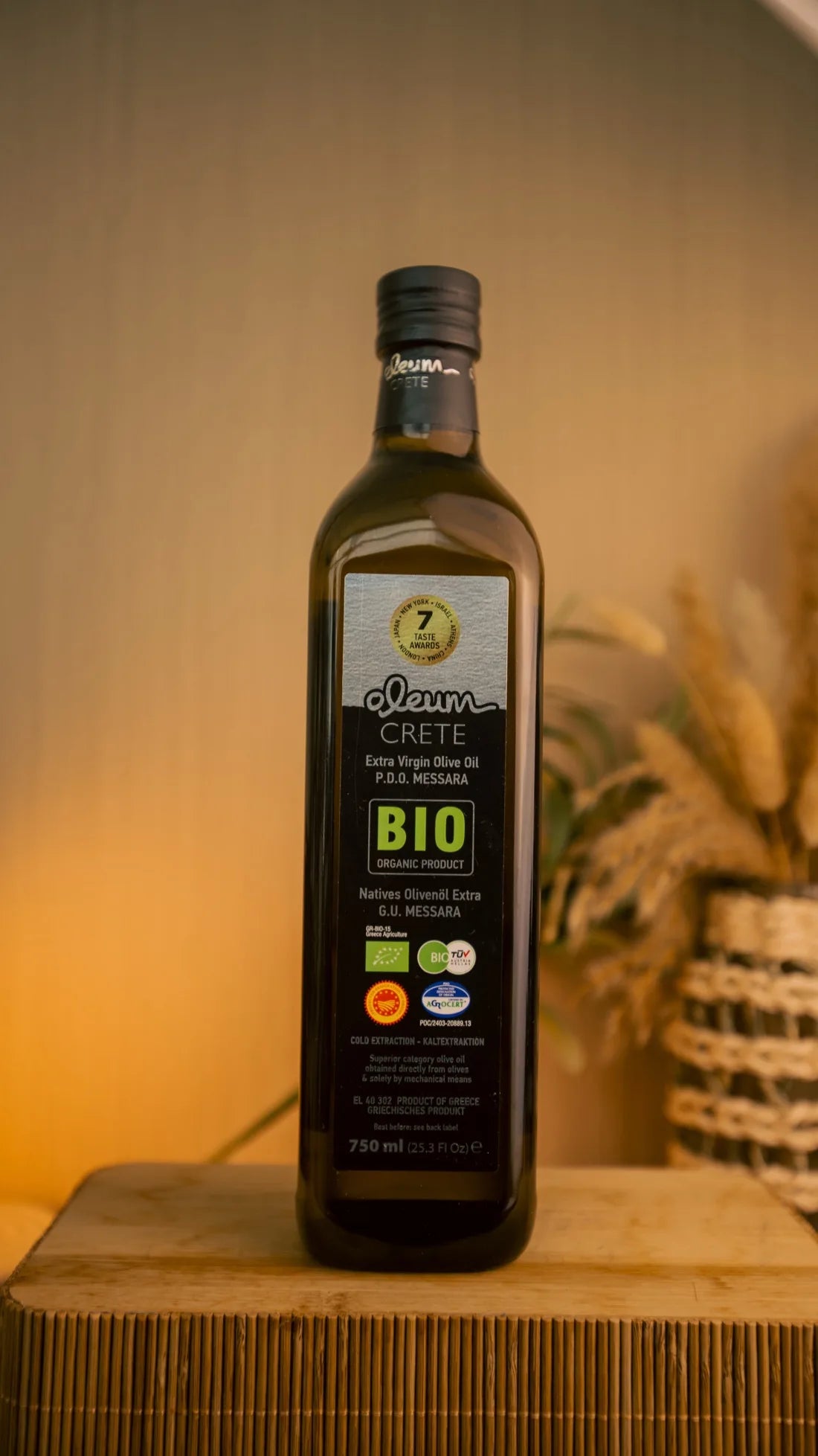
For most families of four, the everyday 750ml PDO bottle is the natural starting point. It is certified EU Organic and carries PDO Messara status, pressed from Koroneiki olives grown on a single estate in the valley. Two bottles a month covers the baseline. If you regularly open a third, it is time to consider the tin.
When the 5L Tin Makes More Sense Than Bottles
The rule is straightforward. If your household reliably uses 1.5 litres or more a month, the olive oil 5L tin is worth a look. Below that, bottles keep the oil fresher.
Signs You Are a 5L Household
- You order two or more 750ml bottles every month and still occasionally run out.
- Someone in the house fries, roasts or bakes with olive oil daily.
- Two or more adults take a daily shot on top of regular cooking.
- You host often, whether for weekend lunches, family gatherings or iftar during Ramadan.
- You cook in batches or run a small catering kitchen.
If three or more of these apply, your family olive oil consumption probably sits at 2 litres a month or above. At that rate a 5L tin is finished in two to three months.
Why Fewer, Larger Orders Beat Frequent Small Ones
A tin means fewer reorders and much less glass and packaging per litre. It also blocks light completely, which glass cannot fully do. For an extra virgin oil, light is one of the main causes of lost flavour.
The trade-off is air. As the tin empties, more oxygen sits above the oil. General freshness advice warns against one large container that sits half-empty for months, but notes that a 5L tin works well when decanted into smaller daily-use containers. So when you open the tin, fill two or three small dark bottles to the brim, seal them, and keep the tin closed in the coolest cupboard you have. Use one bottle at a time.
Cost per litre is part of the decision for many buyers. For the wider picture, our guide to what actually drives olive oil pricing in the UAE explains how harvest timing, certification and format shape what you pay.
Lighter Households and Gift Bottles: When Smaller Sizes Win
Not every kitchen needs litres. For smaller households and gift buyers, the answer to how much olive oil to buy is usually less, and more often.
Couples and Small Households
A couple who cooks a few nights a week and dresses the odd salad may use well under a litre a month. For them, a 500ml bottle is the right size. It is finished inside the freshness window, so the last spoonful tastes almost as bright as the first.
Within our 500ml range, the choice depends on how you use it. One Day Extra Virgin Olive Oil is picked at dawn and pressed within hours, and suits finishing, dipping and raw dressing. Organic Early Harvest is the greener, more peppery pressing, and the one we suggest for a morning shot.
Buying for Gifting Rather Than Daily Use
A gift bottle needs to look the part and stay good until the recipient opens it. A 500ml size does both. It is generous without leaving someone with more oil than they can finish while it is at its best.
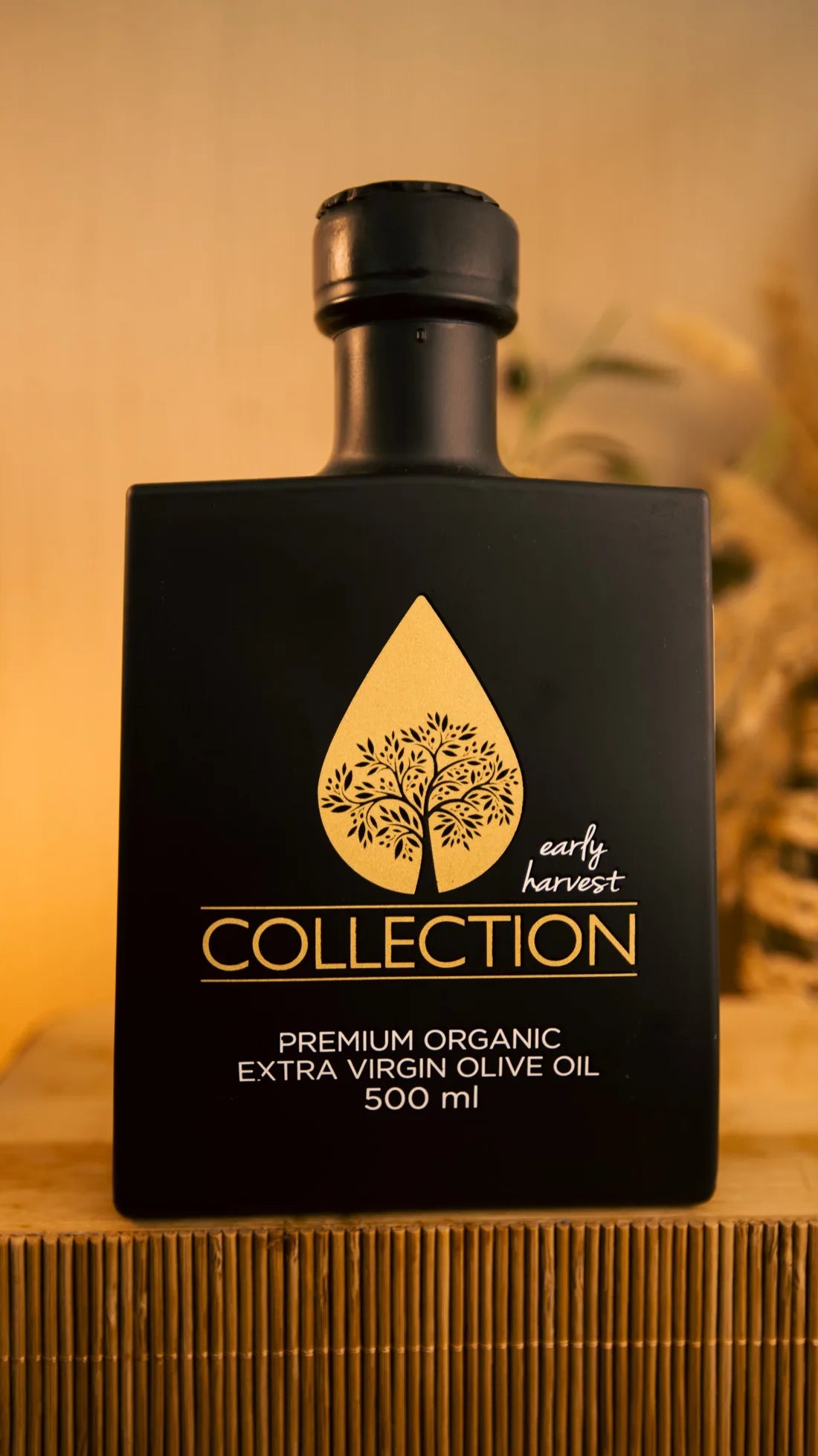
For gifting we recommend the Collection Premium Organic Olive Oil in the signature black bottle. The opaque black glass protects the oil from light, and the presentation suits a host gift or a present for anyone who loves Mediterranean food. It comes from a single family estate on the Messara Plain, hand-harvested, and recognised at international competitions including NYIOOC.
Avoiding the Two Common Mistakes: Running Short and Wasting Oil
An estimate is only a starting point. After a month or two, your own kitchen will show whether you guessed right.
Signs You Under-Bought
- You run out a week or more before your next order arrives.
- You find yourself rationing the good oil or switching to another fat mid-month.
- Salads go undressed or shots get skipped because the bottle is nearly empty.
If this happens, move up one band in the table. That might mean adding a third 750ml bottle or switching to the 5L tin.
Signs You Over-Bought
- An opened bottle has been on the counter for more than six weeks.
- The peppery finish has faded and the oil tastes flat.
- The aroma has turned waxy or stale rather than green and fruity.
Peak flavour in opened extra virgin olive oil generally lasts 30 to 60 days, though it stays usable for some months after that. In Dubai conditions, local guidance recommends using an opened bottle within four to six weeks for the best freshness, and within three months at most, even when it is tightly sealed and kept dark.
Storage Habits That Change the Numbers
Heat and light shorten every timeline above. Dubai Municipality guidance states that oils should not be stored above 30°C. UAE-focused advice sets a tighter ideal of 14 to 18°C and recommends refrigeration when your kitchen regularly goes above 28°C. A bottle kept beside the hob or on a sunny windowsill can lose its flavour within weeks.
Storage also affects polyphenols, not just taste. In one set of measurements, a high-polyphenol oil starting at about 950mg/kg fell to around 640mg/kg over 18 months when kept dark, cool and sealed. With poor storage it fell to around 380mg/kg, losing more than half.
Unopened oil keeps longer. It generally holds its best quality for 18 to 24 months from harvest in a cool, dark place. In Dubai conditions, 12 to 14 months is the more realistic peak. Check the harvest date rather than the best-before date. We ship every order temperature-controlled within 24 hours, so the oil reaches you in the condition it left the estate.
Frequently asked questions
How long does an opened bottle of olive oil stay fresh once you start using it?
Opened extra virgin olive oil is at its best for roughly 30 to 60 days. In UAE kitchens, aim to finish it within four to six weeks, and no later than three months even with careful storage. Choose a bottle size you can finish inside that window.
Does storing olive oil in the fridge make a bottle last longer?
For a bottle in daily use, refrigeration is usually unnecessary if you can keep it somewhere cool and dark. The International Olive Council recommends a steady room temperature of roughly 14 to 21°C. Refrigeration helps most when your kitchen regularly runs hot, or for decanted portions of a bulk tin. Chilled oil may turn cloudy, but it clears again at room temperature.
Is a 5L tin cheaper per litre than buying several smaller bottles?
The tin means fewer orders and much less packaging per litre, and it is the format designed for heavier use. Compare current per-litre prices across the range on our collection page before you decide. Value only holds if you finish the oil while it is fresh, so the tin pays off for households using 1.5 litres or more a month.
Can the same bottle be used for both cooking and finishing dishes?
Yes. Good extra virgin olive oil works for sautéing, roasting and raw finishing alike, and our everyday 750ml PDO bottle is made for exactly that. Some households still keep a 500ml One Day bottle for finishing, where its green tomato and herb notes come through most clearly.
How should olive oil be stored at home to avoid waste in the UAE climate?
Keep it in a dark cupboard away from the hob, ovens and windows, and close the cap after every use. Ideally the oil should sit between 14 and 18°C and never above 30°C. If your kitchen regularly goes above 28°C, refrigerate it. If you buy the 5L tin, decant it into small, full, sealed dark bottles.
Work out which size fits your household, then shop the full Oleum Crete range and have single-estate PDO Messara oil delivered free anywhere in the UAE, with no minimum spend.
More from the Journal
All entriesKoroneiki Olive Oil and Heart Health: What Studies Show
Koroneiki olive oil carries some of the highest polyphenol counts of any olive variety, and that matters for heart health. We look at what the research actually shows, what the EU health claim permits us to say, and how much oil delivers it.

Olive Oil Acidity Level: How to Check Before You Buy
Acidity is the one number most shoppers skip past on an olive oil label, yet it decides whether a bottle can legally call itself extra virgin. Here is how to find it, read it and check it against the PDO Messara standard before you buy.

What Drives the Price of Koroneiki Olive Oil in the UAE?
A bottle of Koroneiki olive oil can cost three times as much as the one next to it on the shelf, and the gap is rarely random. Harvest date, certification, shipping method and bottle size each add real cost, and knowing which ones matter helps you tell a fair price from an inflated one.
