
Olive Oil Acidity Level: How to Check Before You Buy
Acidity is the one number most shoppers skip past on an olive oil label, yet it decides whether a bottle can legally call itself extra virgin. Here is how to find it, read it and check it against the PDO Messara standard before you buy.

In this article7 sections
Key takeaways
- The olive oil acidity level for extra virgin must not exceed 0.8% under EU and International Olive Council rules. Oil above that line has to be sold as a lower grade.
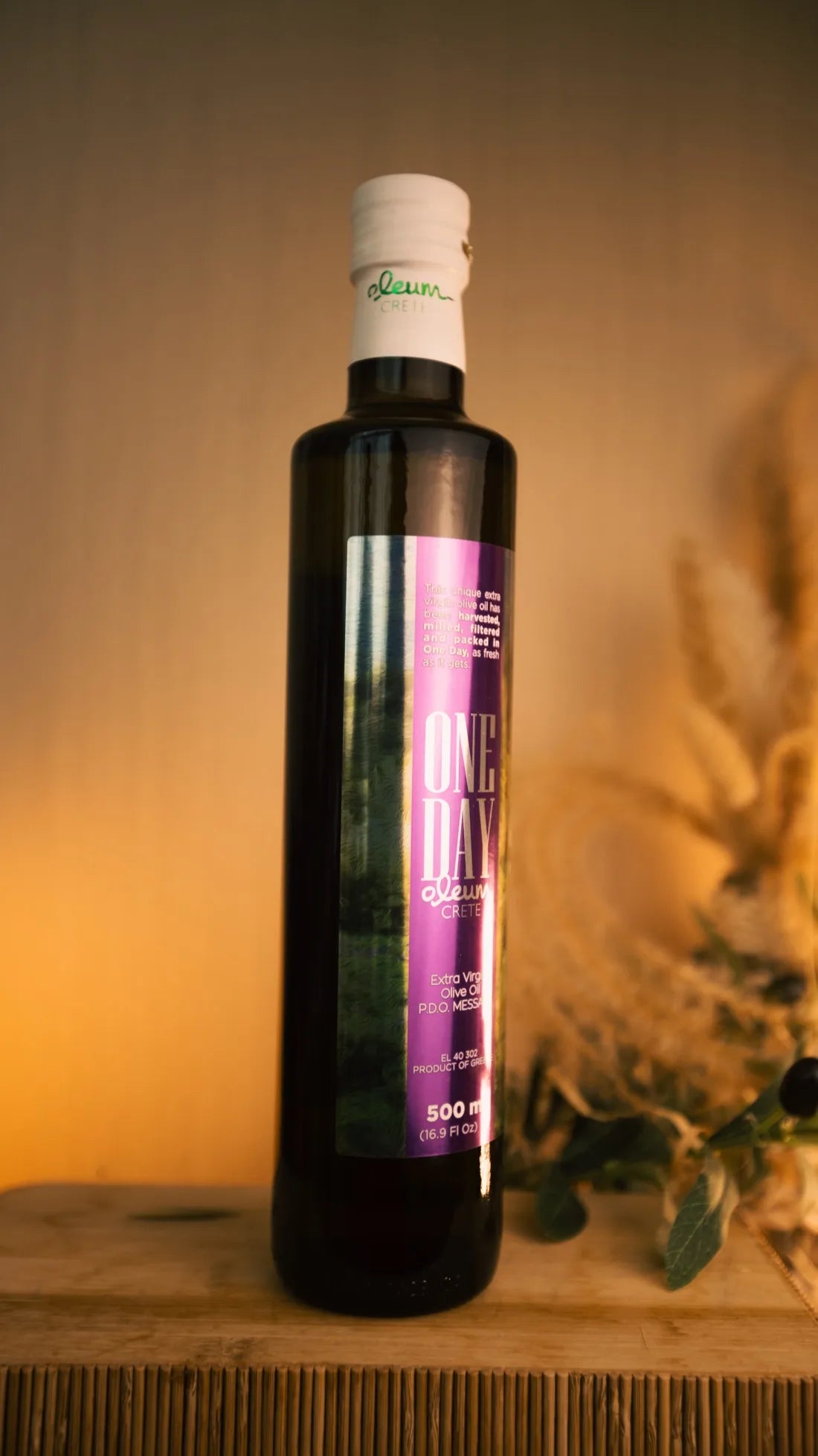
- Oleum Crete's One Day Extra Virgin Olive Oil is PDO Messara certified at under 0.3% acidity, well inside the extra virgin limit.
- Acidity is printed on the back label or the batch certificate, not always on the front, so you may need to look past the brand claims.
- A low acidity number does not prove freshness or flavour on its own. Read it alongside the harvest date, PDO status and polyphenol content.
- Only a laboratory can measure acidity. A quick taste for rancidity or flatness is still a useful check you can do yourself.
To check an olive oil acidity level before you buy, find the free acidity percentage on the back label or the batch certificate. Confirm it sits at or below 0.8%, the ceiling for extra virgin. Then read it together with the harvest date and any PDO or organic certification on the same label. At Oleum Crete we bottle single-estate Koroneiki oil from the Kidonakis family groves on Crete's Messara Plain. Our One Day pressing tests at under 0.3%. This guide explains what that number means, where to find it and what it cannot tell you.
What the Olive Oil Acidity Level Actually Measures
Acidity is the first figure most producers quote, and the one most often misunderstood. It is a chemical measure of how intact the oil was when it left the mill.
Free Fatty Acids, Not Sourness
Olive oil is made mostly of triglycerides: three fatty acids attached to a glycerol backbone. When some of those fatty acids break away, they become "free" fatty acids. Free acidity is the share of these loose fatty acids in the oil, expressed as a percentage of oleic acid, the main fatty acid in olive oil.
The word "acidity" has nothing to do with taste. An oil at 0.2% does not taste less sour than one at 0.7%. Acidity cannot be seen, smelled or tasted by itself. Colour, thickness and how an oil behaves in the fridge tell you nothing about it either. The figure comes from a laboratory test, which is why it has to be printed or certified rather than guessed.
Why Damaged or Old Olives Raise the Number
Free fatty acids form when the fruit's own enzymes start breaking down its fats. That happens when olives are bruised, attacked by pests, left on the ground, or stored in piles waiting for the mill. Every hour between picking and pressing gives those enzymes more time to work.
A low number is therefore a record of care at harvest. On the Kidonakis estate every olive is picked by hand, and our One Day oil goes from tree to bottle within a single day. That speed is what keeps the acidity so far below the legal line.
The Extra Virgin Acidity Standard, and What Sits Below It
The grading system for olive oil is a fixed scale. Once you know where the lines are, you can judge any bottle against it.
Extra Virgin, Virgin and Lampante Compared
Under EU rules, extra virgin olive oil's acidity must not exceed 0.8%. Plain virgin olive oil may go up to 2.0%. The grade sold simply as "olive oil" is a blend of refined oil with virgin or extra virgin oil, and it is capped at 1%. Its low number comes partly from refining, which strips out free fatty acids along with much of the flavour.
Oil above the virgin limit is classed as lampante. It cannot be sold to consumers as it is and must be refined first.
| Grade | Maximum free acidity | Sold to consumers as is? | What it means for you |
|---|---|---|---|
| Extra virgin olive oil | 0.8% | Yes | Top grade, mechanically extracted, no defects allowed |
| Virgin olive oil | 2.0% | Yes | Mechanically extracted, minor flaws permitted |
| Olive oil (refined and virgin blend) | 1.0% | Yes | Low number partly achieved by refining |
| Lampante olive oil | Above 2.0% | No | Must be refined before sale |
The grade on the label tells you which ceiling applies. It does not tell you what is in the bottle beyond that. If you want to go further than the grade, our guide on how to tell real Koroneiki oil from a blend covers variety and origin.
Why a Lower Number Usually Means Fresher Oil
The 0.8% ceiling is generous. Oil from sound fruit, pressed quickly, often lands well below it. A figure close to the limit suggests delays, damaged fruit or long storage before bottling. A figure far below it suggests the opposite.
The word "usually" matters. Acidity is fixed largely at the mill, and oil can lose freshness on a shelf while its acidity barely moves. That is why the checklist below pairs the number with a harvest date.
How PDO Messara Sets a Tighter Limit Than the EU Minimum
Protected Designation of Origin status ties an oil to one defined place and one defined way of making it. For Messara, it also tightens the chemistry.
What PDO Certification Adds on Top of 'Extra Virgin'
The official PDO Messara specification caps acidity at 0.6% by weight of oleic acid, a stricter line than the 0.8% extra virgin ceiling. It also sets limits on three further markers:
- K232 at or below 1.80 and K270 at or below 0.13. These are ultraviolet absorption readings that track oxidation.
- Peroxide value at or below 8.5 meq O2/kg. This measures early oxidation.
- Oleic acid content between 75 and 83%. This reflects the fatty acid profile of Koroneiki grown on the plain.
The same document states that these particularly low absorption indices indicate the product's freshness, and that the low peroxide value is directly related to the oil's high tolerance for storage. A bottle of PDO Messara olive oil is a claim about place, and it is also a claim about these measured limits.
Where Oleum Crete's One Day Oil Sits on the Scale
Our One Day Extra Virgin Olive Oil, certified under 0.3% acidity, sits below half of the PDO Messara cap and well under the extra virgin ceiling. It is 100% Koroneiki from the single Kidonakis estate, with no blending across varieties or valleys.
Picked at dawn on the Messara Plain and pressed within hours, the One Day oil holds a brightness that slower oils lose: green tomato, garden herb and a clean peppery finish.
Where to Find the Acidity Percentage Before You Pay
The figure is rarely on the front of the bottle. The front carries the brand story. The numbers are usually elsewhere.
Back Label and Batch Certificate
Turn the bottle round first. Producers who test well tend to print acidity on the back label, often as "acidity ≤ 0.3%" or "max. acidity". Look for it near the harvest date, the lot number and any certification marks such as PDO, EU Organic or TÜV Austria. Our guide to what a genuine organic certification label must show explains how to read those marks.
The batch certificate goes further. It is the lab report for a specific lot, and it usually lists acidity, peroxide value and UV readings. When you buy online, check the product page for these figures. If they are missing, ask the seller whether a certificate exists for the batch you would receive.
When a Bottle Doesn't State It at All
A missing figure does not mean the oil fails the standard. The words "extra virgin" are already a declaration that it met the 0.8% ceiling. But you have nothing to measure the bottle against. You cannot tell whether it sits at 0.2% or 0.79%, and that gap separates fruit pressed within hours from fruit that waited.
Producers who press quickly and test low usually want you to see the number. When a premium price comes without one, treat the silence as information.
A Four-Step Checklist to Verify Acidity Before You Buy
This olive oil quality check takes a minute in a shop aisle or on a product page.
Step 1: Find the Number
Check the back label, the product page or the batch certificate for a free acidity figure, expressed as a percentage. Note whether it is an exact result or a maximum such as "below 0.3%".
Step 2: Compare It to the Extra Virgin Ceiling
Hold the figure against the extra virgin acidity standard of 0.8%. Anything above that line cannot be extra virgin, whatever the front says. If the bottle claims PDO Messara status, the stricter benchmark is 0.6%. The further below the line the oil sits, the better the fruit was handled.
Step 3: Check the Harvest Date Alongside It
Acidity is set largely at the mill. The harvest date tells you how long the oil has had to lose aroma and polyphenols since then. A low number from a recent harvest is the combination you want. If only a best-before date is shown, you know less about the oil's age.
Step 4: Look for PDO or Organic Certification on the Same Label
Certification adds independent checks on top of the producer's own claim. PDO ties the oil to a defined origin with its own chemical limits. EU Organic covers how the olives were grown. A bottle that shows a low acidity figure, a recent harvest and a recognised certification together gives you three separate signals that support each other.
What a Low Acidity Number Does Not Tell You
Acidity is the most quoted quality marker, but it is only one of several. Relying on it alone can mislead you.
Acidity vs Flavour and Freshness
To qualify as extra virgin, an oil must pass more than the acidity test. It must also meet limits on peroxide value, UV absorption, fatty acid ethyl esters and purity criteria, and a trained tasting panel must find it free of defects. An oil at 0.4% acidity is not automatically extra virgin if it fails any of these tests.
Freshness also depends on what happens after bottling. Heat, light and air drive oxidation, and in the UAE heat is the main risk in transit. For the full picture of how an oil is checked beyond acidity, see our guide on how olive oil purity is lab tested in the UAE.
Acidity vs Polyphenol Content
Polyphenols are the compounds behind the bitterness and pepper you notice in good oil. Acidity tells you nothing about them. Two oils at 0.3% can differ widely in polyphenol content, depending on variety, ripeness at picking and how the oil was handled.
The EU-authorised health claim for olive oil polyphenols reads, in its official wording: "Olive oil polyphenols contribute to the protection of blood lipids from oxidative stress." It says nothing beyond that, and it is not a reason to self-treat any condition. If you are choosing oil for a health reason, talk to your doctor or a registered dietitian.
Frequently asked questions
Can an olive oil have low acidity but still taste bad?
Yes. Acidity measures free fatty acids, not oxidation or sensory defects. An oil can test low and still taste rancid, musty or flat if it has been stored badly or exposed to heat and light. That is why extra virgin status also requires a defect-free result from a trained tasting panel.
Does acidity change after a bottle is opened?
Free acidity is set largely at the mill and rises only slowly afterwards. Once a bottle is open, the bigger risk is oxidation from air, light and heat, which dulls aroma and erodes polyphenols. Keep the cap tight, store the bottle somewhere cool and dark, away from the hob and windows, and use it within a few months.
Is a lower acidity percentage always better?
A lower figure usually reflects sound fruit pressed quickly. Beyond a certain point, though, the difference between two very low readings tells you less than the harvest date, the polyphenol content and how the oil tastes. Also remember that refined grades can show low acidity because refining strips out free fatty acids.
How is olive oil acidity tested in a lab?
The official method is a cold titration. A weighed sample is dissolved in a solvent mixture, then titrated with an alkaline solution until the free fatty acids are neutralised. The result is calculated as a percentage of oleic acid, which is the figure printed on labels and certificates.
Does acidity affect the smoke point of olive oil?
A 2026 study found that free fatty acid content was the main determinant of olive oil's smoke point, with a strong inverse relationship between the two: as free fatty acids rise, smoke point tends to fall. Acidity is one factor among several that shape how an oil performs when heated, alongside storage conditions and processing.
Ready to taste the difference a sub-0.3% acidity bottle makes? Shop the Collection at Oleum Crete and bring home PDO Messara oil pressed within a day of harvest.
More from the Journal
All entriesKoroneiki Olive Oil and Heart Health: What Studies Show
Koroneiki olive oil carries some of the highest polyphenol counts of any olive variety, and that matters for heart health. We look at what the research actually shows, what the EU health claim permits us to say, and how much oil delivers it.

How Much Olive Oil Should a Family of Four Buy Monthly?
Most households either run out of olive oil mid-month or let a bottle oxidise on the shelf. Here is a concrete monthly estimate for a family of four, broken down by cooking, salads and daily shots, mapped straight onto Oleum Crete's 500ml, 750ml and 5L sizes.

What Drives the Price of Koroneiki Olive Oil in the UAE?
A bottle of Koroneiki olive oil can cost three times as much as the one next to it on the shelf, and the gap is rarely random. Harvest date, certification, shipping method and bottle size each add real cost, and knowing which ones matter helps you tell a fair price from an inflated one.
