
Organic Olive Oil Certification: What the Label Must Show
The word "organic" on a bottle means nothing on its own. A genuine certification carries a control body name, a code number and a traceable lot, and a PDO seal adds a separate, stricter promise again. Here is exactly what to look for before you pay a premium price for it.

In this article7 sections
Key takeaways
- Real organic olive oil certification shows three things: the name of the control body (such as TÜV Austria), a licence or operator code, and the EU organic leaf logo or a national equivalent. The printed word "organic" on its own is not enough.
- PDO Messara and organic are separate certifications. PDO fixes the geographic origin and variety. Organic certifies the farming method. A bottle can carry one without the other.
- A genuine single-estate bottle has a batch or lot code that ties back to a specific harvest date. Supermarket blends rarely disclose this.
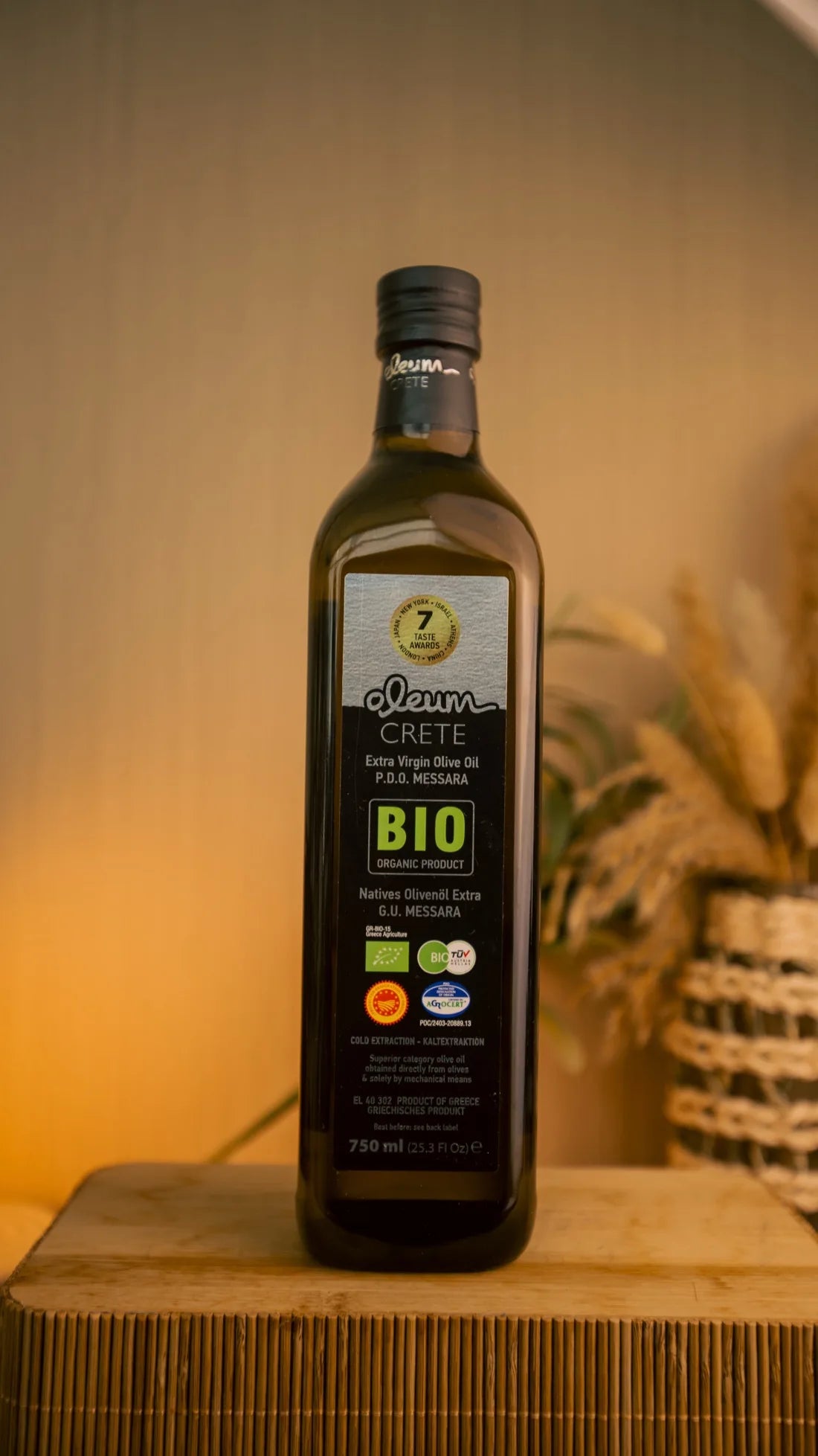
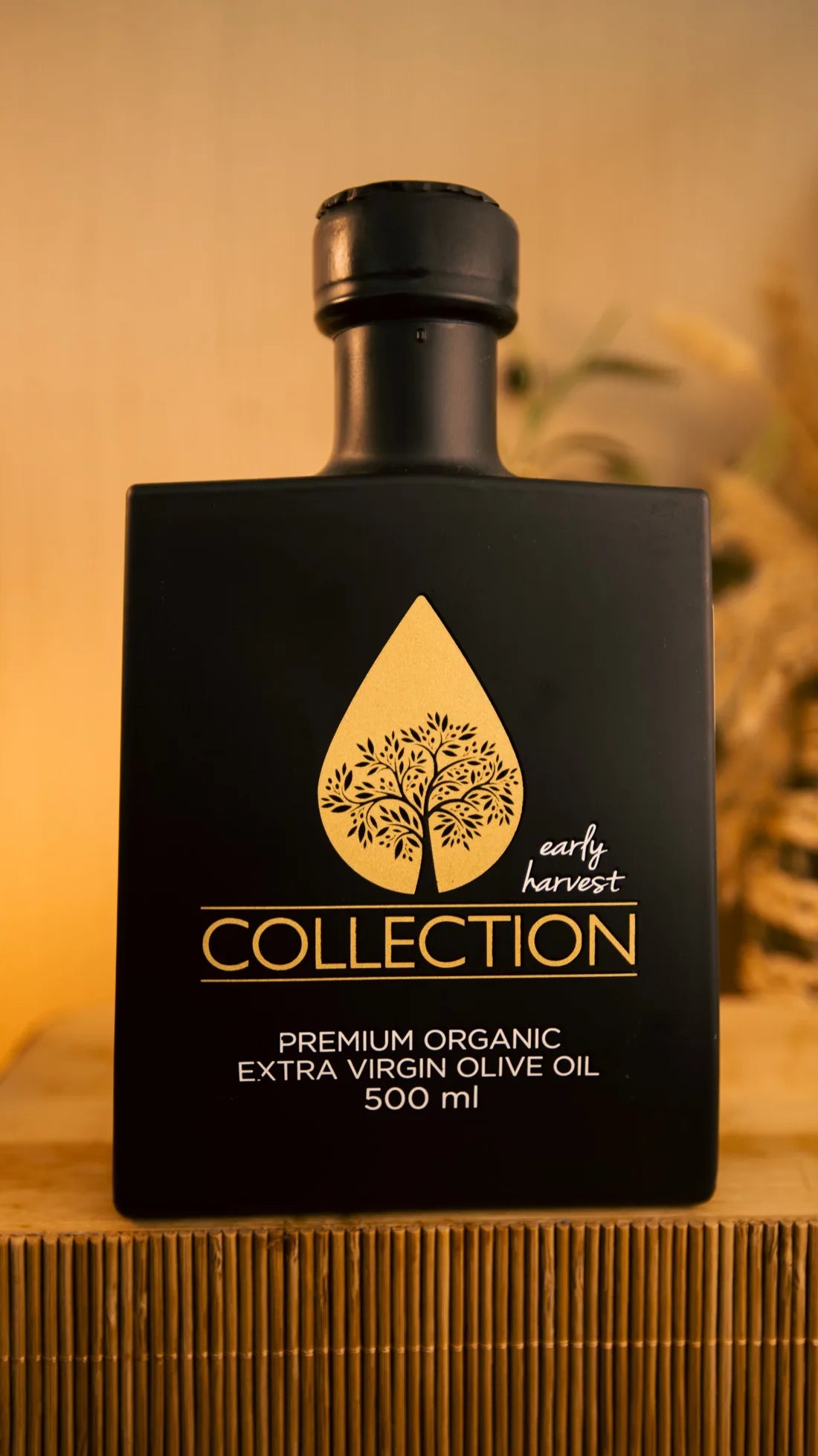
- At Oleum Crete, our Organic Extra Virgin Olive Oil (750ml) and Collection Premium Organic Olive Oil (500ml) carry organic certification alongside PDO Messara status. Both are stated on the bottle, not just implied by marketing copy.
- Three signs that a label is overstating its organic claim: no control body code, vague origin wording like "Product of the EU", and no lot number.
Why "Organic" Alone Is Not a Certification
The word "organic" costs nothing to print. Organic olive oil certification is what makes the word mean something. It takes years of inspected farming, record-keeping and testing before a control body lets an estate use it. At Oleum Crete, we hold that certification alongside PDO Messara status, and once you understand the gap between a claim and a certificate, a supermarket shelf becomes much easier to read.
The difference between a marketing claim and a certified claim
A marketing claim is a description the producer chooses. "Pure", "natural", "traditional" and "farm fresh" all fall into this category, and none of them has to be proven to anyone. A certified claim is different. An independent body has inspected the grove, the mill and the paperwork, and it has granted a licence that can be checked.
The European Commission is explicit on this point. The code number of the control body "must appear on all organic products, whether the EU organic logo is used or not" (European Commission, organic rules FAQ). In practice, that means a bottle saying "organic" without a control body code is not making a legally supported organic claim under EU rules, however green the label looks.
Who actually licenses organic status for olive oil sold in the UAE
Organic status is granted where the oil is produced, then recognised where it is sold. For a Cretan oil, an EU-approved control body inspects and certifies the estate, and that certification is stated on our label.
When the oil reaches the UAE, a second layer applies. Organic products must comply with UAE.S GSO 2055, the organic food standard. Organic claims on labels must be supported by valid certification from an accredited body recognised in the UAE (Nextmove Services). So two checks sit behind every authentic organic bottle in the country: one at origin and one at import.
The Six Elements a Genuine Organic Olive Oil Certification Must Show
Turn the bottle round and work through these in order. A certified organic olive oil should let you tick every one of them without needing to visit a website.
Control body name and code number
The control body is the independent inspector, and its name should appear on the label. Look for TÜV Austria or another EU-approved certifier, together with its code number. The code is not optional. EU rules require it next to the organic logo (Organicity).
Operator or licence code
This code identifies the certified producer or packer, the business that holds the organic licence. It links the bottle to a named operator rather than to a vague brand.
Organic farming logo (EU leaf or national equivalent)
The EU organic logo is a leaf shape made of white stars on a green background. It is compulsory on prepacked organic food sold under EU rules (Organicity). Some markets also use a national mark. Either way, there should be a recognised symbol and not just a decorative leaf.
Country or region where the raw material was farmed
EU rules require the label to say where the agricultural raw materials were farmed, placed alongside the logo (Organicity). That statement can legally be broad. A named valley, such as Messara, tells you far more than a continent does.
Lot or batch reference
The lot code links the bottle to one production run. On a single-estate oil, this should lead back to a specific harvest. We return to it below, because it is where provenance becomes something you can check.
Certificate validity, not just a logo
A logo shows that a certificate existed at some point. It does not show that the certificate is current. Certification has to be maintained through regular inspection and testing, and ongoing compliance. A reputable seller should be able to show you a certificate with a validity period that covers the oil you are buying.
| Element | Where to find it | What it proves | If it is missing |
|---|---|---|---|
| Control body name and code | Next to the organic logo | An approved inspector certified the oil | The organic claim is not legally supported |
| Operator or licence code | Back label, near the certifier | A named, licensed producer or packer | No accountable operator |
| EU leaf or national logo | Front or back label | Recognised organic status | "Organic" is a marketing word only |
| Place of farming | Beneath the logo | Where the olives were grown | Origin is unverifiable |
| Lot or batch code | Neck, base or back label | A traceable production run | No link to a harvest |
| Current certificate | From the seller on request | Status is active today | The logo may be out of date |
Our Organic Extra Virgin Olive Oil, certified organic and PDO Messara, is our everyday PDO pressing. It is 100% Koroneiki from the Kidonakis family estate, with its certification printed where you can read it.
PDO Certification: A Separate Promise From Organic
Organic answers the question of how the olives were grown. PDO certification answers a different question: where they were grown, and what they are. A reader looking for full provenance needs both answers on the same bottle.
What PDO Messara actually certifies
Protected Designation of Origin ties an oil to a defined geographic area and its traditional production rules. PDO Messara covers the Messara Plain in south-central Crete. It confirms the oil came from that valley and was made to its specification, including the variety. For us, that variety is Koroneiki alone, never blended.
One independent food guide describes our oil as carrying both schemes. It is PDO, "which ensures its authenticity, quality, and adherence to traditional production methods", and it is organic, "made from olives grown without the use of synthetic pesticides or fertilizers" (TasteAtlas). These are two distinct certifications sitting on one bottle.
Why a bottle can be organic but not PDO, or PDO but not organic
An organic oil can come from anywhere organic farming is practised and certified. It might be blended from several regions, as long as every component is organic. A PDO oil, by contrast, can come from conventionally farmed groves inside the protected area. Each scheme checks what it was designed to check, and nothing more.
That is why we certify for both. The Collection Premium Organic Olive Oil is our black-bottle gifting pressing. It carries organic certification and PDO Messara status together, so the person receiving it holds an oil whose farming and its valley are both on record.
Reading the Traceability Code on the Back Label
Certification marks tell you the rules were followed. The lot code tells you which oil you are holding.
What a lot number should let you trace
On a genuine single-estate bottle, the lot or batch reference should lead back to a specific harvest date and pressing. Our One Day range is picked at dawn on the Messara Plain and pressed within hours, by hand, from olives grown on our own estate. Its lot code therefore corresponds to one day's harvest. That makes it a record of the moment the fruit left the tree, and not just a stock-control number.
If a seller cannot tell you what a lot code refers to, the code is doing very little for you.
Single-estate vs blended: what the code does and doesn't prove
A lot code proves that a batch can be traced inside a producer's system. It does not prove, on its own, that the batch came from a single estate or a single variety. A large blender can assign one lot code to oil from many sources.
The difference shows when you put the code alongside the other marks. A single estate, a single named variety, PDO status and a harvest-dated lot together make a closed chain. If you want to test the variety claim as well, our guide on how to tell real Koroneiki olive oil from a blend covers taste, colour and label cues.
What Importers and Retailers Must Be Able to Show You in the UAE
Buying organic olive oil in the UAE adds one more party to the chain: the importer. Behind every lawful bottle on a Dubai shelf sits a set of documents.
Dubai Municipality requires every product (SKU) an importer brings in to be registered through the Food Import and Re-export System (FIRS) before its first shipment can clear, and no product category is exempt (Business Dubai). For organic goods, the supplementary documents sometimes requested include a Certificate of Proof for Organic Food Products issued by entities recognised by the Ministry of Climate Change and Environment (ChemLinked).
Questions worth asking before you buy online
A serious seller should be happy to answer these:
- Which control body certifies this oil as organic, and can I see the current certificate?
- Is the oil PDO certified, and for which designation?
- What does the lot code on my bottle refer to: harvest date, pressing date or bottling date?
- Is the oil from a single estate and a single variety?
- How is the oil stored and shipped within the UAE?
Certification covers farming and origin. Purity is a separate question, answered in the laboratory. We explain how olive oil purity is lab tested in the UAE in a companion guide.
Why how a bottle travels matters to certification, not just convenience
A certificate describes the oil as it left the mill. Heat and light can then wear down the freshness, aroma and polyphenols that the certification and any awards were built on. A flawless label means little if the bottle has spent days sitting in a hot warehouse.
That is why we ship our oils in temperature-controlled conditions across the UAE. The oil that arrives at your door should still taste of green tomato, garden herb and a clean peppery finish, exactly as it did on the Messara Plain.
Five Label Red Flags That Signal a Weak or False Claim
You can reject most doubtful bottles in under a minute. Look for these five signs.
Vague origin wording like "Product of the EU"
This phrase can legally cover olives from several countries, blended and bottled anywhere in the bloc. It is not necessarily false, but it tells you almost nothing about provenance. A genuine single-origin oil names its region.
No control body code anywhere on the bottle
Under EU rules, the control body code must appear on every organic product (European Commission). If you cannot find one, treat the organic claim as unsupported.
"Organic" printed but no logo at all
A recognised organic logo is compulsory on prepacked organic food under EU rules (Organicity). A green leaf drawn by the brand's own designer is not that logo.
No batch, lot or harvest reference
Without a lot code, there is no way to link the bottle to a harvest, a pressing or a certified operator's records. Traceability stops at the shelf.
Certification claimed but no PDO when origin is named
If a label leans heavily on a famous origin, such as a named Cretan region, but shows no PDO mark, ask why. The oil may come from that region without meeting its specification. Or the origin may simply be a story.
Frequently asked questions
Is organic olive oil always extra virgin?
No. Organic describes how the olives were farmed, and extra virgin is a separate quality grade based on chemical and sensory testing. An oil can be organic and a lower grade, so check that the label states both. Every oil in the Oleum Crete range is extra virgin.
Does organic certification mean higher polyphenols?
Not by itself. Organic certification covers farming methods, not polyphenol content, which depends on variety, ripeness at harvest and how quickly the fruit is pressed after picking. A short gap between harvest and milling tends to protect these compounds better than a long one, but that is a question for laboratory testing, not for the organic mark.
Can a bottle be PDO certified without being organic?
Yes. PDO confirms the origin, variety and traditional production rules of a protected area, but it does not require organic farming. A PDO oil from conventionally farmed groves is entirely possible, which is why our organic pressings carry both certifications.
How long does organic certification for olive oil stay valid?
Organic status is not a one-time award. It is kept active through ongoing inspections, record-keeping and testing by the control body. The certificate itself shows its validity period, and a reputable seller should be able to show you one that is current.
Why do some genuine organic oils cost more than others?
Hand-harvesting, single-estate production, low yields, fast pressing and holding more than one certification all add cost. A blended organic oil from several regions can be produced at a larger scale than a single-variety PDO oil pressed within a day of picking. Price alone does not prove quality, but an unusually cheap oil that claims rare provenance deserves a close look at its label.
Every bottle in the Oleum Crete range carries its organic and PDO Messara certification on the label, not just in the marketing copy. Shop the Collection to see it for yourself.
More from the Journal
All entriesKoroneiki Olive Oil and Heart Health: What Studies Show
Koroneiki olive oil carries some of the highest polyphenol counts of any olive variety, and that matters for heart health. We look at what the research actually shows, what the EU health claim permits us to say, and how much oil delivers it.

Olive Oil Acidity Level: How to Check Before You Buy
Acidity is the one number most shoppers skip past on an olive oil label, yet it decides whether a bottle can legally call itself extra virgin. Here is how to find it, read it and check it against the PDO Messara standard before you buy.

How Much Olive Oil Should a Family of Four Buy Monthly?
Most households either run out of olive oil mid-month or let a bottle oxidise on the shelf. Here is a concrete monthly estimate for a family of four, broken down by cooking, salads and daily shots, mapped straight onto Oleum Crete's 500ml, 750ml and 5L sizes.
