
How to Tell Real Koroneiki Olive Oil From a Blend
Most bottles labelled Koroneiki on UAE shelves are blends. Here is how to check the label, taste and acidity before you pay for single-variety extra virgin olive oil.

In this article7 sections
Key takeaways
- A genuine single-variety Koroneiki oil names the variety and the estate on the label, not just the country, Greece.
- PDO Messara certification ties the oil to Koroneiki olives grown and pressed within a defined area of Crete's Messara Plain. A generic "Product of Greece" label promises nothing of the kind.
- Real Koroneiki extra virgin oil has a peppery finish and a bitter, grassy bite from its polyphenols. A flat, buttery oil with no aftertaste is a warning sign.
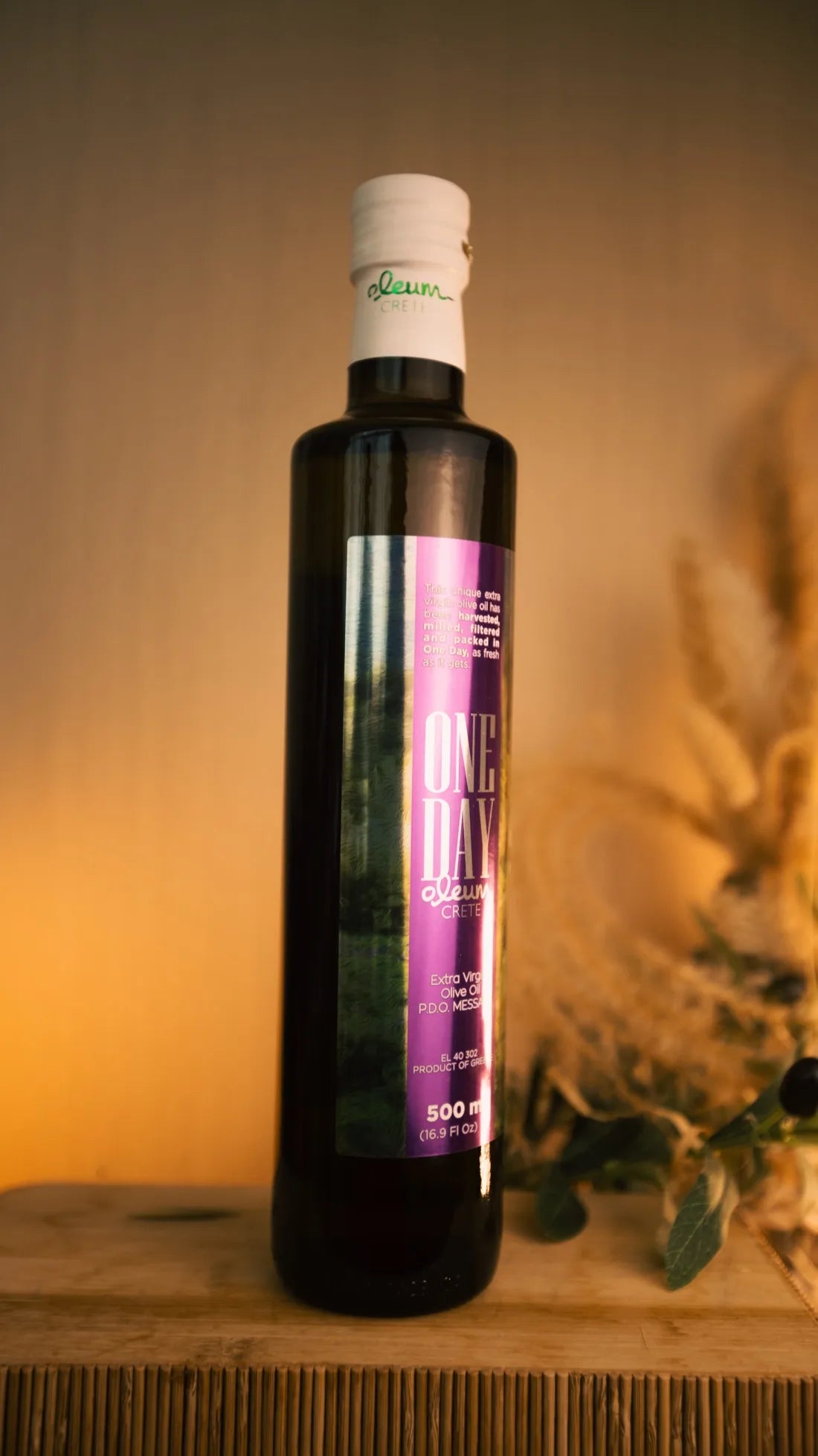
- Extra virgin oil must sit at or below 0.8% free acidity, and a fresh single-estate Koroneiki such as Oleum Crete's One Day oil should test comfortably below that limit.
- A harvest date (not only a best-before date) and a batch or lot number tell you more than any front-label slogan. Cloudiness is a clue to read alongside them, never proof on its own.
What "100% Koroneiki" Actually Promises
Real Koroneiki olive oil is pressed only from Koroneiki olives, and the bottle proves it with specifics: the variety, the estate or producer, a harvest date and a lot number, ideally alongside a PDO seal that ties it to one place. At Oleum Crete we press nothing but Koroneiki from the Kidonakis family estate on Crete's Messara Plain, so this is the standard we hold our own bottles to. Start with the label, then use your nose, then your palate.
Single-variety versus multi-varietal blends
A single-variety oil comes from one cultivar. Single-estate narrows it further: one family's groves, one valley, one mill. A blend combines several varieties, often from more than one country, to hit a price point and keep the flavour consistent from year to year.
Blends are not fraudulent in themselves, and many are labelled honestly. The trouble starts when the front of the bottle leans on the word Koroneiki while the oil inside is mostly something milder. Variety is also a separate question from grade: an oil can be 100% Koroneiki and still fall short of extra virgin, which is why it helps to understand how extra virgin and virgin Koroneiki grades actually differ.
Why Koroneiki is blended so often in the UAE market
Koroneiki is a small olive with a big reputation. It yields an intense, green, peppery oil rich in polyphenols, so the name sells. A modest share of Koroneiki can lift the colour and pepper of a softer oil, and that is enough for some labels to feature it prominently.
Distance matters too. Oil bound for the Gulf often travels in bulk before it is bottled, and every handover between grove, mill, trader and bottler is another chance for oils to be combined. The further the bottling happens from the grove, the more the label has to prove.
Check the Label Before You Check the Taste
The label is the quickest test, and you can run it in a shop aisle or on a product page before you spend anything. For a fuller label checklist, see our guide to Greek olive oil brands. These three elements matter most for a Koroneiki claim.
Variety stated by name, not just "extra virgin"
"Extra virgin" is a grade. It says nothing about which olives went in. Look for "100% Koroneiki" or "single-variety Koroneiki" in plain words. Phrases such as "made with Koroneiki", "Koroneiki selection" or "Koroneiki blend" usually mean other oils share the bottle.
Harvest date versus best-before date
UAE labelling rules under UAE S.9:2017 already require lot identification, production and expiry dates, and country of origin on prepackaged food. That gives you a floor. A production date, though, may simply be the day the oil was bottled, which can be long after the olives were picked.
A harvest date tells you which crop you are holding. Polyphenols and fresh aromas fade with time, so the harvest date is the single best predictor of how lively the oil will taste. Producers proud of their freshness print it.
PDO or PGI seal and estate or producer name
A PDO (Protected Designation of Origin) seal links the oil to a defined area and an agreed method of production. PGI is a looser geographical link. Alongside the seal, look for the name of the estate or producer and where the oil was milled and bottled. Imported food in the UAE also falls under standards set by MOCCAE, Dubai Municipality and the Emirates Authority for Standardization and Metrology (ESMA), which covers packaging and labelling, so an importer's details should be easy to find.
Five Checks You Can Do With the Bottle in Hand
Once the label passes, the oil itself has to back it up.
| Check | Genuine single-estate Koroneiki | Suggests a blend or tired oil |
|---|---|---|
| Colour and clarity | Green to green-gold; may be slightly hazy when very fresh | Pale, flat yellow; heavy sediment in an old bottle |
| Rub test aroma | Cut grass, tomato leaf, artichoke, fresh herbs | Little scent, or crayon, vinegar, musty or cardboard notes |
| Acidity on label | Stated, and well under the 0.8% limit | Not stated at all |
| Polyphenols | Stated in mg/kg, high for the category | Not stated, or vague "rich in antioxidants" wording |
| Price per litre | Reflects hand harvest and single-estate milling | Far below other single-estate oils |
Colour and clarity
Colour is the weakest of the five checks. Chlorophyll gives young Koroneiki a green cast, but colour alone proves nothing, which is why professional tasting panels use tinted glasses. Haze can mean an unfiltered, freshly pressed oil, yet visible sediment or cloudiness can also point to poor filtration or age. Read it alongside the harvest date, never in isolation.
The rub test for aroma
Put a few drops in your palm, rub your hands together and breathe in. Fresh Koroneiki smells green and alive: grass, tomato leaf, a little almond. An oil that smells of very little has usually lost its volatile aromas to age or heat. Wax crayon, wine-vinegar or damp-cellar notes are defects, and an oil with defects cannot be extra virgin.
Acidity figure on the label
Under IOC and EU standards, extra virgin oil must have free acidity of no more than 0.8% and a peroxide value of 20 meq O₂/kg or less, and it must pass a sensory panel with zero defects. Low acidity reflects sound fruit that was milled quickly. A producer confident in its numbers tends to publish them.
Polyphenol content, where stated
The average freshly pressed olive oil holds 100 to 300 ppm of polyphenols, and fresh Koroneiki often sits at the top of that range or above it. Our single-day-harvest One Day oil is picked and bottled within a day, so the polyphenols have little time to fade before the oil is sealed, and the figure is stated on the label rather than left as a vague antioxidant claim.
Price per litre versus bulk blended oils
Compare per litre, not per bottle, because sizes vary. Hand-harvesting, single-estate milling and certification all cost money. A "single-estate Koroneiki" priced like a bulk supermarket blend should make you look harder at everything else on the label.
What Real Koroneiki Olive Oil Should Taste Like
Taste confirms what the label claims. Pour a spoonful into a small glass, cup it in your hand for a minute to warm it, then sip with a little air and swallow.
Bitterness and pepper at the back of the throat
The sting you feel in your throat is the point. Research has found a positive link between oleocanthal and oleacein content and the intensity of pungency and bitterness in Koroneiki oils. A cough after swallowing is a good sign. A Koroneiki with no bite at all has lost its phenolic compounds, through age, heat damage or dilution with a softer oil.
Green tomato and herb notes versus a flat, oily taste
Picked at dawn and pressed within hours, fresh Koroneiki tastes of green tomato, garden herb and artichoke, with a clean, peppery finish that lingers. A blended or tired oil coats the mouth and then disappears. It may taste buttery, sweet or simply of fat, with nothing left on the palate seconds later. If your "100% Koroneiki" tastes like that, the label and the oil disagree.
Red Flags That Point to a Blend
Use this checklist to rule out suspect bottles quickly.
Vague origin wording
- "Mediterranean blend", "packed in Greece" or "Greek-style" in place of a named region
- "Product of Greece" with no estate, mill or producer named
- "Made with" or "featuring" Koroneiki, rather than "100% Koroneiki"
No harvest date or lot number
- A best-before date with no harvest date or harvest season
- No lot or batch number, which makes the oil untraceable
- No acidity or polyphenol figures anywhere on the label or product page
Price far below single-estate oils
- A per-litre price close to bulk supermarket oil while claiming single-estate status
- Constant deep discounting on a supposedly limited harvest
- Large sizes priced below the smaller bottles of named-estate oils
Why PDO Messara Matters More Than the Word "Greek"
Greece produces oil from many varieties, regions and mills. "Greek" tells you the country and little else. PDO Messara tells you the valley.
What PDO Messara restricts
PDO Messara limits the oil to Koroneiki olives grown and pressed within a defined area of Crete's Messara Plain, following the method set out in its specification. It guarantees origin and method. It does not replace the quality tests: a PDO oil must still pass the chemical limits and a sensory panel, and one that fails either cannot be labelled extra virgin, even with the seal.
Our oil comes from the Kidonakis family estate on the Messara Plain, harvested entirely by hand. Every bottle is single-estate, single-variety and from a single valley. None of it is blended.
How this differs from a generic "Product of Greece" label
A "Product of Greece" label can cover oil drawn from several regions, varieties and harvests, bottled wherever is convenient. PDO Messara closes those gaps. Add an estate name, a harvest date and published lab values, and you have an oil you can trace from the grove to your kitchen.
That is the thinking behind our five pressings, all 100% Koroneiki and single-day harvest:
- One Day Extra Virgin Olive Oil (500ml): harvest to bottle within a day, at its brightest and most peppery
- Organic Early Harvest Olive Oil (500ml): our high-polyphenol pressing for those who want maximum intensity
- Organic Extra Virgin Olive Oil (750ml): the everyday PDO bottle for cooking and the table
- Collection Premium Organic Olive Oil (500ml): a black gift bottle for Mediterranean-food lovers
- Extra Virgin Olive Oil 5L Tin: for busy kitchens and catering
Our oils have been recognised at competitions including NYIOOC, TerraOlivo, London IOOC and Great Taste. We ship across the UAE, keeping the oil cool in transit so it arrives tasting as it did on the estate.
Frequently asked questions
Can olive oil be 100% Koroneiki but still not be extra virgin grade?
Yes. Variety and grade are separate. A pure Koroneiki oil that exceeds 0.8% free acidity, exceeds the peroxide limit or shows any sensory defect cannot legally be called extra virgin. Poorly handled fruit or slow milling can drag an honest single-variety oil down to virgin grade.
Does PDO certification alone guarantee the oil isn't blended with other varieties?
PDO Messara restricts the oil to Koroneiki from a defined area, so it rules out other varieties and other regions. It does not guarantee a single estate, because a PDO oil can combine fruit from many growers within the zone. Nor does it guarantee extra virgin grade on its own. Look for an estate name, harvest date and lab values alongside the seal.
Why does some oil labelled Koroneiki taste bland or buttery with no bite?
The bite comes from phenolic compounds such as oleocanthal and oleacein, and they fade with age, heat and light. A bland Koroneiki has usually been stored too long or too warm, or diluted with a softer oil. Check the harvest date first. Fresh Koroneiki should catch the back of your throat.
Is a cloudy bottle a sign of real, unfiltered Koroneiki oil?
Not on its own. Very fresh, unfiltered oil can be hazy, but cloudiness and sediment can also come from poor filtration or age. Treat it as one clue and weigh it against the harvest date, lot number and stated acidity.
How do I check the acidity percentage before buying online in the UAE?
Look on the product page and the label image for a stated free acidity figure, ideally with polyphenol content and the harvest date. If they are missing, ask the seller for the lab analysis for that lot. A full report may also list fatty acids, with oleic acid between 55% and 85% for oil within olive oil norms.
Does a high price always mean the Koroneiki oil is genuine?
No. Price reflects the cost of hand harvesting and single-estate milling, but anyone can charge a premium. A high price only means something when it comes with a named variety, a named estate, a harvest date, a lot number and published acidity and polyphenol figures.
If you want a bottle you don't have to interrogate, shop the Oleum Crete collection: single-estate, PDO Messara, 100% Koroneiki, with the harvest date on every bottle.
More from the Journal
All entriesKoroneiki Olive Oil and Heart Health: What Studies Show
Koroneiki olive oil carries some of the highest polyphenol counts of any olive variety, and that matters for heart health. We look at what the research actually shows, what the EU health claim permits us to say, and how much oil delivers it.

Olive Oil Acidity Level: How to Check Before You Buy
Acidity is the one number most shoppers skip past on an olive oil label, yet it decides whether a bottle can legally call itself extra virgin. Here is how to find it, read it and check it against the PDO Messara standard before you buy.

How Much Olive Oil Should a Family of Four Buy Monthly?
Most households either run out of olive oil mid-month or let a bottle oxidise on the shelf. Here is a concrete monthly estimate for a family of four, broken down by cooking, salads and daily shots, mapped straight onto Oleum Crete's 500ml, 750ml and 5L sizes.
