
How Extra Virgin Olive Oil Is Made: Tree to Bottle in One Day
Most extra virgin olive oil spends days or weeks between picking and pressing, and loses flavour and polyphenols at every stage. Oleum Crete presses within hours of harvest. Here is what that actually involves, step by step.

In this article8 sections
Key takeaways
- Extra virgin status depends on two things: mechanical extraction without heat or chemicals, and free acidity at or below 0.8%. The time between picking and pressing decides how much flavour and polyphenol content survives.
- Hand-harvesting by combing or shaking the tree avoids bruising the fruit. A damaged olive starts to oxidise and ferment within hours.
- Oleum Crete presses its One Day range within hours of picking on the Messara Plain. When olives travel to shared mills, the wait is often days or weeks.
- Cold extraction below 27°C in a centrifugal decanter separates oil from water and solids without heat. This protects the peppery, green-tomato notes typical of Koroneiki olives.
- A harvest date on the label, not just a best-before date, is the clearest sign a bottle was pressed soon after picking.
How is extra virgin olive oil made, in outline
Extra virgin olive oil is made by picking ripe or early-season olives and washing them. The whole fruit is then crushed into a paste and stirred gently (malaxation). Finally a centrifuge spins the oil away from water and solids. Nothing else is permitted. Under International Olive Council standards, the oil must come from the fruit "solely by mechanical or physical means" under conditions that do not deteriorate it. The only treatments allowed are washing, decantation, centrifugation and filtration. For the extraction to count as cold, paste temperatures must stay at or below 27°C, and free acidity must not exceed 0.8 grams per 100 grams, the strictest limit of any grade.
Those rules set the minimum. They do not say how fast the work must happen, and speed is where quality is won or lost. At Oleum Crete, the Kidonakis family harvests every olive by hand on our estate in the Messara valley. Our One Day oils go from tree to press within hours, so the fruit has no time to degrade. The steps below follow that journey and show why each stage matters.
Step 1: picking the olives by hand
The Koroneiki olive oil process starts in the grove, with a decision most producers make on cost. Small, dense fruit like Koroneiki can be stripped by machine or picked by hand. On our estate in the Messara valley, it is always by hand.
Koroneiki is a small olive with a high ratio of skin to flesh. It is naturally rich in polyphenols, which explains much of what makes Koroneiki olives distinct. That small size also makes the fruit easy to damage. It needs gentle handling from the moment it leaves the branch.
Why combing and shaking beat machine harvesters
Hand-harvesting on Crete means one of two things. Pickers run long-tined combs through the branches, or they shake the boughs with handheld tools so the olives drop onto nets spread beneath the tree. The fruit falls a short distance onto a soft surface and is gathered into ventilated crates.
Machine harvesters work by force. Trunk shakers grip the tree and vibrate it hard. Over-the-row machines strip fruit as they pass. Both are efficient. Both cause more split skins, crushed fruit and torn stems, and every damaged olive is a small flaw carried forward into the oil. Hand-picking is slower and costs more. It is the only way to bring in a harvest where almost every olive arrives intact.
What happens to a bruised olive within hours
An olive is a closed system. Its oil sits in cells alongside water, enzymes and the phenolic compounds that give fresh oil its bitterness and pepper. Bruise the skin and those cells rupture. Enzymes meet oil and oxygen, and two processes begin: oxidation, which breaks down the fragile aromatic compounds, and fermentation, as yeasts and bacteria feed on the exposed flesh.
Neither process waits for the mill. Within hours, a bruised olive is producing compounds that raise acidity and dull the flavour. Left long enough, it produces the sensory defects tasters call "fusty" or "winey". Intact fruit holds out far longer. That is why careful picking matters as much as anything that happens at the press.
Step 2: the race from grove to mill
If one variable decides the quality of the finished oil, it is the gap between picking and pressing. This is the idea behind one day harvest olive oil. The harvest-to-bottle process is treated as a race, and every hour the fruit spends waiting costs something that cannot be recovered.
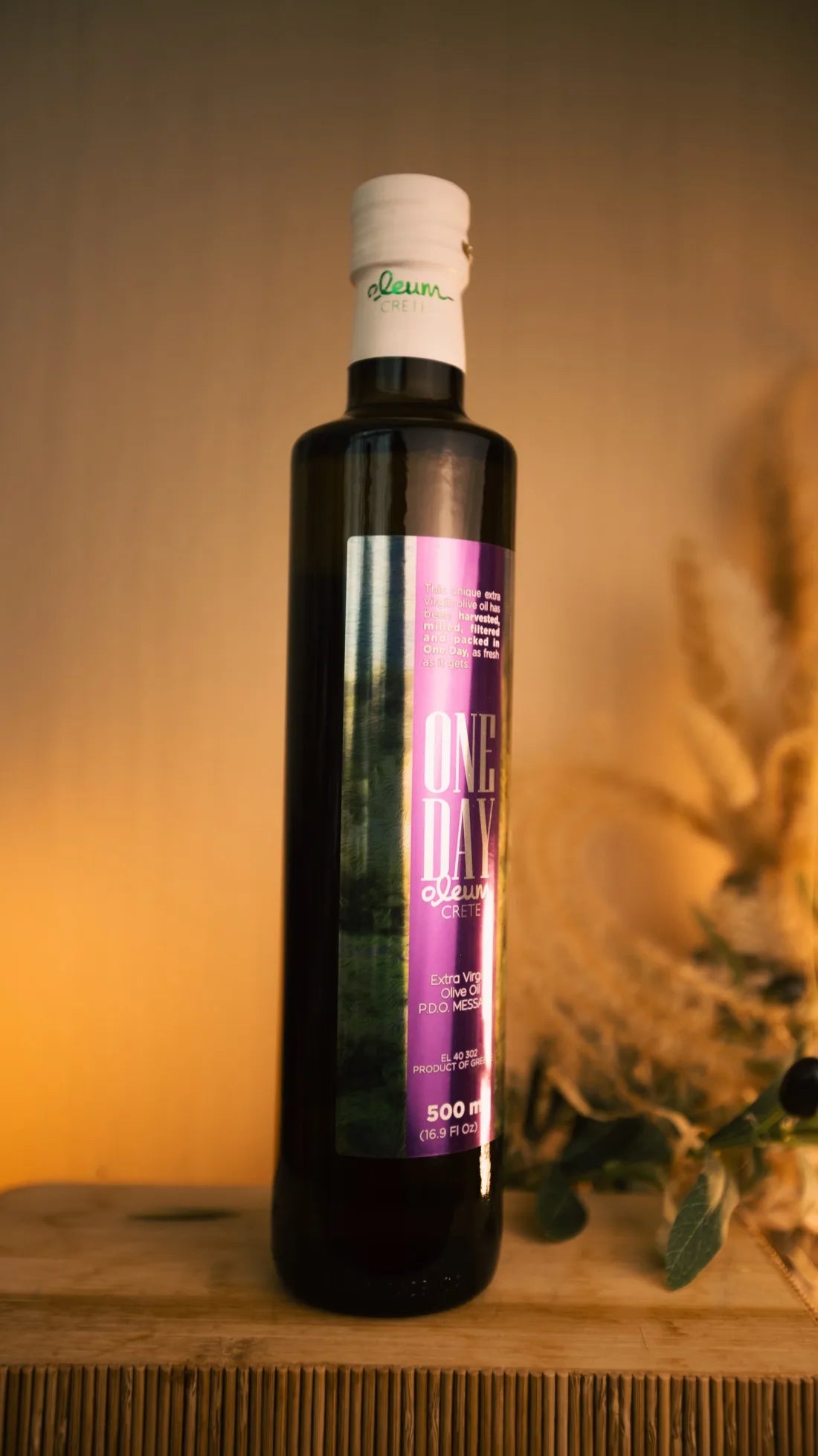
Our One Day Extra Virgin Olive Oil takes its name from this principle. Picked at dawn on the Messara Plain and pressed within hours, it keeps a brightness that most oils have lost long before they reach the bottle: green tomato, garden herb and a clean peppery finish.
What happens to olives left in crates or sacks
Even undamaged olives keep living after harvest. They respire, generate heat and slowly break down. Piled in sacks or stacked deep in crates, the fruit at the bottom carries the weight of everything above it. Air cannot circulate, warmth builds up and bruising spreads. Fruit that was sound when picked can start to ferment simply from waiting.
The losses are cumulative. Polyphenols degrade. The volatile compounds behind cut-grass and green-tomato aromas fade. Free acidity creeps upward. An oil from olives that waited may still pass the extra virgin threshold, but it will taste flatter and keep less well than oil from the same trees pressed the same day.
Why same-day pressing is unusual in the industry
Most olive growers do not own a mill. They sell their fruit or take it to a cooperative or commercial press shared by many farms. At the height of harvest, those mills run constantly and the queue grows. Olives wait at the farm until there is enough to transport, then wait again in the mill yard for their turn. Days can pass, and in a busy season, weeks.
Same-day pressing requires a press close to the groves and a harvest planned around its capacity. Pickers bring in only as much fruit as can be milled that day. It is a slower, more deliberate way to work. For the One Day range, it is the whole point.
Step 3: washing, crushing and malaxation
Once the olives reach the mill, the mechanical work of extraction begins. Knowing how extra virgin olive oil is made at this stage helps explain why two oils from the same variety can taste so different.
First the fruit is cleaned. Blowers strip away leaves and twigs, and a water bath rinses off dust and soil. Washing is one of the few treatments the international standard permits, and it does nothing to the oil itself.
Crushing the whole olive, pit included
Next the whole olive, stone and all, goes into a crusher. Modern mills use hammer or disc crushers, which break the fruit into a thick paste in seconds. Older mills used stone wheels. The pit is not removed. Its fragments help break open the oil-bearing cells, and the skin and stone contribute to the oil's phenolic and aromatic character.
How hard the fruit is crushed shapes the oil. Finer crushing releases more oil and more bitterness. Gentler crushing can give a softer result. Millers adjust to the fruit in front of them, and small, firm Koroneiki olives respond to careful settings.
Malaxation: why time and temperature matter here too
The paste then moves into a malaxer, a trough or tank where slow-turning blades mix it gently. Malaxation encourages tiny droplets of oil to merge into larger ones that can be separated. During this stage, many of the aroma compounds that define a fresh oil are formed.
It is also where quality can slip. Mix too long and the paste is exposed to more oxygen, so delicate compounds break down. Warm the paste and more oil flows out, but polyphenols and fresh aromas pay the price. The IOC defines cold extraction as oil obtained below 27°C with no heating of the paste during malaxation. That is the benchmark serious producers work to.
Step 4: cold extraction and separation
The final stage separates oil from everything else in the paste. Today this is done in a horizontal centrifuge called a decanter, which spins at high speed. Oil, water and solids have different densities, so they separate into layers and leave through different outlets. A second, vertical centrifuge often polishes the oil further. Some oils are then filtered, and others rest so the remaining sediment can settle.
In the Koroneiki olive oil process, this is the last point where heat could do damage, and the reason to keep it out is simple.
Why heat is the enemy of polyphenols
Polyphenols are what make high-quality Koroneiki oil bitter and peppery at the back of the throat. They also help the oil resist oxidation in the bottle. Many of these compounds are sensitive to heat, and so are the volatile aromatics behind green, grassy notes.
Warmer extraction gives a higher yield, which is why it tempts producers. It also gives an oil with fewer of the compounds that make it worth buying. Oils pressed quickly and kept cold throughout extraction hold on to more of these compounds, which is part of why polyphenol-rich oils can carry the EU's permitted health claim for olive oil, the strictest wording allowed on any food label making that statement. To understand what the polyphenol figures actually mean, it helps to know that they depend on the fruit, the speed of pressing and the temperature at every step.
What "cold-pressed" and "cold extraction" actually mean
The two terms are often used interchangeably, but they come from different methods. "Cold-pressed" refers to traditional pressing, where paste was spread on mats and squeezed in a hydraulic press. Few mills work that way now. "Cold extraction" refers to the modern centrifugal method. In both cases, "cold" has a precise meaning: the paste was kept at or below 27°C throughout.
One-day harvest versus the typical timeline
The difference between a one day harvest olive oil and a conventionally produced oil comes down to where time is spent. Here is how the two routes from harvest to bottle compare, stage by stage.
| Stage | Typical route via a shared mill | Oleum Crete One Day range |
|---|---|---|
| Harvest method | Often mechanical shaking or stripping | Entirely by hand, combing and shaking onto nets |
| Fruit storage before milling | Sacks or deep crates, at the farm and then the mill yard | Ventilated crates, moved to the press the same day |
| Gap from picking to pressing | Commonly days, sometimes weeks in peak season | Within hours |
| Source of fruit at the mill | Many farms, often blended | Single estate, single variety (100% Koroneiki) |
| Extraction temperature | Varies; warmer extraction raises yield | Cold extraction, at or below 27°C |
| Origin | Varies | PDO Messara, single valley on Crete |
Messara is a registered Protected Designation of Origin in the EU's geographical indications register, covering olive oil produced in the Messara valley. Our oils are also certified EU Organic. This is the same discipline that underpins how extra virgin olive oil is made at its best: single estate, single variety, pressed the day it is picked.
How to tell if a bottle was actually pressed quickly
Knowing how extra virgin olive oil is made gives you an advantage at the shelf. Most of what decides quality happens before bottling, but a few clues are visible from the outside, and others reveal themselves once you pour.
Reading the harvest date, not just the best-before date
A best-before date tells you little. It is usually set a fixed period after bottling, and oil can sit in bulk tanks for a long time before it is bottled. A harvest date, or a harvest season such as a stated crop year, tells you when the olives came off the tree. That is the date that matters.
When you compare bottles, look for:
- A harvest date or crop year printed on the label
- A named estate, variety and region rather than "a blend of EU oils"
- A recognised origin certification such as PDO
- Dark glass or a tin, which protects the oil from light
For further checks for spotting fake or stale extra virgin oil, including what certifications and award listings can and cannot tell you, see our guide.
Tasting notes that signal fresh pressing
Pour a little into a small glass, cup it in your hand to warm it, then smell and sip. Freshly pressed Koroneiki oil smells green: cut grass, green tomato, artichoke, garden herbs. On the palate, expect a degree of bitterness and a peppery catch at the back of the throat. That catch is the polyphenols at work.
Oil from olives that waited too long, or from an old bottle, tells a different story. It may smell of very little, or of something faintly vinegary, musty or like crayons. It can feel heavy or greasy in the mouth, with no pepper at all. Good oil should taste of fruit.
Frequently asked questions
What does cold-pressed mean on an olive oil label?
It means the olive paste was kept at or below 27°C during extraction, so no heat was used to raise the yield. Strictly, "cold-pressed" describes traditional pressing on mats, while "cold extraction" describes the modern centrifuge method. Most quality oils today use cold extraction, and both terms point to the same temperature limit.
How long can olives sit before pressing and still be called extra virgin?
No fixed time limit exists. Extra virgin is a grade awarded on test results: free acidity at or below 0.8%, plus chemical and sensory criteria. Olives that wait can still pass if the fruit was sound, but every hour costs flavour and polyphenols, so a passing oil is not necessarily a fresh-tasting one.
Does a longer gap between harvest and pressing make olive oil unsafe to drink?
Generally, no. Oil from olives that waited is usually safe. The longer gap affects quality, not safety: it raises acidity, dulls the aroma and reduces polyphenol content. If the fruit ferments badly, the oil develops defects that disqualify it from the extra virgin grade.
Why do some extra virgin olive oils taste bland or greasy instead of peppery?
The usual causes are slow pressing, warm extraction, very ripe fruit, or an oil that has aged or been stored badly. All of these reduce the polyphenols and volatile compounds behind bitterness, pepper and green aromas. Without them, what is left is the fatty texture of the oil itself.
Is extra virgin olive oil made differently from regular or light olive oil?
Yes. Extra virgin is extracted mechanically and sold without any further treatment. "Olive oil" and "light olive oil" are typically refined oils, processed to remove defects and flavour, with a little virgin oil sometimes blended back in. "Light" describes the mild taste and colour, not fewer calories.
Taste the difference a same-day press makes: shop the Oleum Crete collection and bring Messara Plain freshness to your kitchen.
Read next: Extra Virgin Olive Oil 5L Tin: Is Bulk Buying Worth It?
More from the Journal
All entriesEarly Harvest Olive Oil Uses: 9 Ways to Use It Daily
Early harvest olive oil belongs on the table every day, not just on special occasions. Here are nine practical ways to use it, and the proof points that separate a genuine high-polyphenol Cretan oil from a marketing claim.

Olive Oil Harvest Date: How to Read Labels and Buy Fresh
Most bottles on UAE shelves hide the one date that actually matters. Here is the checklist we use ourselves to separate a genuinely fresh, single-estate oil from an old blend dressed up in a nice label.

Greek Olive Oil vs Italian and Spanish: What Sets Crete Apart
Most Italian and Spanish extra virgin olive oil is blended from several varieties, regions and harvest dates. Single-estate Cretan Koroneiki, pressed within a day of picking on the Messara Plain, takes a different path, and the polyphenol numbers show it.
