
Does Olive Oil Need to Be Organic? What Actually Changes
Organic certification changes what lands on the olives before harvest, not what happens in the press room. We farm olives both ways on the Messara Plain and explain honestly what organic buys you, and what it doesn't.

In this article7 sections
Key takeaways
- Organic certification governs farming inputs, mainly the absence of synthetic pesticides and fertilisers. It says nothing about pressing method or freshness.
- High polyphenol content comes from harvest timing and olive variety, not organic status.
- A non-organic oil pressed within a day of harvest can taste fresher and test higher in polyphenols than an organic oil whose olives sat for weeks before milling.
- Organic certification does lower the likelihood of synthetic pesticide residue. That matters most if residue, rather than taste or polyphenol count, is your main concern.
- Single-estate traceability, acidity below 0.3% and a harvest date on the label tell you more about quality and authenticity than the organic logo alone.
Does Olive Oil Need to Be Organic? The Short Answer
No. Olive oil does not need to be organic to be genuine, fresh or rich in polyphenols. Organic certification describes how the trees were farmed: which fertilisers, pesticides and soil treatments were allowed in the grove. It does not tell you when the olives were picked, how quickly they reached the mill or how the oil was stored afterwards. Those factors decide what you taste and how many polyphenols end up in the bottle.
At Oleum Crete we farm organically on our family estate on Crete's Messara Plain, and we value it. We also know it is one signal among several, not the one that decides the quality of your oil. If you are weighing up olive oil, organic or not, start with the harvest date, the variety, the estate and the acidity. Then treat the organic logo as a sign of how the grove is farmed, which matters most if synthetic pesticide residue is a specific concern for you.
What Organic Certification Actually Controls
Organic is a farming standard. It covers the grove and the handling chain, and it is enforced through audits. Seeing exactly where it starts and stops makes the question of olive oil organic or not much easier to answer.
Farming Inputs: What's Allowed and What Isn't
In the EU, organic production and labelling are governed by Regulation (EU) 2018/848. The European Commission summarises the key principles of organic farming as including the prohibition of GMOs and limits on the use of herbicides and pesticides.
In practice, synthetic fertilisers and most synthetic crop protection products are kept out of the grove. Organic growers rely instead on compost, cover crops between the rows, natural predators and careful pruning to keep trees healthy. The aim is living soil and a tree that crops steadily without chemical support.
Certification Bodies Like TÜV Austria and What They Check
A farm cannot simply call itself organic. Under EU rules, growing and processing facilities must be audited by an accredited certifier before the EU organic logo can appear on packaging. TÜV Austria is one such body.
Auditors look at inputs bought and applied, field records, how organic olives are kept separate from conventional fruit, and how the mill and bottling line handle the oil. The certificate covers the whole chain from tree to bottle, which is why the logo carries a code identifying the control body.
What Organic Status Does Not Guarantee
Organic certification does not grade the oil. It does not confirm the oil is extra virgin, fresh, low in acidity or high in polyphenols. Grade is checked separately: EU countries must carry out a minimum number of annual controls on olive oil marketing standards, including whether the declared category, such as extra virgin, is accurate.
Nor is the logo immune to abuse. Common fraud in the olive oil trade includes adding cheaper seed oils, mixing in refined or pomace oil, and making false claims about quality grade, organic status and origin. A logo is a starting point. Traceability is what lets you check it.
Organic vs Non-Organic: What Changes and What Doesn't
Here is how organic certification maps onto the things buyers say they care about.
| What you care about | Does organic status affect it? | What actually drives it |
|---|---|---|
| Synthetic pesticide residue | Yes, it reduces the likelihood | Farming inputs, audited by a certifier |
| Soil and grove health | Yes, over the long term | Compost, cover crops, pruning |
| Polyphenol content | Not directly | Variety, harvest timing, speed to mill, extraction conditions |
| Taste and aroma | Indirectly at most | Ripeness at picking, time to mill, milling and storage |
| Acidity and extra virgin grade | No | Fruit condition, milling speed, handling |
| Freshness in the bottle | No | Harvest date, bottling, storage, shipping temperature |
| Origin and traceability | No | Single-estate sourcing, PDO certification |
| Price | Usually higher | Organic farming and certification costs, plus estate and harvest choices |
Organic changes two rows decisively: residue and the way the grove is farmed. Everything that shows up as flavour, polyphenols and freshness is decided elsewhere.
Why Harvest Timing Beats Organic Status for Polyphenols
Polyphenols are the compounds behind olive oil's bitterness and pepper, and behind its one authorised EU health claim. They form in the fruit, peak while the olive is still green and decline as it ripens. Organic farming has no lever on that clock. The picker does.
The 800mg/kg Threshold and Where It Comes From
Regulation (EU) 432/2012 authorises this claim, in its exact wording: "Olive oil polyphenols contribute to the protection of blood lipids from oxidative stress." The regulation attaches conditions of use to the claim, and an oil must meet them to carry it. We explain those conditions in full in our guide to the EU health claim under Regulation 432/2012.
Our oils test above 800mg/kg polyphenols, which meets the conditions of that claim. That figure is a result of how we harvest, not of the organic certificate. The claim states exactly what it states. It is not a promise about any condition, dose or outcome, and anyone with a health question should speak to their doctor.
The research is consistent on what drives the number. A peer-reviewed study of Frantoio and Manzanilla olives found that fruit maturity at harvest affects total polyphenols, along with chlorophyll and fatty acid composition. A wider review identifies harvest time and malaxation conditions as crucial factors in the phenolic content of extra virgin olive oil. Variety matters too. We press only Koroneiki, the small-fruited Cretan olive prized for its intensity, and we never blend it with other varieties or estates.
Why a Non-Organic Early-Pressed Oil Can Outscore an Organic One
Picture two oils. The first comes from conventionally farmed trees, picked green and milled the same day. The second is certified organic, but the fruit was picked late, stacked in sacks and left waiting for a mill.
The first oil will almost always be brighter, more bitter, more peppery and higher in polyphenols. Once an olive leaves the tree, it begins to break down. Bruised fruit oxidises, acidity climbs and polyphenols are lost. The organic certificate on the second oil is genuine, but it cannot reverse what the delay did.
This is why we built our process around the clock. On the Messara Plain we hand-harvest and take every pressing from tree to bottle within a single day. If you want to check this for yourself on any bottle, learn how to read the harvest date on a label, and be wary of bottles that only show a best-before date.
Does Organic Change the Taste in the Bottle?
Only indirectly. Organic farming shapes the soil and the tree, and healthy trees bear sound fruit. But two organic oils from the same valley can taste worlds apart, because flavour is fixed by ripeness at picking, the hours between grove and mill, and how carefully the oil is extracted and stored. When choosing olive oil, organic or not, taste alone is a poor way to tell the two apart.
What Buttery, Peppery and Green Tomato Notes Actually Come From
Green, early-harvest fruit gives the notes we prize most: green tomato leaf, artichoke, cut grass and garden herbs. The bitterness on the tongue and the catch at the back of the throat come from polyphenols. That peppery finish is a sign of a polyphenol-rich oil, not a fault.
Riper fruit gives softer oil: buttery, almond, ripe apple, with less bitterness and pepper. Both styles can be excellent extra virgin oil.
Delay brings faults. Fruit left to sit can produce fusty, winey or musty flavours. No organic logo prevents them. Speed does.
Our Koroneiki pressings have earned international taste awards, including at NYIOOC, TerraOlivo, London IOOC and Great Taste. Judges at those competitions taste blind. They are scoring what came out of the mill, not the certificate on the bottle.
What Makes an Organic Olive Oil Actually Worth Buying
If organic is your priority, and for many households it should be, the question becomes what the best organic olive oil looks like. Our answer: an organic oil that also passes every other quality test. The logo should be one tick on a list, not a replacement for the list.
Checklist: Certification, Harvest Date, Polyphenols, Single Estate
- Certification you can verify. Look for the EU organic logo with a control body code, and a named certifier such as TÜV Austria.
- A harvest date, not just a best-before date. The harvest date tells you how fresh the oil is.
- A stated polyphenol figure. Serious producers test and publish it. Above 800mg/kg marks a genuinely high-polyphenol oil.
- Acidity below 0.3%. Extra virgin grade allows more, but low acidity points to sound fruit milled quickly.
- Single estate and single variety. One grove and one olive means a traceable oil. PDO certification adds legal protection of origin.
- Careful delivery. Heat degrades oil. In the UAE, choose a seller who ships temperature-controlled and quickly.
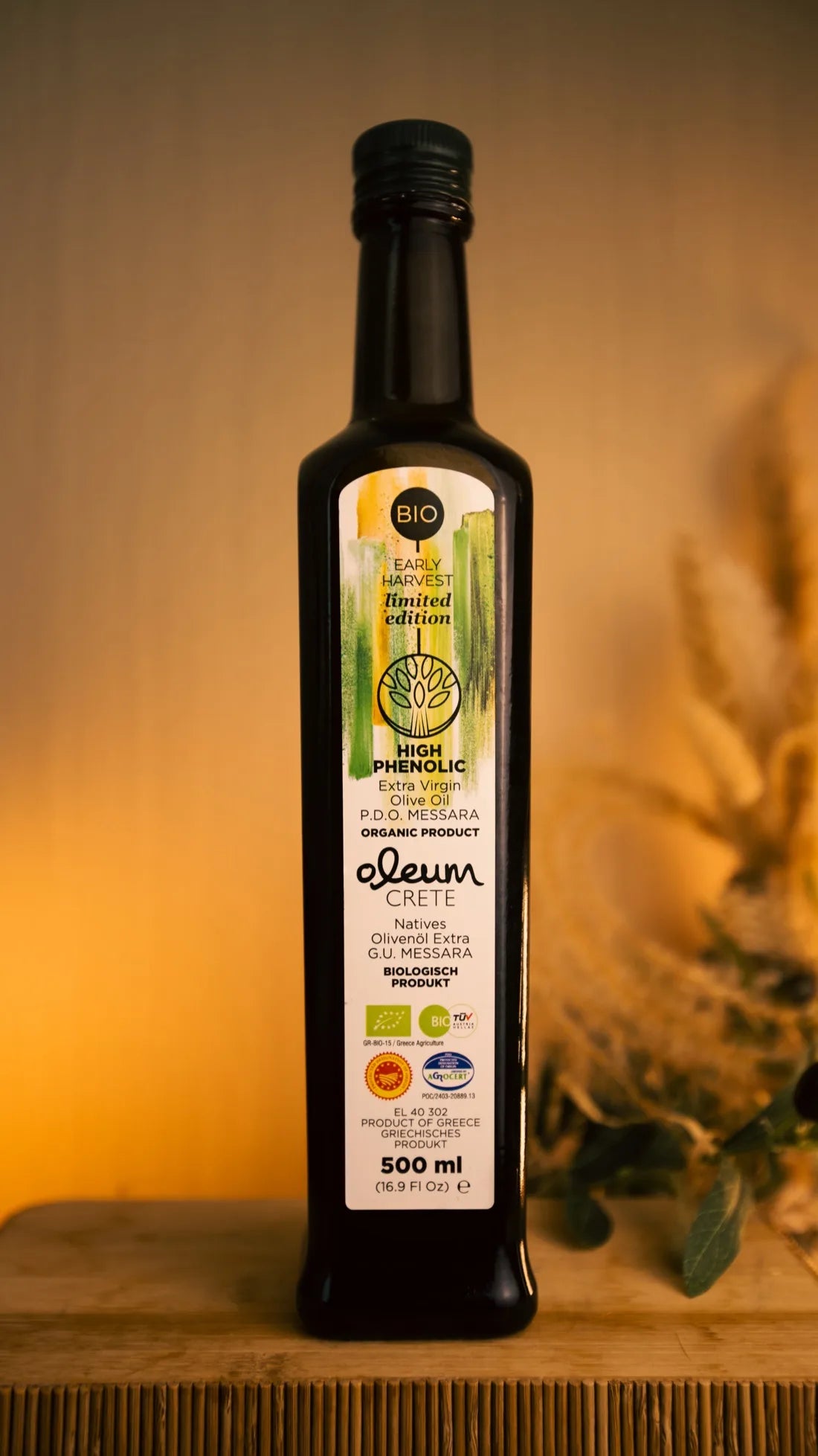
Our organic range meets each point on that list. The Organic Early Harvest Olive Oil (500ml) is our high-polyphenol pressing, picked green for maximum pepper and bitterness. The Organic Extra Virgin Olive Oil (750ml) is our everyday PDO Messara oil for cooking and the table. The Collection Premium Organic Olive Oil (500ml), in its black bottle, is the one we make for gifting. If you are deciding between the first two, start by comparing our Early Harvest and Classic organic oils.
Every order ships free across the UAE, temperature-controlled, within 24 hours. That means the oil arrives as it left the bottle.
Frequently asked questions
Is organic olive oil healthier than non-organic olive oil?
Not automatically. The EU-authorised health claim relates to olive oil polyphenols, and polyphenol content depends on variety, harvest timing and milling, not organic status. Organic oil does carry a lower likelihood of synthetic pesticide residue. If you have a specific health question, ask your doctor or a registered dietitian.
Does organic olive oil cost more, and is it worth the price difference?
It usually costs more, because organic farming and annual certification audits cost more to run. Whether it is worth paying depends on what you value. If avoiding synthetic pesticide residue matters to you, organic is worth it, provided the oil also shows a harvest date, a polyphenol figure and a traceable origin.
Can non-organic olive oil still be high in polyphenols?
Yes. A conventionally farmed oil from early-harvest fruit, milled within hours, can test higher in polyphenols than an organic oil made from late or delayed fruit. Polyphenols are set by the fruit and the speed of milling, which organic rules do not govern.
How do I check if an olive oil is genuinely certified organic?
Look for the EU organic logo and the control body code printed near it, which identifies the certifier that audited the producer. Under EU rules, both growing and processing facilities must be audited before the logo can be used. A named single estate makes the claim easier to trace, and helps guard against false organic labelling.
Is PDO certification the same as organic certification?
No. Organic certification covers farming inputs and is governed by Regulation (EU) 2018/848. PDO protects origin and is registered under a separate scheme, Regulation (EU) No 1151/2012. An oil can hold one, both or neither. Our organic oils carry both, as PDO Messara pressings from a single estate.
If you want an oil that's organic, single-estate and pressed within a day of harvest, shop the Oleum Crete collection and taste the difference for yourself.
More from the Journal
All entriesIs High Polyphenol Olive Oil Healthy? Dose and Side Effects
High polyphenol olive oil carries a real, EU-recognised health claim, but only at the right dose and only if the oil actually earns the label. Here is what the science says, how much to take, and what can go wrong if you overdo it.

Oleum Crete: services, prices and where we work
What we do Oleum Crete imports and sells single estate, PDO Messara extra virgin olive oil from the Kidonakis family estate on Crete's Messara Plain, direct to consumers across the UAE. The range…

Koroneiki Olive Oil Taste: Pepper, Grass and That Throat Catch
Bitter, grassy, peppery, and that sharp catch at the back of the throat: this is what a genuine koroneiki olive oil tastes like, and why it has nothing to do with a faulty bottle.
