
Olive Oil Harvest Date and Price: What One Day Really Costs
A single-day harvest costs more to produce than oil pressed from weeks of mixed picking, and the price difference shows up on the shelf. Here is what that premium buys, bottle by bottle.

In this article8 sections
Key takeaways
- Single-day harvest oil such as Oleum Crete's One Day costs more to produce because every olive is picked and pressed within hours. It is not gathered over weeks of mixed ripeness.
- Price per serving matters more than price per bottle. A 500ml bottle used sparingly to finish dishes can cost less per meal than a cheaper multi-litre tin poured generously into a frying pan.
- The harvest date predicts polyphenol content and freshness of flavour. The best-before date does not, so two oils with the same shelf life can differ sharply in quality.
- PDO Messara certification and single-estate, single-variety Koroneiki sourcing carry verification costs that generic blended extra virgin oils skip entirely.
- Bottle price alone does not tell you the landed cost. UAE import duty and logistics add to what a bottle costs before it reaches your door.
What Does Olive Oil Harvest Date Have to Do With Price?
The link between olive oil harvest date and price is simple. The closer the pressing is to the moment of picking, and the narrower the window of fruit that goes into it, the more each litre costs to make. In the UAE, authentic extra virgin olive oil generally averages AED 80 to 130 per litre, and rarely sells below AED 70 a litre. A single-estate, single-day harvest oil like Oleum Crete's One Day sits at the top of that range, reflecting the cost of picking a narrow window of fruit rather than a season's worth.
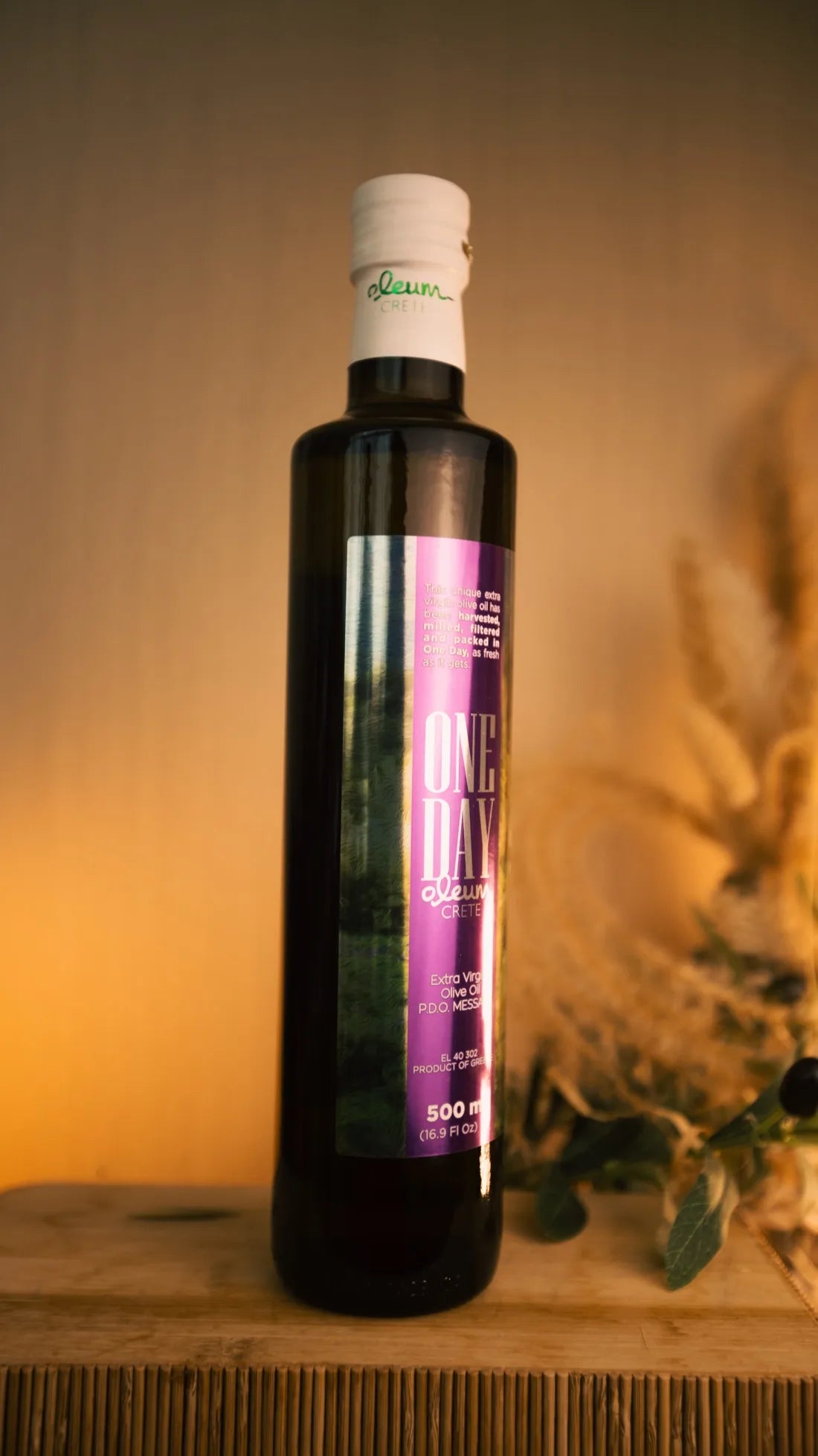
At Oleum Crete, our One Day oil is built around that idea. Koroneiki olives from the Kidonakis family estate on Crete's Messara Plain are hand-picked and in the bottle within a day.
Conventional oil works differently. Many producers collect fruit over a long harvest season and store it before milling. They then press large mixed batches of ripe, overripe and green olives together. That spreads the cost of labour, transport and milling across a far larger volume, so each litre is cheaper. It also blurs the flavour. The grassy, peppery character of fresh-pressed Koroneiki fades as fruit waits in crates.
The harvest date also sets the starting point for the oil's chemistry. Polyphenols, the compounds behind that bitter, peppery catch at the back of the throat, begin to decline from the day the olives are picked. For pricing, the point is this: a date close to picking costs more to achieve, and it is the date that tells you most about what is in the bottle.
Why Single-Day Harvest Costs More to Produce
Three production choices drive the cost of a single-day harvest. Each one trades volume for precision.
Picking Only Ripe Fruit, Not a Whole Season's Fruit
A single day's harvest means choosing the moment the fruit is right and picking only that. Nothing is held back to make up the volume later. Picking earlier, when olives are still green, raises the cost further. Green-stage olives contain only 8 to 14% oil by weight, and a producer needs two to three times more fruit to make the same volume of early-harvest oil.
Koroneiki adds its own pressure. The fruit is tiny, under a gram, and the yield per tree is low. That is why Koroneiki oil costs more per litre than high-yield varieties grown elsewhere. You get a fragrant, green-tomato-and-artichoke oil from a small olive, and you pay for the many olives it takes.
Pressing Within Hours Means a Smaller, Faster Mill Run
Fruit picked in a single day has to reach the mill that day. That means smaller, separate pressings rather than one long run of stored olives. Every batch is kept apart, so the oil can be traced to its estate, its variety and its day. The mill cannot simply wait for enough fruit to fill a large run. The schedule follows the harvest, and the harvest follows the fruit.
Hand-Harvesting Versus Mechanical Stripping
The Kidonakis family estate on the Messara Plain harvests entirely by hand. Hand-picking is slower and needs more people than mechanical shaking or stripping. It also bruises less fruit, and bruised olives begin to oxidise before they reach the press. With hand-harvested olives, you are paying for the care that keeps the fruit intact until it is crushed.
One Day's Price Per Bottle, Per Litre and Per Serving
Shelf price is the least useful number on an olive oil label. What matters is how much oil each meal uses and what that oil does on the plate.
Our range comes in three sizes. The table shows how many 15ml tablespoons each holds. As a guide, authentic extra virgin olive oil in the UAE averages AED 80 to 130 per litre, so divide a bottle's price within that range by its servings to get your cost per spoonful.
| Product | Size | Approx. 15ml servings | Best suited to |
|---|---|---|---|
| One Day Extra Virgin Olive Oil | 500ml | 33 | Finishing, dipping, raw dishes |
| Organic Early Harvest Olive Oil | 500ml | 33 | High-polyphenol, peppery finishing |
| Collection Premium Organic Olive Oil | 500ml | 33 | Gifting, special tables |
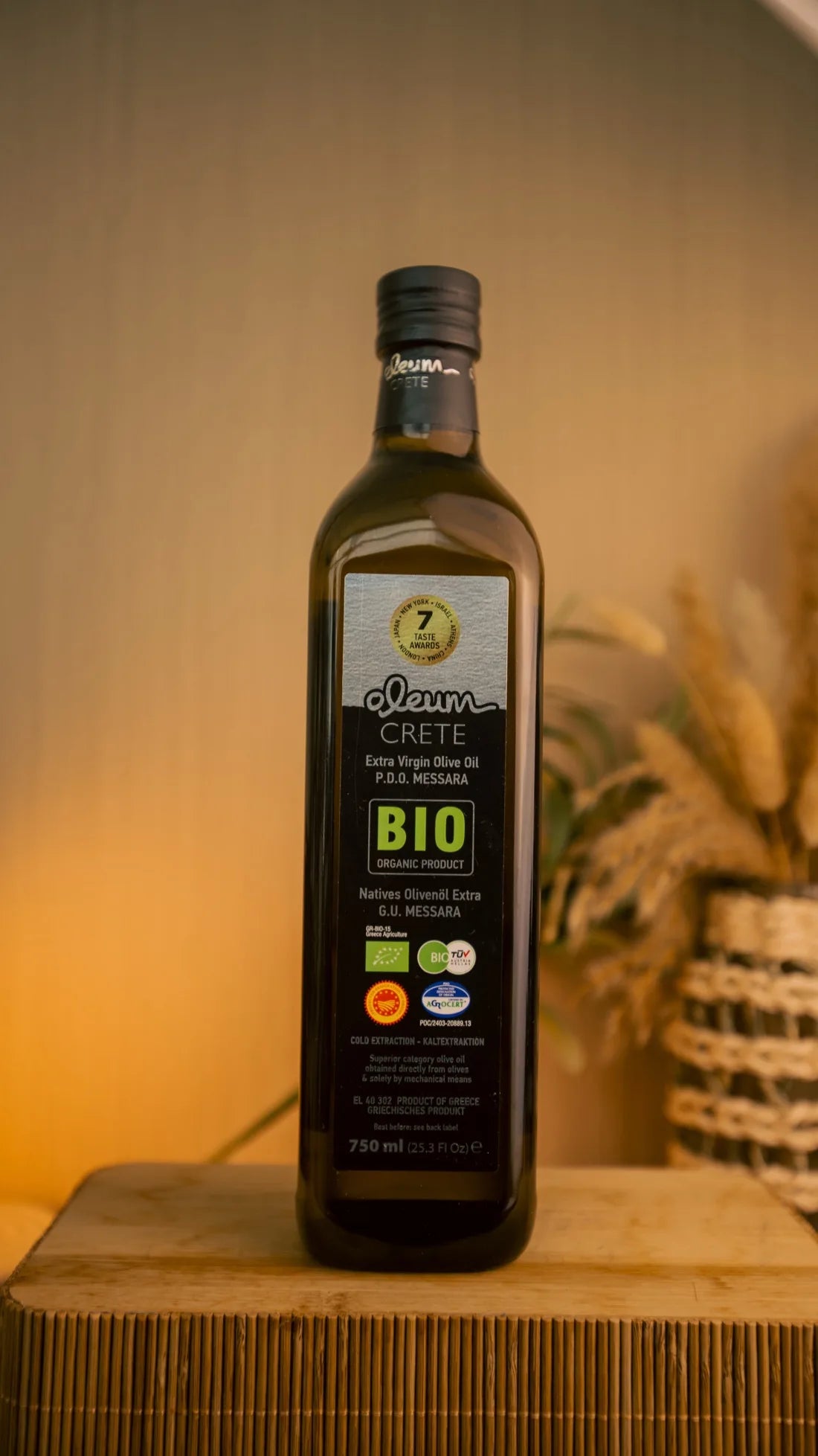
| Organic Extra Virgin Olive Oil | 750ml | 50 | Everyday PDO cooking and dressing |
| Extra Virgin Olive Oil 5L Tin | 5 litres | 333 | Heavy cooking, large households, catering |
Working Out Cost Per Serving
The formula is the bottle price divided by the number of servings you actually use. As a reference point, genuine single-estate early-harvest Cretan oil sells at the mill for 8 to 25 euros a half-litre, depending on harvest date and certification, while authentic oil in UAE shops typically lands at AED 80 to 130 a litre. At the top of that range, a 500ml bottle works out at well under a dirham or two per tablespoon.
Now think about how you use it. A tablespoon of One Day Extra Virgin Olive Oil drizzled over grilled halloumi or a tomato salad is one serving. A shallow-fry can take several tablespoons from a tin, and most of that oil stays in the pan. The cheaper oil can end up costing more per meal, simply because so much more of it goes in.
Why a Smaller Bottle Can Still Be the Better Buy
Once a bottle is opened, air and light start working on the oil. A 500ml bottle that a household finishes within a few weeks is used while its aromas are still vivid. A large tin opened for occasional finishing may lose that brightness before the last litre is poured. Match the size to how quickly you get through it, and the smaller bottle often gives better value per serving and better flavour.
One Day Versus Multi-Week Harvest and Supermarket Blends
UAE shoppers meet three broad kinds of extra virgin olive oil. Here is how they compare on the points that affect price.
| Single-day harvest, single estate (One Day) | Multi-week harvest, single origin | Supermarket blend | |
|---|---|---|---|
| Harvest practice | Picked and pressed within a day | Fruit gathered and milled over weeks | Fruit and oils from many sources |
| Variety | 100% Koroneiki | Often single variety | Usually mixed |
| Traceability | One estate, one valley, one day | One region, many days | Often several countries |
| Certification | PDO Messara | Varies | Rarely PDO |
| Typical price position | Top of the market | Middle | Lowest |
The price gap is wide. A single-estate early-harvest Koroneiki at 18 to 25 euros a half-litre is a different product from a 6-euro supermarket blend. Prices across Crete have also risen with drought. Extra virgin Koroneiki that sold to wholesalers for 5 to 7 euros a litre in 2020 sells for 11 to 15 euros in 2026. Greek Koroneiki also costs more than oil from higher-yield varieties grown elsewhere, for the reasons set out above.
What a bottle costs at origin is not what it costs once it reaches the UAE. UAE customs apply a 5% tariff on the CIF value of imported olive oil, and import duties plus logistics typically add another 12 to 18% to the landed cost, once freight, port handling and GCC-standard bilingual labelling are included. That gap between mill price and shelf price is one reason a genuine single-estate oil sold in Dubai costs more than the same oil would at the Cretan mill gate.
What the Premium Actually Buys You
Taste is the obvious reward. The less visible part of the price pays for proof.
PDO Messara Certification and Traceability
PDO Messara is a protected designation of origin. It ties the oil to a defined area of Crete's Messara Plain and to the production rules that come with that name. Meeting those rules involves inspection and record-keeping that a blended oil does not need. Our oil is 100% Koroneiki from a single estate, with no blending, so the origin on the label is the whole story.
PDO certification also gives you a way to check provenance without simply trusting the brand. That matters if you have ever wondered whether a supermarket "extra virgin" bottle is what it claims to be.
Independent Checks: Competitions and Polyphenol Testing
International competitions give you an outside check on quality alongside our own tasting notes. The New York International Olive Oil Competition (NYIOOC) is one of the most respected panels judging oils like ours, and recognition there is worth more than a brand's own description of itself.
Polyphenols are a second check. There is no legal minimum for polyphenol content, so any figure on a label is worth testing against its source. Our oil tests above the 250mg/kg level associated with the EU antioxidant claim; check the current lab result and harvest date on the product page. Under Commission Regulation (EU) No 432/2012, the authorised wording of that claim is: "Olive oil polyphenols contribute to the protection of blood lipids from oxidative stress." We make no claim beyond that wording. If you have a specific health question, a doctor or registered dietitian is the right person to ask.
Shipping Suited to UAE Heat
Heat damages olive oil, and the UAE summer is hard on any bottle left in a warehouse or a delivery van. We ship our oil protected from heat rather than leaving it to sit in transit. Check the Oleum Crete site for current delivery terms and timing, as these can vary by order and location.
Who Should Pay the One Day Premium, and Who Shouldn't
Not every bottle in your kitchen needs to be our most expressive oil. The right choice depends on how you cook.
For Daily Cooking on a Budget
If most of your oil goes into the pan for sautéing vegetables, roasting or slow-cooked stews, much of the fine aromatic detail is softened by heat. The 750ml Organic Extra Virgin Olive Oil, our everyday PDO Messara oil, is made for this. It has the same estate, the same Koroneiki and the same certification, in a size built for daily use. For large families or catering kitchens, the 5L tin lowers the cost per serving further, provided you get through it reasonably quickly.
For Finishing Dishes, Gifting or High-Polyphenol Use
One Day earns its price where you can taste it raw. Try it on labneh, warm bread, grilled fish or a plate of ripe tomatoes, where the garden-herb nose and clean peppery finish come through. If you are choosing a gift olive oil in the UAE for someone who loves Mediterranean food, the Collection Premium Organic Olive Oil in its black bottle is designed for the table and the gift bag. For those who want the boldest, most peppery profile, the Organic Early Harvest bottle is our high-polyphenol pressing.
A Four-Point Check Before You Pay a Premium Price
Use these checks on any bottle, ours or anyone else's, before deciding whether the price is justified.
- Find the harvest date, not just the best-before. The harvest date tells you when the olives were picked, and polyphenols start falling from there. Best-by dates are set by the bottler. Some quality bodies cap them at 24 or 32 months after harvest, so look for the most recent harvest you can find.
- Look for a named origin and certification. A PDO name, a single estate and a single variety mean the origin is specific and can be checked. "Blend of EU and non-EU oils" means it cannot.
- Ask for the polyphenol test behind any figure. Look for a named lab, a test method and a date within 12 months. For reference, 250mg/kg or more is the level associated with the EU antioxidant claim.
- Check how it reaches you. Ask how the oil is stored and shipped in UAE heat, and what import duty, logistics and delivery terms add to the shelf price.
When you are ready to compare bottles side by side, browse the full Oleum Crete collection.
Related: How harvest date affects polyphenol levels · Why Greek olive oil costs more than Italian or Spanish oil
Frequently asked questions
Does a later harvest date mean lower quality olive oil?
Not necessarily. Later-harvest oil from riper fruit tends to be softer and more buttery, with fewer polyphenols than early-harvest oil, and some people prefer that style. What matters more is how recent the harvest is and how well the oil has been stored since.
Why is Greek olive oil generally more expensive than Italian or Spanish oil?
Varieties like Koroneiki have very small fruit and low yields per tree, so each litre takes more olives and more labour. Many Greek estates are small and family-run, with hand-harvesting on hillside groves, and recent droughts on Crete have pushed prices up further.
Can I find the exact harvest date printed on an Oleum Crete bottle?
Yes. Every Oleum Crete bottle is labelled with the single-day harvest date it comes from, as part of our One Day harvest-to-bottle process. If you want more detail about a specific bottle, call us on +971 50 790 6847.
Does paying more always mean higher polyphenol content?
No. Price reflects many things, including packaging, branding and import costs, and there is no legal minimum for polyphenol content. A named lab result with a recent date is a far better guide than the price tag.
How much olive oil should I use daily to make the cost worthwhile?
There is no fixed amount. Value depends on how you use the oil rather than on hitting a daily quantity. A spoonful to finish a dish shows off a premium oil, while cooking volumes suit a larger everyday bottle. If your question is about diet or health, a registered dietitian can advise on your situation.
Is a 5L tin better value than a 500ml bottle for everyday cooking?
For heavy cooking in a busy household or a catering kitchen, yes, the 5L tin usually lowers the cost per serving. If you use oil mainly for finishing, a 500ml bottle finished within a few weeks keeps more of its fresh aroma. Choose the size you will use while the oil is at its best.
Taste the difference a single day makes: shop the Oleum Crete collection and check current delivery terms for your order.
More from the Journal
All entriesKoroneiki Olive Oil and Heart Health: What Studies Show
Koroneiki olive oil carries some of the highest polyphenol counts of any olive variety, and that matters for heart health. We look at what the research actually shows, what the EU health claim permits us to say, and how much oil delivers it.

Olive Oil Acidity Level: How to Check Before You Buy
Acidity is the one number most shoppers skip past on an olive oil label, yet it decides whether a bottle can legally call itself extra virgin. Here is how to find it, read it and check it against the PDO Messara standard before you buy.

How Much Olive Oil Should a Family of Four Buy Monthly?
Most households either run out of olive oil mid-month or let a bottle oxidise on the shelf. Here is a concrete monthly estimate for a family of four, broken down by cooking, salads and daily shots, mapped straight onto Oleum Crete's 500ml, 750ml and 5L sizes.
