
Olive Oil Harvest Date vs Best-Before Date: What Changes Polyphenols
A harvest date tells you when the olives were picked. A best-before date tells you the latest point of sale, often two years out, and says nothing about polyphenol content. Oleum Crete explains the difference and why single-day harvest-to-bottle timing matters more than any date printed on the back

In this article7 sections
Key takeaways
- A harvest date records when the olives were picked. A best-before date is a shelf-life marker, commonly set up to 24 months after bottling, and it says nothing about polyphenol content.
- Polyphenol levels are largely set at harvest and milling. The faster olives reach the press after picking, the more of their phenolic compounds survive into the oil.
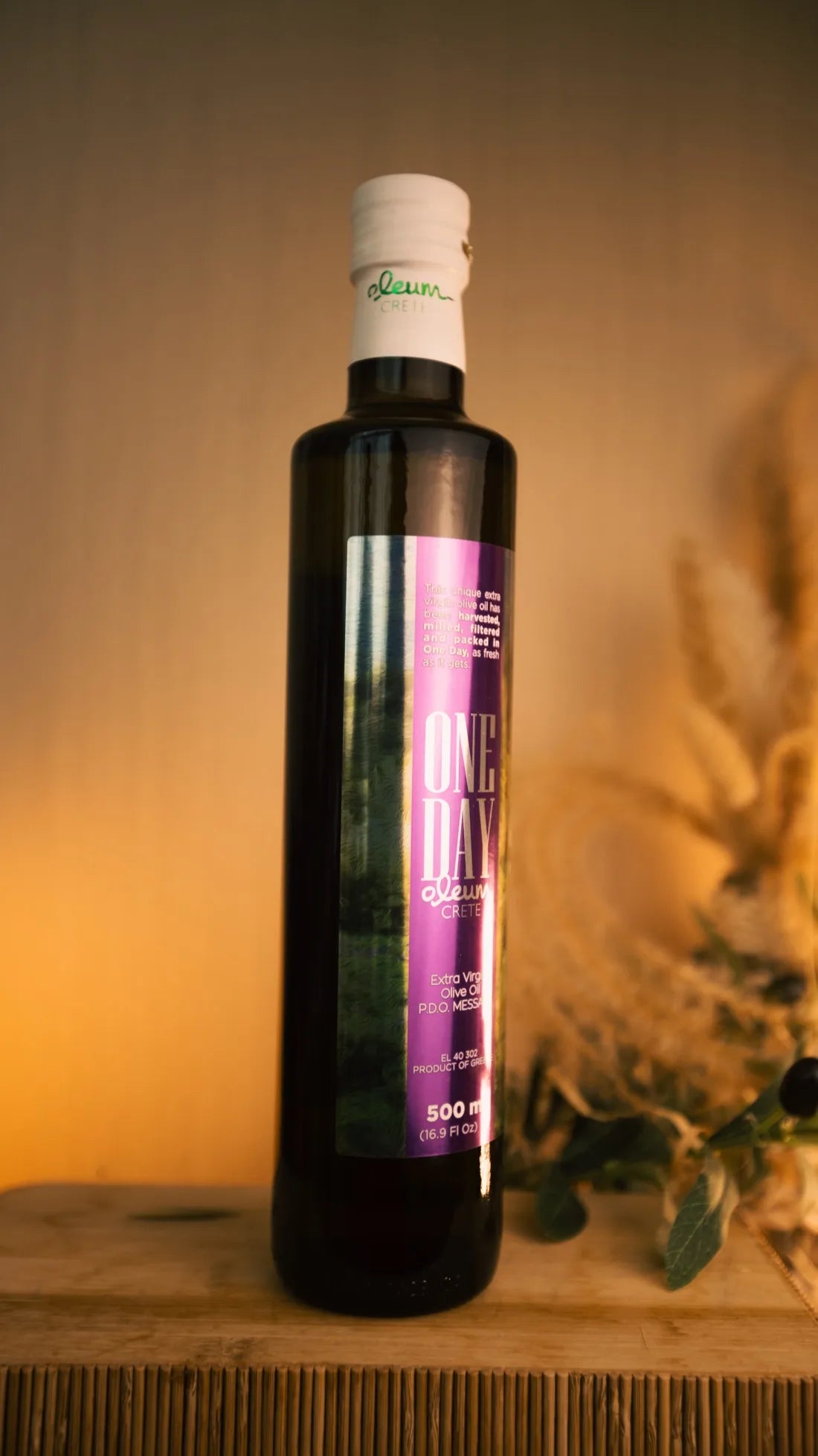
- Oleum Crete's One Day Extra Virgin Olive Oil is pressed within a day of picking on the Messara Plain. Bulk-milled oils, made from olives gathered over several days, rarely match that timeframe.
- PDO Messara certification ties an oil to one protected valley, and EU rules allow a harvest year on the label only when all of the oil comes from that harvest. Look for both, not a best-before date alone.
- A best-before date marks the outer limit for sale. It does not tell you whether the oil was fresh and rich in polyphenols when it was bottled.
On olive oil, the harvest date and polyphenols are closely linked, and the best-before date is largely beside the point. Polyphenols, the compounds behind a fresh oil's bitterness and peppery finish, are set mostly in the hours between picking and pressing. After that they only decline. A best-before date counts forward from bottling, which can happen long after the olives were milled. At Oleum Crete we press single-estate Koroneiki olives from the Kidonakis family groves on Crete's Messara Plain within a day of harvest. That is why we treat the harvest clock as the date that matters. Here is how to read both dates and what each one can and cannot tell you.
Harvest Date vs Best-Before Date: What Each One Actually Means
What the Harvest Date Tells You
The harvest date anchors an oil to one crop. Under Commission Delegated Regulation (EU) 2022/2104, the harvesting year may be shown either as the marketing year or as the month and year of harvest. The month must correspond to the month the oil was extracted from the olives. Only extra virgin and virgin olive oil may carry it, and only if 100% of the contents come from that harvest.
In practice, the harvest date tells you two things. It tells you when the oil was made. It also tells you the bottle holds a single season's crop rather than a mix of old and new.
What the Best-Before Date Tells You
A best-before date is a shelf-life marker set by the producer. For commercial extra virgin olive oil, industry guidance commonly places it up to 24 months after bottling, on the assumption that the oil is stored correctly. The count starts at the bottling line, not in the grove.
This is the key distinction. Two oils with the same best-before date could have been milled many months apart.
Why Buyers Confuse the Two
Most foods carry one date, and for bread or milk it works well, because production and packing happen almost together. Olive oil breaks that pattern. Oil can rest in tanks before it is bottled, so the gap between pressing and bottling can be wide, and a best-before date hides that gap completely. When the harvest date is missing, the best-before date becomes the only date on the label, and buyers reasonably read it as a freshness signal. It is not one.
Why Polyphenol Levels Fall After Harvest, Not After Bottling
The decline starts in the grove, not on the shelf. By the time an oil is bottled, much of its polyphenol story has already been written.
Oxidation Starts the Moment Olives Are Picked
Once an olive leaves the branch, its cells begin to break down. Bruising, warmth and time in crates set off enzymatic and oxidative changes in the fruit. A 2023 study found that the quality of olives stored at room temperature drastically decreases after five days of storage, while holding them at 5°C for five days may help maintain high oil quality. Cold storage buys time. Pressing quickly removes the need for it.
How Milling Speed Changes the Final Polyphenol Count
The mill captures what the fruit still holds. Whatever phenolic content survived the journey from tree to press is what passes into the oil, and nothing added later can restore it. A fruit pressed hours after picking reaches the mill closer to its state on the branch than one that waited days in a bin.
This is the principle behind our One Day Extra Virgin Olive Oil. Koroneiki olives from the Kidonakis family estate on the Messara Plain are hand-harvested and pressed within a day. Picked at dawn and pressed within hours, the oil keeps a brightness of green tomato, garden herb and a clean, peppery finish that slower oils lose before they ever reach the bottle.
Why a Bottling Date Can Mislead You
Some labels show a bottling or packing date. It looks like freshness information, but it only records when the oil moved from tank to glass. An oil milled early in one season can be bottled months later and still carry a recent date. Meanwhile, polyphenols keep declining in storage. One Australian trial reported losses of total polyphenol over 36 months ranging from 0% to 19% of the initial content for oils stored at 15°C and 22°C. A bottling date tells you none of that history.
How to Read a PDO Messara Label for the Harvest Date
Where the Harvest Date Appears on a PDO Bottle
Look on the back or side label, usually near the lot number and best-before date. Under the EU rules above, the harvest appears in one of two forms. It may be a marketing year, shown as two years joined by a slash, or a month and year. A month and year is the more precise of the two, because it places the oil within a single extraction month.
What PDO Certification Adds That a Generic Label Doesn't
A protected designation of origin names one place. On a PDO Messara bottle, "Messara" is a protected claim about where the olives grew, not a flavour description. That matters because EU origin labelling must spell out split origins. If olives are harvested in one country and milled in another, the label must state that the oil was "obtained in" one place "from olives harvested in" another. A single-estate oil grown, picked and pressed in the same valley has a far shorter chain between tree and bottle, and a harvest date on it describes one crop from one place.
For a wider set of label checks beyond the harvest date, see our label checklist for choosing Greek olive oil in the UAE.
Spotting a Label With No Harvest Date at All
A missing harvest date is not proof of a poor oil, because showing the harvest year is optional. But remember the rule: it may appear only when 100% of the oil comes from that harvest. A blend across seasons cannot show one. If a bottle carries only a best-before date and a broad origin such as a mix of EU oils, you have no way to judge its harvest clock from the label. Ask the seller directly.
One-Day Harvest vs Multi-Week Harvest: A Side-by-Side Comparison
Time From Picking to Press
In a one-day system, each day's picking is milled the same day. In a multi-week harvest feeding a bulk mill, olives from many groves are gathered over days or weeks. Each load may wait before its turn at the press.
Typical Effect on Polyphenol Retention
The research above points one way: the longer olives sit at room temperature, the more quality they lose. Shorter waits generally mean more of the fruit's phenolic content reaches the oil.
What It Means in the Bottle
| One-day harvest to press | Multi-week harvest, bulk milling | |
|---|---|---|
| Time from picking to press | Within a day | Can stretch to several days per batch |
| Fruit condition at the mill | Close to its state on the branch | Exposed to bruising, warmth and time in crates |
| Source of olives | Single estate, single variety | Often pooled from many groves |
| Polyphenol retention | Higher share of the fruit's phenolics survive | Losses build with every day of waiting |
| Flavour in the glass | Green, bitter, peppery, aromatic | Flatter, softer, fewer fresh notes |
| Harvest date on label | One specific crop, easy to state | Often a marketing year, or omitted |
What a Best-Before Date Can't Tell You About Freshness
Why a Long Best-Before Window Is Normal
Well-made extra virgin olive oil keeps for a long time when it is protected from light, heat and air. A window of up to 24 months from bottling is standard practice, not a warning sign. The trouble is only that the window starts from bottling. It tells you nothing about the months that may have passed before.
Best-Before Dates Mark a Regulatory Minimum, Not a Quality Peak
A best-before date is the producer's promise that the oil should still meet its grade until that day under the stated conditions. It is a floor, not a peak. EU rules also require olive oil labels to state that the oil must be stored away from light and heat, because the date assumes that care. An oil is at its freshest soon after milling. The best-before date sits at the opposite end of its life.
How Oxidation Continues After the Date Is Printed
Printing a date does not pause the chemistry. One long-term study found that phenolic compounds degraded at a similar initial rate at 5°C and 15°C. The rate increased considerably at 25°C and was faster still at 50°C. The same research notes that storage temperature even affects how long an oil can support the EU-authorised claim that "olive oil polyphenols contribute to the protection of blood lipids from oxidative stress".
In a warm climate, that makes storage at home part of the freshness question. Keep the bottle closed, in a cool, dark cupboard, away from the hob and sunny windows. For what happens once the cap is off, read our guide to how long olive oil really lasts after opening.
A Four-Point Checklist Before You Trust a Harvest Date
Look for a Specific Harvest Date, Not Just a Year
A month and year places the oil within one extraction month. A marketing year spans a full season. Both are lawful, but the month tells you more. Choose the most recent harvest available, and treat its absence as a reason to ask questions.
Confirm the PDO or Estate Name Matches the Date
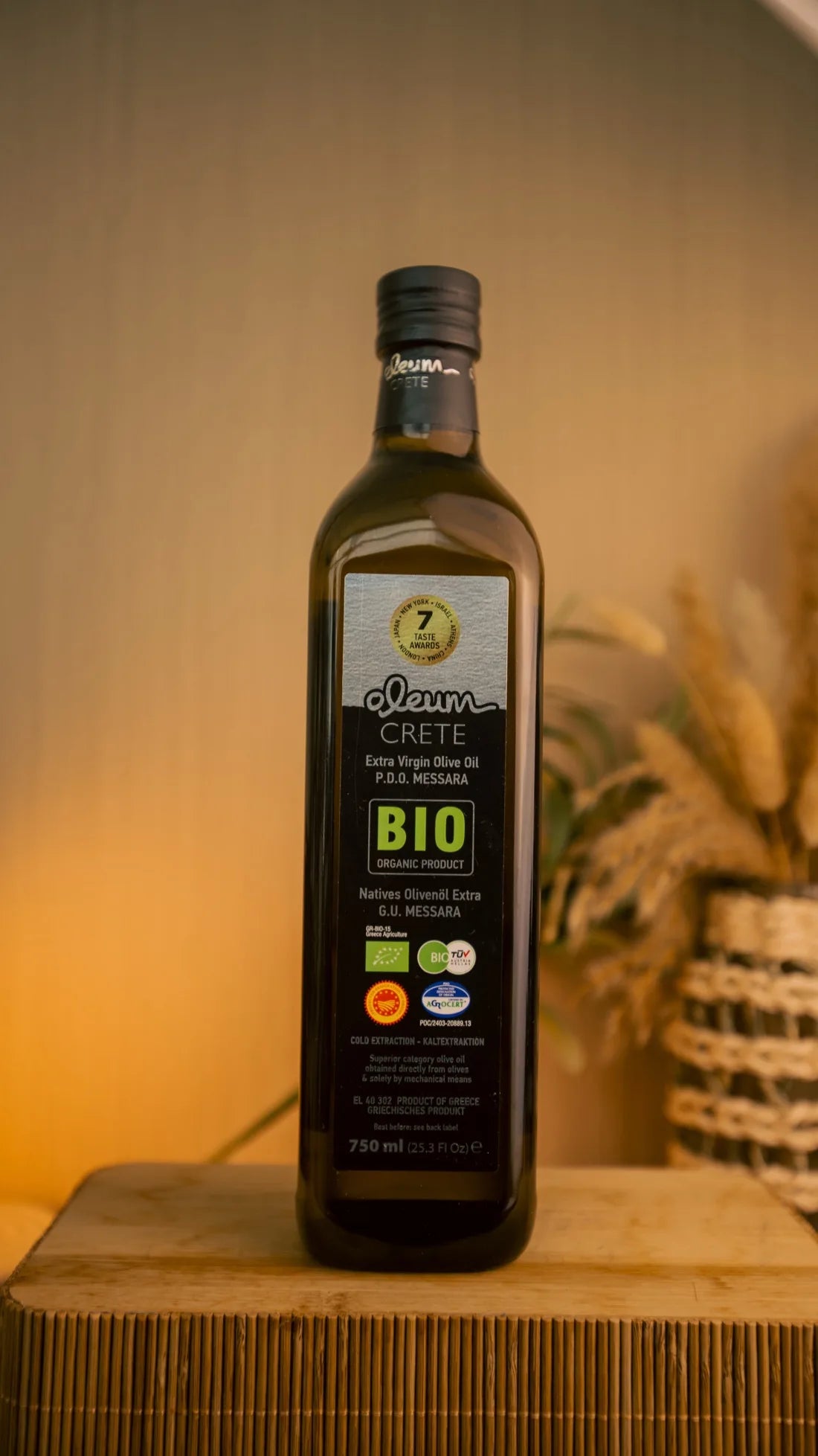
A harvest date means most when it belongs to a named place. Check that the PDO area or estate on the label is a single origin, and that nothing in the origin wording suggests olives were grown in one place and milled elsewhere. Our Organic Extra Virgin Olive Oil 750ml is PDO Messara, organic and 100% Koroneiki from one estate.
Ask How Long Passed Between Picking and Pressing
Few labels state this, so ask. A producer who presses quickly will know the answer. If the reply is vague, or the olives were bought in from many growers over weeks, the harvest date tells you less than it seems to.
Check the Polyphenol Figure Against the Harvest Date
A polyphenol figure is a measurement taken on a particular date, not a fixed property of the oil. Ask when it was tested and against which harvest it belongs. Levels decline during storage, so a high figure measured at milling describes the oil as it was then, not necessarily as it is on the shelf months later.
Frequently asked questions
Is a harvest date the same as a 'produced on' date?
Not always. Under EU rules, a harvest month must match the month the oil was extracted from the olives, so it reflects milling. A "produced on" or "packed on" date may instead mark bottling, which can come months later. Check which event the date describes.
Why do some olive oil labels only show a best-before date?
The harvest year is optional on extra virgin and virgin olive oil. It may only appear when 100% of the oil comes from that harvest, so blends across seasons cannot show one. Some producers of single-harvest oils simply choose not to print it.
How long after harvest should olive oil be pressed to protect polyphenols?
There is no single legal deadline, but the research is consistent: shorter is better. One study found olive quality dropped drastically after five days at room temperature, while cold storage at 5°C helped hold it. We press our One Day olives within a day of picking so they barely wait at all.
Does olive ripeness at harvest affect polyphenol levels?
Yes, ripeness is one factor among several. Peer-reviewed research has found that polyphenol content varies with the ripeness index of the olives at picking, alongside variety, growing conditions and milling speed. Rather than judging ripeness from the calendar month alone, ask for a measured polyphenol figure tied to a specific harvest.
Can polyphenol levels be verified after the oil is bottled?
Yes. A laboratory can measure polyphenols in a bottled oil at any time. The result reflects the oil on the day of testing, so ask the producer when their figure was measured and compare it with the harvest date.
Pressed within a day of picking on the Messara Plain, Oleum Crete oils carry their harvest clock from grove to glass. Shop the Collection and taste the difference a single day makes.
Read next: Olive Oil Harvest Date and Price: What One Day Really Costs
Read next: Does Harvest Date Change Olive Oil's Smoke Point for Cooking?
More from the Journal
All entriesKoroneiki Olive Oil and Heart Health: What Studies Show
Koroneiki olive oil carries some of the highest polyphenol counts of any olive variety, and that matters for heart health. We look at what the research actually shows, what the EU health claim permits us to say, and how much oil delivers it.

Olive Oil Acidity Level: How to Check Before You Buy
Acidity is the one number most shoppers skip past on an olive oil label, yet it decides whether a bottle can legally call itself extra virgin. Here is how to find it, read it and check it against the PDO Messara standard before you buy.

How Much Olive Oil Should a Family of Four Buy Monthly?
Most households either run out of olive oil mid-month or let a bottle oxidise on the shelf. Here is a concrete monthly estimate for a family of four, broken down by cooking, salads and daily shots, mapped straight onto Oleum Crete's 500ml, 750ml and 5L sizes.
