
Olive Oil Shots vs Capsules: Which Gives More Polyphenols
A daily shot of high-polyphenol extra virgin olive oil delivers far more polyphenols, in a more bioavailable form, than an olive oil capsule, and costs less per effective dose. Here is the comparison, with the numbers.

In this article8 sections
Key takeaways
- In the olive oil shots vs capsules comparison, the liquid shot wins on volume. A 20g shot of an oil above 800mg/kg supplies roughly 16mg of total polyphenols, comfortably above the EU health claim threshold of 5mg of hydroxytyrosol and its derivatives per 20g of oil.
- Oil-filled capsules commonly hold 0.5 to 1g each, so even a high-polyphenol oil inside one delivers a small fraction of what a 20g shot provides.
- Encapsulation, storage and time are all points where delicate phenolic compounds can degrade, and few capsule labels say when the oil inside was pressed.
- Oleum Crete's high-polyphenol pressings measure over 800mg/kg, well above the EU health claim threshold, so one daily shot covers a dose that oil-filled capsules cannot practically match.
- Cost per effective dose favours liquid oil. A 500ml bottle gives roughly 23 daily shots of 20g, while matching a single shot with oil-filled capsules means swallowing 20 to 40 of them.
Olive Oil Shots vs Capsules: The Short Answer
The answer to olive oil shots vs capsules comes down to weight. A liquid shot gives you far more polyphenols than an oil-filled capsule, because you swallow 20 to 40 times more oil. At Oleum Crete we press single-estate Koroneiki oil on Crete's Messara Plain, and our high-polyphenol pressings measure over 800mg/kg. A 20g shot of oil at that level carries about 16mg of total polyphenols. A 1g capsule of the same oil carries about 0.8mg.
Concentrated extract capsules are a different product. Some list several milligrams of olive polyphenols per capsule, but they are not olive oil, and the EU health claim for olive oil polyphenols is written around drinking the oil itself. If you want the polyphenols as they occur in the oil, alongside its flavour and its fat, the shot is the more direct route.
How Much Oil Fits in a Shot Versus a Capsule
The whole comparison rests on weight. Polyphenol content is measured in milligrams per kilogram of oil, so the amount you take in depends on how many grams of oil you actually swallow.
The EU Dose: 20g a Day
The EU's authorised health claim for olive oil polyphenols, set out in Regulation (EU) No 432/2012, applies only to oil containing "5 mg of hydroxytyrosol and its derivatives (e.g., oleuropein complex and tyrosol) per 20 g of olive oil". A label carrying the claim must also tell the consumer that "the beneficial effect is obtained with a daily intake of 20 g of olive oil". That is about 1.5 tablespoons.
Twenty grams is a comfortable single shot, taken straight from a spoon or a small glass, in one or two swallows. For more on portion and timing, see our dosage guide to how much olive oil to drink daily.
The Capsule Dose: What a Typical Softgel Holds
An oil-filled softgel commonly holds between 0.5g and 1g of oil. Even at the top of that range, a capsule holds one twentieth of a 20g shot. Two capsules a day, the usual label instruction, adds up to 1 to 2g of oil.
One guide to choosing capsules sets out the maths plainly: "Imagine a 1-gram capsule made from oil listed at 500 mg/kg total polyphenols. Each capsule contains about 0.5 mg of polyphenols, not 500 mg... To reach the EU's 5 mg, you would again need about 20 capsules". The mg/kg figure printed on a capsule box describes the oil, not the capsule. That is the most common misreading in this category.
Polyphenol Content: Shots and Capsules Side by Side
The table uses total polyphenols. The EU threshold of 5mg of hydroxytyrosol and its derivatives per 20g corresponds to roughly 250mg/kg total polyphenols in the oil, so the two measures are related but not identical.
| Format | Oil per dose | Polyphenols in the oil | Approximate polyphenols per dose |
|---|---|---|---|
| Liquid shot, high-polyphenol oil | 20g | 800mg/kg | 16mg |
| Liquid shot, oil at the EU threshold | 20g | about 250mg/kg | 5mg |
| Oil-filled capsule | 1g | 800mg/kg | 0.8mg |
| Oil-filled capsule | 0.5g | 800mg/kg | 0.4mg |
| Oil-filled capsule | 1g | 500mg/kg | 0.5mg |
| Concentrated extract capsule | Not oil | Varies by brand | Labels vary widely |
The bottom row needs care. Some extract-based supplements state 5 to 6mg of total olive polyphenols per capsule, while other products on the market claim a single capsule equals the polyphenols of several tablespoons of high-phenolic oil. Equivalence claims differ so much between brands that the only useful number is a tested milligram figure per capsule, with a test date.
It also helps to know what "extra virgin" does not tell you. The grade means the oil meets legal limits for acidity and peroxides: EEC Regulation 2568/91 sets acidity below 0.8% and peroxides below 20 meq O₂/kg. It says nothing about polyphenols. Two oils can both be extra virgin and differ several-fold in phenolic content, which is why we publish ours.
Why Capsules Lose Polyphenols Before You Swallow Them
Polyphenols are fragile. They are the compounds that give a fresh, early-harvest oil its bitterness and the peppery catch at the back of the throat, and they decline with heat, light, air and time. A capsule does not exempt the oil inside from any of these. It adds steps.
Processing and Heat During Encapsulation
Softgel shells are formed from warmed gelatin or plant-based material, and the oil is filled, sealed and dried by machine. Any stage that warms the oil or exposes it to air is a stage where phenolic compounds can degrade. How much is lost depends on the manufacturer's process, and capsule labels rarely say. With a bottled oil, the chain is shorter: pressing, settling or filtering, bottling. Our One Day range goes from tree to bottle within a single day.
Oxidation Inside the Shell Over Time
A sealed capsule limits contact with air, but it does not stop the clock. Research cited in a patent on high-polyphenol oil production found that one high-polyphenol extra virgin oil no longer met the EFSA requirement of more than 250ppm about ten months after production, while a specially processed oil held 280ppm at 18 months. Starting high matters, and so does the date.
Capsule boxes tend to show a best-before date, not a harvest or pressing date. Without that, you cannot tell how far through its life the oil already is. Light matters too: an oil in clear glass under supermarket-style lighting can lose up to 96% of its polyphenols over a few months, against about 25% in an opaque container. Whatever format you choose, ask how and where it has been stored.
Does the EU Health Claim Apply to Capsules?
The claim in EU Regulation 432/2012 is written around olive oil as a food. Its conditions are a polyphenol content per 20g of olive oil, and a statement that the benefit comes from a daily intake of 20g of that oil. Capsule makers acknowledge the same point: the EU allows olive oil to carry the claim "only if the oil contains at least 5 mg of hydroxytyrosol and its derivatives per 20 grams. The label must also explain that the benefit comes from eating 20 grams a day".
For an oil-filled capsule, that creates a practical problem. Meeting the 20g daily intake would mean swallowing 20 to 40 capsules. For an extract capsule, the product is no longer olive oil at all, so whether a particular supplement can lawfully use similar wording is a regulatory question for its manufacturer and the market where it is sold. We would not read a capsule's marketing as carrying the same meaning as the claim on a qualifying oil.
The claim is also narrow. It does not promise a cure, a weight change or any result beyond its own wording. Our guide to what the EU health claim does and does not cover sets this out in full. If you are considering olive oil or a supplement for a specific health reason, a doctor or registered dietitian is the right person to advise on your situation.
Cost Per Effective Dose: Shots Versus Capsules
Price per bottle or per box tells you little. The fair comparison is cost per dose that actually meets the threshold you care about.
Olive oil is slightly lighter than water, so 500ml weighs a little under 500g. That gives these approximate shot counts at 20g a day:
| Our bottle | Approximate 20g shots | Roughly lasts |
|---|---|---|
| 500ml (One Day, Organic Early Harvest, Collection Premium Organic) | 23 | Three weeks |
| 750ml (Organic Extra Virgin) | 34 | A month |
| 5L tin (Extra Virgin) | 228 | Seven months, shared across a kitchen |
To work out cost per effective dose yourself:
- Divide the bottle price by the number of 20g shots it holds.
- For oil-filled capsules, find the oil weight per capsule and the oil's mg/kg figure, then work out how many capsules match one shot. At 800mg/kg, that is 20 capsules of 1g or 40 of 0.5g.
- Divide the pack price by the pack count, then multiply by that number of capsules.
- For extract capsules, compare only the tested milligrams per capsule, and remember you are not getting olive oil itself.
Once you run that calculation, matching a single daily shot with oil-filled capsules tends to cost noticeably more than the shot itself, simply because of how many capsules the maths requires. A bottle avoids that arithmetic and gives you an oil you can also pour over tomatoes, beans or warm bread.
Choosing a High-Polyphenol Oil for a Daily Shot
For a daily shot, choose an oil with a published polyphenol figure, a recent harvest, and storage that has kept light and heat out. Every Oleum Crete oil is 100% Koroneiki from a single estate, the Kidonakis family's groves on the Messara Plain, hand-harvested and carrying PDO Messara certification. Four generations have worked the estate since 1983, and our pressings have won international taste awards, including at NYIOOC.
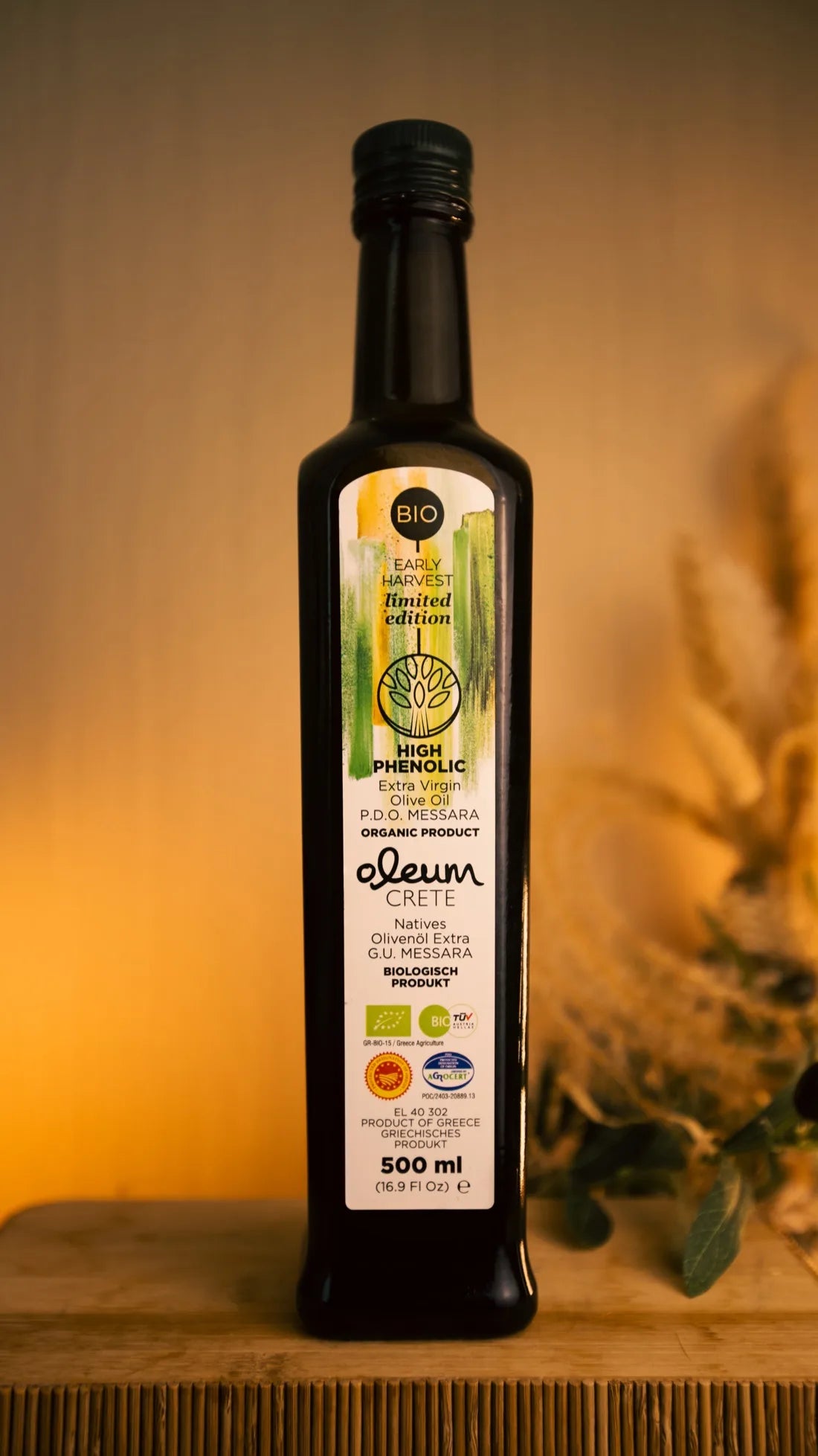
Our Organic Early Harvest Olive Oil is the bottle we point to first for a shot. It is picked early, when the olives carry their greatest bitterness and pepper, and it comes from pressings in our range that measure over 800mg/kg, well above the EU health claim threshold. The Collection Premium Organic, in its black bottle, comes from the same high-polyphenol range, and the dark glass is a quiet advantage for an oil you open every morning.
For the table, our One Day Extra Virgin Olive Oil is picked at dawn and pressed within hours, keeping its green tomato, garden herb and clean peppery finish. The 750ml Organic Extra Virgin is our everyday PDO oil for cooking and dressing. If you are new to shots, read how to take an olive oil shot raw, chilled or with lemon.
Every order ships in temperature-controlled conditions within 24 hours, with free delivery across the UAE and no minimum spend, so the oil reaches you as close to the press as we can manage.
Frequently asked questions
Can I take olive oil capsules instead of a shot if I dislike the taste?
You can, but check what the capsule contains: oil or extract, the milligrams of polyphenols per capsule, and a test date. If the bitterness is the problem, a 20g serving stirred into a dressing, poured over yoghurt or spooned onto warm vegetables still counts as oil you have eaten.
How many olive oil capsules equal one tablespoon of oil?
Twenty grams is about 1.5 tablespoons, so one tablespoon is roughly 13 to 14g. With capsules holding 0.5 to 1g of oil, that works out at somewhere between about 14 and 27 capsules. Check the oil weight on your capsule label, as it varies by product.
Do olive oil capsules go through the same testing as bottled oil?
Not necessarily in the same way. Bottled extra virgin oil must meet the chemical limits that define the grade, while a capsule is sold as a supplement under whatever rules apply where it is marketed. Neither grade nor format guarantees a polyphenol level, so ask any brand for a certificate of analysis showing the polyphenol figure and the date it was tested.
Is it safe to take a daily olive oil shot on an empty stomach?
Many people take their shot first thing in the morning, while others prefer it with food. How well you tolerate it is individual, and olive oil is calorie-dense, which matters if you are tracking intake. If you have a digestive or gallbladder condition, or take regular medication, ask your doctor before starting a daily shot.
Do capsules keep polyphenols fresher than an opened bottle of oil?
A sealed capsule limits air contact, but the oil inside still ages from the day it was pressed, and polyphenol levels can fall below the EU threshold within months. An opened bottle stays at its best when kept closed, cool and away from light, and at one 20g shot a day a 500ml bottle is finished in about three weeks. A fresh harvest and dark storage matter more than the format.
Shop the Oleum Crete collection for the high-polyphenol oils behind these numbers, including the Organic Early Harvest and Collection Premium Organic bottles, delivered free across the UAE.
Read next: Why Greek Olive Oil Costs More Than Italian or Spanish
More from the Journal
All entriesKoroneiki Olive Oil and Heart Health: What Studies Show
Koroneiki olive oil carries some of the highest polyphenol counts of any olive variety, and that matters for heart health. We look at what the research actually shows, what the EU health claim permits us to say, and how much oil delivers it.

Olive Oil Acidity Level: How to Check Before You Buy
Acidity is the one number most shoppers skip past on an olive oil label, yet it decides whether a bottle can legally call itself extra virgin. Here is how to find it, read it and check it against the PDO Messara standard before you buy.

How Much Olive Oil Should a Family of Four Buy Monthly?
Most households either run out of olive oil mid-month or let a bottle oxidise on the shelf. Here is a concrete monthly estimate for a family of four, broken down by cooking, salads and daily shots, mapped straight onto Oleum Crete's 500ml, 750ml and 5L sizes.
